18 September 2011

dust and mala (麻辣)

Some of the best places are the ones you will never find on your own. They evade happenstance and lucky turns. They are places that need an introduction, that require someone who knows the way.

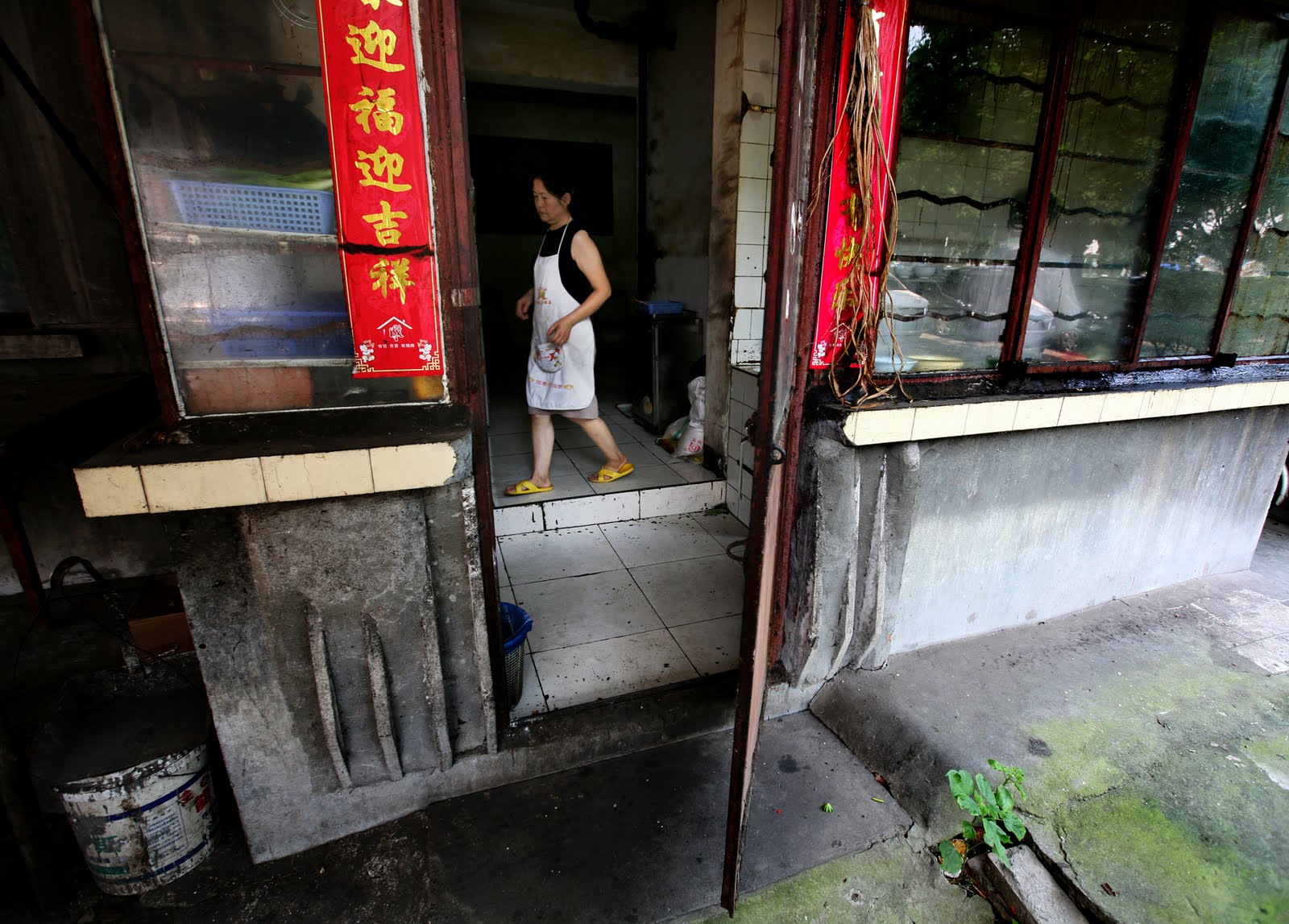
In Chengdu, these places can be warehouses clogged with old Chinese furniture. And getting there requires a friend who already knows where to turn off the highway and when to start driving the wrong way down a side road. 

We arrived to sprawling landscapes of old wooden stuff. Row upon row of furniture, with the clunky pieces pooled at the bottom and the wispy stuff all piled on top. We passed armoires and chairs and intricate wooden screens; shuffled through dirt and dodged raindrops sneaking through the ceiling. 

We did our best to see past the dust, and when it was so thick that it smothered all imagination we licked a finger and dredged it through the powder to see what was hiding beneath. And the thing to know before you fall in love with any of it is that the dust moves aside but the prices don’t budge.


After you pay too much for that thing you found, you should eat because all of that exploring can leave one famished. So our friend took us to a small place that serves spicy wonton soup. It’s the mala (麻辣) kind of spice which means that it makes your lips thrum, drenching your mouth in a numbing buzz that all the orange soda in the world can’t take away. And damn, it’s good, but if you’re being honest you might say it could use just a touch of salt.


At one point in our meal, a man set up a hill of ground pork and wonton skins on the table next to ours and started crafting fresh wonton. Ignoring the half-moons of dirt under his nails it felt like the right way to eat. Real food put together with real hands. Wonton folded with just the right crook.

There’s a rhythm to it and the man was two times as fast as the woman who occasionally joined in. For every two he made, she'd make one. But at one point he answered his cellphone and his pace slowed. It could have been her chance to catch up, but she didn't. She had to serve the customers and someone had ordered two more bowls of numb.

12 September 2011

mooncakes: by any other name...


If you focused on the name alone, mooncakes would be fairytale sweets. They sound ephemeral and delicate and something like happily ever after. They sound petite or perhaps enormous. Maybe lighter than air. It’s the kind of name that makes you wonder what pastry miracle this cake might be. But for all of the wondering, and extravagant imaginings, mooncakes are something else.

This year China celebrated the Mid-Autumn Festival中秋节)on September 12. This holiday is related to the autumn equinox and the rhythms of agrarian life, and it occurs when the moon is at its fullest and brightest. Because of the intricacies of the Lunar Calendar the date of the holiday changes annually, but what never changes is that this is the day of the mooncake. They are meant to be eaten with family as you appreciate the beauty of the moon, and they are an integral part of the celebration.

The first thing to know about mooncakes is that they are not cakes in the western sense. They are something small and singular and special, and for newcomers like myself they elude a clear and concise description. This is because they can be many things. They can be sweet and they can be savory. They can be soft and they can be firm. And most confusing, they can be all of these things at once.

We had a small collection of mooncakes in our house so we thought it only fitting to celebrate our first Mid-Autumn Festival with a decidedly amateur, and hopefully educational, mooncake tasting. 

(Mooncakes reviewed left to right)

Our favorite
It’s a rabbit! In honor of the Year of the Rabbit, Starbucks produced this cuter than average variety. The Starbucks folks told me it’s hazelnut flavor but we think it’s more like chocolate, coffee and caramel. The texture is like biting into a hunk of marzipan or really solid mashed potatoes. 

Split personality
There’s an egg yolk at the center of this mooncake. It tastes salty and meaty but is coated with a sweet gel. It’s sort of like eating toast and jelly, and a hard-boiled egg all at the same time. I just wish it would choose a side.

Easiest to eat
The daintiness of this mooncake means that it’s not as intense, or as much like a hockey puck, as some others. It has a delicate figgy sweetness.


Best for beginners
This lotus mooncake is sweet and a little mysterious, with hidden notes of honeydew. Nothing chewy. Nothing salty. Just a whole mess of sweet.

Least surprising
Starbucks says it's blueberry macadamia flavor. We think it tastes like blueberry and coffee and caramelized sugar, and it has the same texture from surface to center. It’s basically a soft chewable hockey puck. The flavors are sweet and identifiable to the western palette but still not as sweet as candy or birthday cake.

Still speechless
This mooncake has the consistency of Play-Doh and is bursting with chewy dried meat. It smells like anice and is reminiscent of the aroma in Taiwanese convenience stores. Bottom line: It’s pretty disconcerting to run into salty meat strings when chewing through an otherwise sweet mass.


Let’s call it “just ok”
Could be lotus. Could be something else. It’s sweet with an odd tendril of an even sweeter musky flavor. If I didn’t know better I'd say there was a touch of circus peanut in there somewhere.

Leave it to the experts 
There’s a really meaty egg yolk at the center that's been dried out and intensified. The texture is off-putting, at times hard and dry, at other times flaky and chewy. It’s encased by that generically sweet gel all mooncakes seem to have, but it continues to be meaty tasting at the same time. Pretty intense.

Most flavor fighting
The inside is crunchy with grains, but the sweet gel and the grains are duking it out. The grains want to taste like fields and farms, but the gel stills wants to be cake and sweet. Lacking harmony.


Birthday worthy
My Chinese teacher spent a lot of time telling me how much she loves ice cream mooncakes so we hunted down a place where they hadn't sold out yet. This led us to Haagen Dazs and their exorbitantly expensive versions. The verdict: They're not mooncakes, they’re ice cream coated in chocolate. And they’re awesome – especially when your other options involve dried meat and egg yolks. 

11 September 2011

same old new


Adjusting to a new place is always a dance between the good and the bad. It’s about discovering how much you really like this, only to get slapped in the face by how much you hate that. Back and forth. Happy and hating. The main issue being that everything is different. All of it.

Take language. In a new place you can lose the ability to represent who you are via the spoken word. You find your voice lacks nuance and rhythm, and the things that come out of your mouth will never be confused with the perfect songs of sentences you used to love to say. You are well aware that saying, “This food is good” makes you sound like a second grader, except that unlike your standard Chinese second grader, you can’t even name the vegetables on the table.

And shoes? Even though you live with 1.3 billion other people who all need shoes – and who also produce the rest of the world’s shoes – there are no shoes in your size. (Or at least no women with feet as big as yours.)

The water? Don’t drink it. If you use it to wash your vegetables – along with soap because you really don't want to know how they fertilize crops in China – then after washing your vegetables with tap water, you have to wash them again with distilled water to wash off the tap water. Yes, I said wash off the water.


As for crossing the street? The walk sign says it’s your turn but don't be fooled. China's drivers have unanimously agreed to disagree on the rules of the road. So don't put a foot past the gutter until you've done an Exorcist-esque head spin to assess the likelihood of being run down. Look for trucks, bicycles, buses. And thousands upon thousands of deathly silent electric scooters.

Make sure there isn't a delivery truck barreling down the sidewalk or a taxi short-cutting its way up the wrong side of the road. And you wouldn't naturally worry about this, but you should also look out for drivers ignoring their own red light in order to turn left and force their way through oncoming traffic –  from the far right lane.

Amidst all of the new there is one thing that survives on the idea of staying the same: Starbucks. If you buy enough coffee (or if your awkward Chinese draws enough attention while you're there) there will come a day when the folks who make your mocha will see you coming and already know your order. And when they ask if you want your usual – that drink you could find in Seoul, and then went on to order in Washington, D.C., and now drink right here in Chengdu – it makes things feel a little bit normal. The no shoes and the don’t drink the water and the sounding like a second grader all take a back seat to the fact that this place is becoming your home. And you like it.

At least until you have to cross the street.

31 August 2011

火锅 is hot pot


Hot pot is exactly what it sounds like, but it's also much better than it sounds. Hot is the spice and the food and the oil and the air. Hot is your skin and your throat and the eel after it cooks. Pot is the container sitting in the middle of your table, with its contents boiling and rolling and making everything better. And it is beloved here in Chengdu.

Maybe it’s eating oil-boiled food straight out of the pot in August, and maybe it’s the spice, but eating hot pot makes you sweat. It's also all about the thrill of the chase, spelunking around in spicy broth using chopsticks and ladles and serrated spoons to find all of the things you’d dropped in earlier.


The hardest part is keeping yourself from eating the items that need more time to cook – the lotus root that given time will become soft and chewy, the quail eggs whose insides melt into orbs of molten yolk if you can wait. But at the same time you should hurry up and get at the pieces that are ready much more quickly, the thin slices of meat and the sheets of tofu skin. It’s both hard to wait and hard to know. And it’s hard to catch every bit of Sichuan pepper before it sneaks onto your tongue and the numbness sets in.

What you drop in the pot to soak up the spice is up to you. There were pork & coriander meatballs presented on cucumber slices. And there was eel… it came to the table fresh and horror-show-bloody but when it came out of the pot it had been transformed into something so good and rich and right. It was instantly something we’d order every time.


But one of the things we’d ordered, a sort of thick rice noodles, just never turned up – except on the bill. We pointed this out to the server and then like clockwork another server came over and produced the missing dish from thin air. (Actually she found it on the lowest rung of a small stand next to our table.) It was strange to discover the missing dish hiding like that when all of the others had been so dramatically delivered to our table or even dumped into our pot by a server. So in a sort of ultimate Chinese test, where a passing grade would mean a whopping $2 off of our bill, we told the server what we thought.

And we passed the test. Not only did they take the rice noodles off of our bill, but we received a very educational explanation about why the noodles had never made it onto our table in the first place. Something about how Server 1 had put the noodles on the shelf but had neglected to tell Servers 2, 3 or 4 that they were there. Naturally this would be a problem in a restaurant where one person is assigned to bring an item near the table, another puts it onto the table, still another dumps it into the pot, yet another swoops in to remove the empty plate, and 16 others circle at all times just to keep the air moving. Not that we begrudge the breeze. Like I said, hot pot makes you sweat.

28 August 2011

welcome to our home


In Chengdu there's a magical apartment full of chili oil and fresh vegetables, tofu chunks and fire. It's easy to walk past and not know that you have a standing invitation to visit. That you're welcome to come in and eat at their table.

This is a place that people tell friends about in near whispers. As in, don't tell a bunch of other people because then the retired couple that runs this little restaurant - and lives here - might be overwhelmed and then our favorite lunch place won't be the same.


This husband and wife have a flow in the kitchen. And with the kitchen being a small stretch of a place there's not much room to stray from the plan, which seems to be to take the fresh things that line the shelves and turn them into wonders.


I want to spend more time watching them in the kitchen. Watching the way the wife preps the ingredients and lines them along the windowsill. The way the husband takes them in a certain correct order and uses two woks and fire to make them delicious.


At one point, as I watched the husband cook, the chili had so overcome our shared cloud of breath that I choked back a cough, afraid to insult the finished product by seeming weak. Truly, each and every dish they turned out was worthy of appreciation.


We ate in an outside patio, under a loose tent. Accompanying our group were vats of chili pickle baking in the August sun and an oscillating fan. Each time the breeze from that fan made its way back to me, my heart nearly skipped a beat. Each time I ate a bite of the food, it skipped two.

25 August 2011

miracle in chinese


I called the restaurant with my cell phone. I told the person who answered that I wanted these three things. I said I would pick them up. Then I went to the restaurant and picked up my order. It had these three things.

20 August 2011

mystery breakfast


This dumpling has something to do with vegetables. We know that because last Sunday morning when we said the Chinese word for vegetables to the lady behind the wall of steaming baskets, she pointed at the steaming basket with these dumplings inside. Then she packed some into a wimpy plastic bag.

The dumplings were awesome. Soft and savory. As for the actual ingredients, that's a real mystery. But it always is. Under ideal mealtime circumstances we're usually working with a best guess level of understanding. At worst we discover a secret Santa level of surprise. As long as you're free of allergies and not a vegetarian it usually works out ok.

18 August 2011

learning


We were taught how to play mahjong (麻将) a few weekends ago and it was fairly straightforward: memorize the pieces and what they’re called, learn how to arrange them in the proper groups. I can recognize and remember the pieces. And I know what I have to do. But I have no strategy, nothing that shows I organically understand what I’m doing. In other words, I know enough to sit down at the table but I don’t know enough to win. It’s like my Chinese. The real players, the born players, could easily run me over and take their win. But so far they just offer encouragement. It's the best kind of beginner's luck.

15 August 2011

how to say takeout (打包)


When you’re speaking Chinese in China you have to not mind blathering on in front of wide-eyed strangers all focused on you like you’re the one monkey at the zoo. You have to not mind because within that group of people is the one person who may eventually figure out the riddle of what you’re trying to say. When it starts happening you can feel the tilt of understanding tip in your favor: she’s crazy… she’s crazy… she’s crazy… wait a minute, I think she means fish-fragrant eggplant! And with that discovery the crazy evaporates and they invite you inside.

It’s a wonderful moment, and you have to work for it – and wait for it – because it doesn’t come easy. But once it does, once that communal light bulb goes on in all of your heads, the butchering of the language and the over-sized pantomime is worth it. You’ve communicated.


In fact, a few days ago I was standing outside a restaurant doing this very thing, and once the group of seven or so restaurant staff finally figured out I was trying to order take-out we were really rolling. It only took five more minutes, along with the help of a translation app on my iPhone and the restaurant's picture menu, to figure out what I wanted to eat. In my personal China this is defined as success – and I say that without a single note of sarcasm.

Once the food was ordered I was invited inside to wait while it was prepared. I’m convinced this is because at the time I was sweating more than anyone else in Chengdu and they were worried I might die. So I followed their suggestion and sat down in front of an air conditioner which they so nicely pointed right at me. I was presented with hot tea and one of the staff talked to me about how much he loves watching American wrestling. I understood at least half of what he was saying which by my current standards of communication is pretty awesome.

And the food… the food was incredible. The top layer of the crispy duck rice (脆皮糯米鸭) was perfectly crisped rice, below that was a chewier rice layer and at the very bottom was the rich bacon-y layer of soft smoky duck, with its crisped skin facing bottom. The fish fragrant eggplant(鱼香 茄子)was all sour and hot and sweet, with ginger, chives, pepper, and garlic swarming over silky eggplant, the flavors building to a molasses-tinged burn.

It’s these kinds of things – the guessing, the wrestling, the eggplant – that can really teach you Chinese.

12 August 2011

fire food


We had been warned. A man had seen fit to actually come out of his restaurant and tell us that the food there was hot. Except that we were speaking Chinese so the word he used was 辣. He said it over and over – even after it was clear that we understood Chinese.

After convincing him we were ready for the spice, our other problem was that we had no clue what they were serving. So we played charades on the sidewalk until we had guessed the two main options. “Rabbit” was easy. After he said the word for rabbit, which we knew, I used my index and middle fingers to make rabbit ears and he nodded happily. Guessing “frog” was more of a challenge, mainly because we didn't know the word. Also because in trying to pantomime what he meant, the man kept moving his arms in a way that was more reminiscent of flapping chicken wings than hopping frog legs.

In the end we ordered the rabbit and as Shi-Wen would later say, “If this food isn‘t hot, then nothing is.” It made us sweat. A lot. In fact, before last night I didn't know it was possible to actually feel your ankles perspire.

The big metal bowl they plunked into the sunken center of our table was filled with molten hot oil, ginger, cilantro, garlic gloves and big green chilis – all swirling around pieces of hacked-up rabbit and red pepper and cucumbers. We would dredge around with our chopsticks looking for rabbit – then drag it out and slop it through the sauce bowls before using our teeth to separate the meat from the small and only vaguely recognizable bones.

Our sauces were mercifully mild, but that wasn't our doing. In fact when the staff had asked how hot they should make our sauces, we said, in Chinese, “a little” hot. The girl who was helping us, and who’d landed that role because she was most adept at understanding our Chinese, then turned to the girl who was preparing our sauces (the one who every time we spoke to her looked at us with a blank smile) and distinctly told her to make our sauces with no heat at all. And hallelujah for her because she was absolutely right.

As was the man who had come out on the sidewalk to warn us. He was 100% right about how our lips were on fire and how they nursed wispy licks of chili flame each time we ate a bite. But what he had neglected to mention was how awesome the food was. And how well it goes with peanut milk. And how it’s the reason crowds wait outside in the August heat, crouched on small plastic chairs, breaking sunflower seeds open with their teeth as they kill the time it takes to get a table.

It’s also true that small Chinese children pointed at me and my sweating ankles. And maybe that made me sweat a little more. But I would do it again.

And when I do I’m getting the frog.