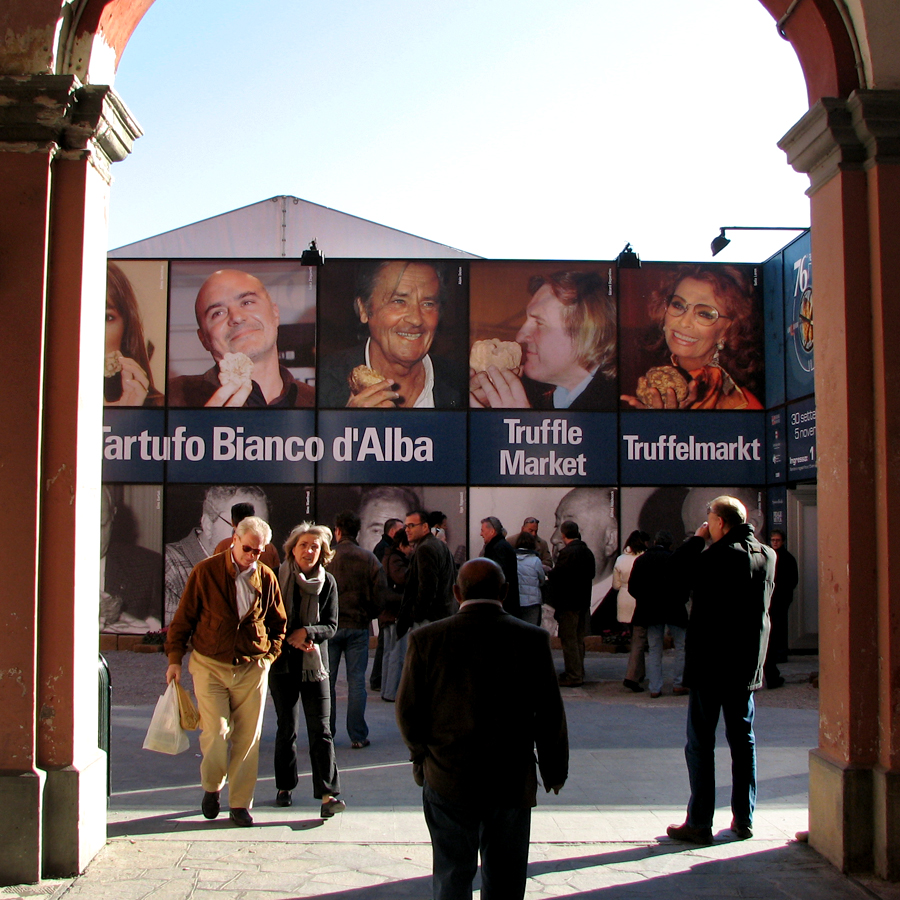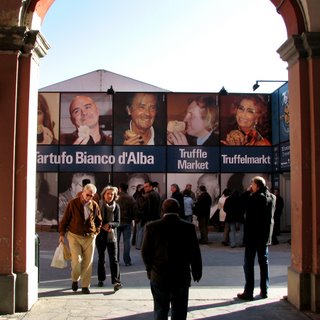
I can't blame the wine - even though we did start drinking shortly after ten in the morning. I can't blame the cheese - even though we sampled enough varieties to seriously harm those allergic to milk. And I can't blame the flourless hazelnut cakes - even though we must have had about five different versions. Our new love for Alba cannot be blamed on one single aspect of the city - no - it must be blamed on all aspects, every single one. Not the least of which was the White Truffle Festival, which from September 30 until today combined all that is glorious about Piemonte's Langhe region into a series of festival halls.
How to begin? Well, first you pay one euro. Just one euro to enter a place that smells more than a little like bad breath. Bad breath, you say? Why would I pay to go in there? Oh, my friend, you will go in there and you will love it. You will marvel over the fact that it was just 1 euro to enter. You will stay there for several hours, wandering the halls, eating and drinking. And when you can finally bring yourself to leave you will roll yourself out with multiple shopping bags in hand, filled with food and wine. It's dangerous... this truffle festival. But it's also divine.

On the map the city of Alba looks fairly close to Milan. And I suppose it is; if you have a car. We took the train and arrived in about three hours, after taking three trains and following what might be kindly-termed a circuitous route. It was more than worth it, though, and as dawn broke we watched wine fields climb the sides of rolling hills, and fall colors sweep across our path. It was gorgeous. And gave us plenty of time to ponder the question of why there's not a more direct route. But I digress.
I'm convinced that I had never been in the presence of a truffle before. Chocolate truffles, yes, I've eaten my share. But truffles that a dog found in the ground? Nope, never. So I didn't know that the smell we came across when we entered the festival was the smell of hundreds of fresh truffles, all of which had been extricated from the ground by skilled truffle-hunters and brought to this market to display and to sell. And I'm sorry, but it's true. The magical fungus that costs obscene amounts of money smells a bit like muted garlic breath.

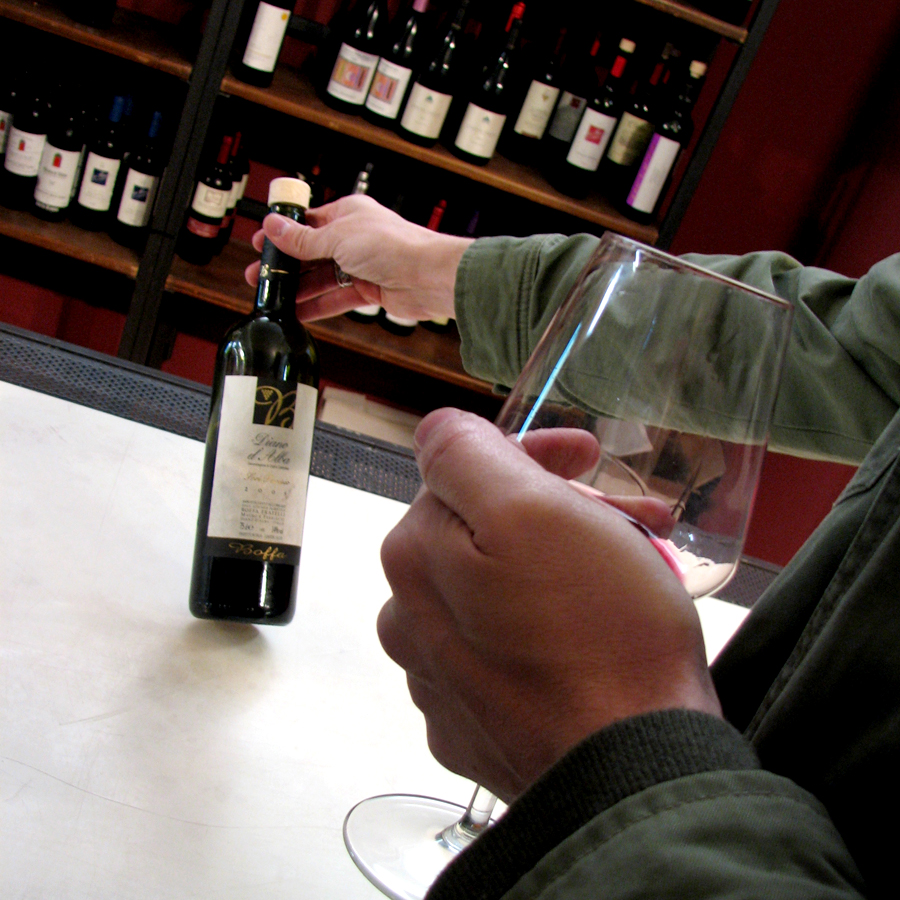
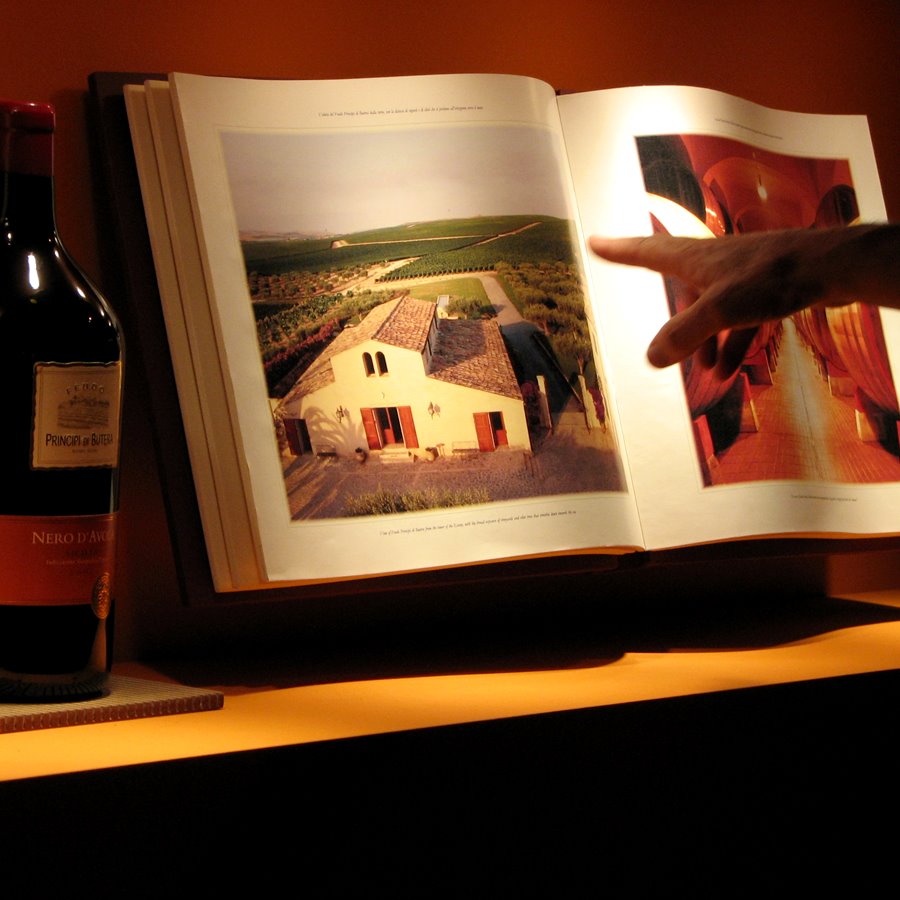
But the wine? First, you're advised to cup the wineglass in your hands in order to warm up the rich red liquid because it's so cold in the festival hall. Then you take a deep sniff to capture the aroma. The Dolcetto smells fruity and earthy and barky and warm. And Asti smells like flowers in the sun, and peaches and apricots and rainbows. And Barolo to me smells meaty and rich.
And the people who run the wineries and who line the festival hall want you to taste these wines. They want you to taste all of the wines. They'll fill your glass and tell you about their grapes, their techniques, and the personality of their soil. And then you'll say thank you and visit someone else who will do the same. It's like pub crawl only the point is not to get drunk and head-butt people in the streets, but rather to taste the magical wines of this silty region and try to grasp what it is that makes them so special. And along the way you're bound to realize there are a hundred reasons why...

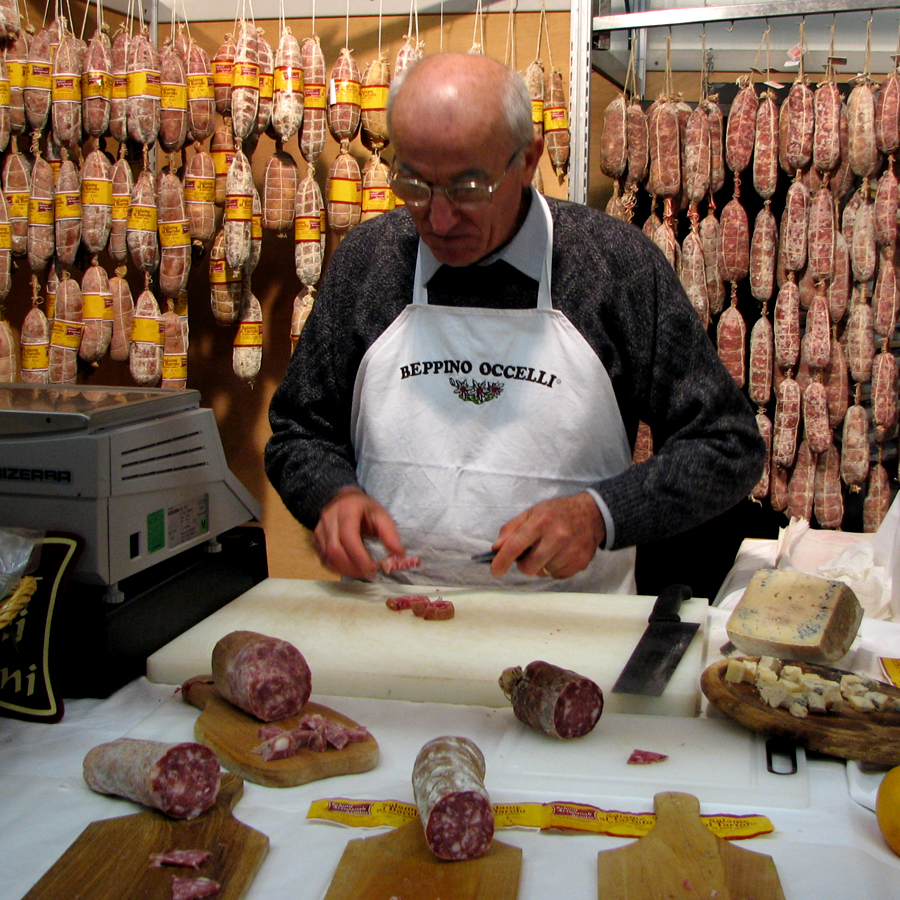
But wait! The cheese people are holding out knives with shavings of cheese on them! And you can't say no because it's cheese. Wonderful cheese! And with so many different kinds - so many textures and flavors, it's almost too good to be true. There is sausage and salami too; hanging along the wall and laid across the table and being cut into bite-sized samples. Not just a paradise for cheese-lovers, but for their meat-loving counterparts as well.

There's also an ungodly amount of cakes, cookies, candies and general sweet ephemera lining the festival. There's the earlier-mentioned flourless hazelnut cake which is moist and not too sweet. And chocolate everywhere; in chunks and bars and elaborate art. There's torrone in bricks large enough to knock out a grown man. And you, as a truffle fest attendee, are obligated to taste everything put before you. Truly. And p.s. there's no shame in going for seconds. I tried.
I will tell you that the one difficulty of the festival is the other festival goers. While we saw very few Americans, there were sackloads of Germans and other Nordic folk. These are not small people - in fact, I'd go so far as to call them quite sturdy. Stefano, who while not being a very heavy fellow is quite tall -- I can usually see him easily across a crowded room -- was absolutely dwarfed by a crowd of men and women who made him look like a toddler. He tried but there was no penetrating the wall of heartiness, and no way for him to reach the salami sample he so badly desired. And while we went back later and Stefano tasted what he claimed was absolutely excellent salami, he still couldn't escape the idea that there are people that large in the world, and that they wouldn't let him near the smoked meats.

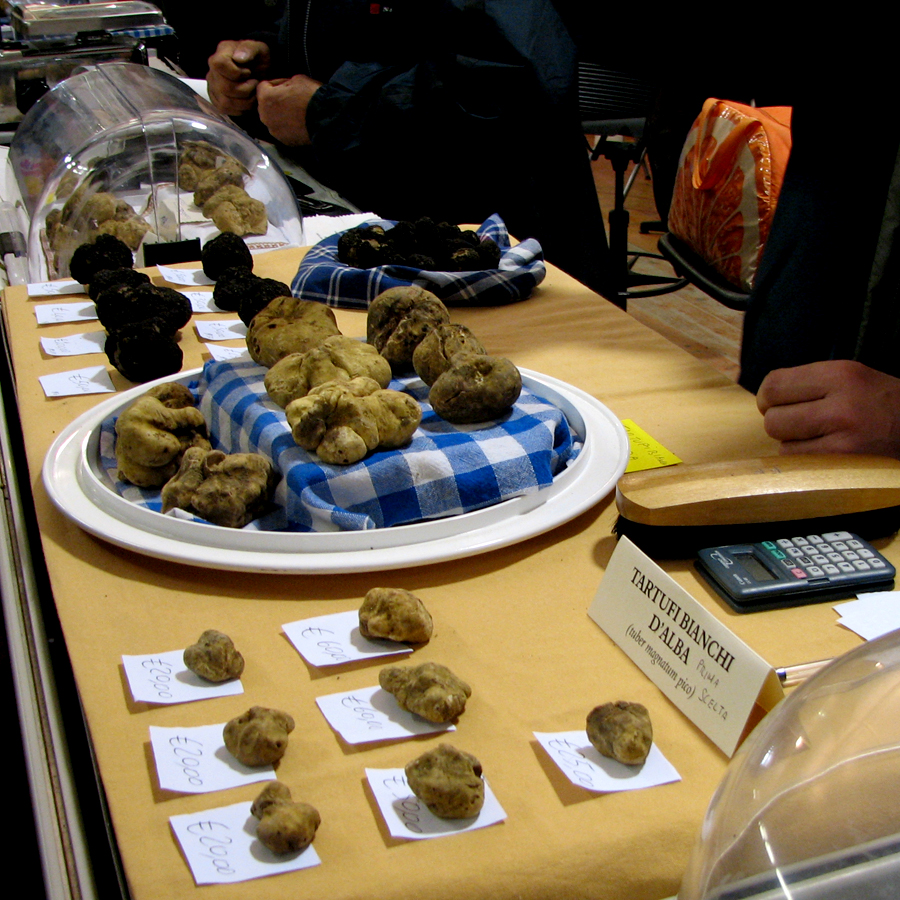
And now we come to the truffles. Oh delicious aromatic fungus. Why haven't we met you before? (Aside from the fact that you're too expensive and kind of rare and all...) The interior of the festival was an area where the truffle hunters lined up at tables, along with their scales and calculators, and displayed their goods. Some simply piled the truffles into little mounds while others preciously laid them out one-by-one. There were white truffles and black truffles and they ranged in size from pretty small to several golf balls large. Very small is almost in our price range, while any larger is definitely not. There was a generously-sized white truffle for 1300 euro which we found almost comical, except for the fact that not everyone in the crowd was pointing and laughing.

As you might imagine, there are very few rag-taggers trotting through the truffle festival. And those who are there as serious buyers are wearing the outfits of the filthy rich. But to be there as a spectator is just as fun. You get to smell the truffles all the same. And you can talk to the truffle-folk about how this line of work found them and their families. We talked to a girl who was there representing the finds of her father -- who truffles at night with his specially-trained dog. He was taught by his father who was taught by his father and so on. We asked her why she didn't hunt for the truffles - and her answer was that she felt it was too dangerous to be wandering around in the middle of the night. A practical girl who then went on to sell several truffles for about 100 euro.
There's definitely an art to knowing a good truffle and we received a brochure that tried to explain it. There's something about the strong garlicky smell of a white truffle originating from all sides of the truffle, and one must also keep an eye out for claw marks from the dog who dug it up. Also, don't buy one that's chock full of parasites or has been reconstituted from multiple small parts by an unscrupulous dealer. Rest assured, though, there's a truffle judging booth at the festival where you can take your prized-purchase to be sure you got your euro's worth.

I have to admit to purchasing our own little truffle. And believe me when I say it's little. But it smells strong and it looks the part. And we're going to shave it thinly and eat it over eggs. That's what everyone else was doing.
If the Alba truffle festival hadn't ended I would encourage everyone to hop onto whatever form of transport was available and get to the festival now. But as today was the final day I can only implore you to plan ahead for next year. This festival was one of the greatest food joys that we've had here in Italy and we're still groaning over its delights. The wine, the cheese, the truffles... The three hour train ride going in circles.
It's all about the goodness of Italy and the lengths people take to enjoy it. Some of us hop on trains and tool around the countryside. Others take their dogs out in the dark of night and hunt for a very special fungus. Still others cultivate grapes with a love that few of us understand. But we all come together every so often and share our energies in a single place. Some of us as wide-eyed visitors, others as wisened producers... at a crisp fall picnic that takes place in Alba.
See you there next year.