23 April 2012

harbin was my teacher

A snippet of what I learned in Harbin the week before last.


Winter stays for a while

Per the advice of my instructors I’d begrudgingly dragged a winter coat and a scarf, some gloves and a hat on this trip. The bulk of it felt out of place in balmy Chengdu but turns out that in Harbin this kind of gear is still really necessary. One morning’s dismal rain even turned into big fluffy snow. My teacher and I paused our discussion to look out the window, both saying how much we love snow. Just not necessarily in April.

Central heating is not year-round

The radiator in my classroom was as cold as the curb outside. But I know from my time in Chengdu (which has zero central heating) that China’s air conditioners, often mounted high on the wall, are also heaters. The problem with my classroom’s unit was that the plug was too short to reach the outlet below. So I buried myself in my coat and scarf and took breaks from intensive Chinese immersion to wish the distance between the cord and plug might spontaneously shrink. When I didn't eat lunch (due to an unrelated stomach issue) and I wore a coat and scarf all day I think my teachers got worried. The next morning I walked into a toasty classroom to discover that a magical item had arrived overnight – an extension cord.


There’s bad air quality and there’s BAD air quality

Sometimes when it’s sunny in Chengdu the air glows, but in Harbin the air actually gets in your eyes. One morning I walked the half-hour to school and then spent a full day trying to rub particulate matter out of my head. It must have been 10pm before my eyeballs felt smooth again.

Just because it looks like a nuclear reactor doesn’t mean it is one

A few years ago when Shi-wen and I first visited Harbin we caught a glimpse of a cooling tower and thought that China had plopped a nuclear plant in the middle of a major metropolitan city. Better yet, on this most recent visit the view from my hotel room featured two of these beauties. An instructor told me that they’re part of a coal-burning plant and laughed at the idea that something so dangerous as a nuclear reactor might be used in the center of a major Chinese city. To avoid possible notes of irony, we did not discuss the effects of placing a coal-burning plant in the center of a major Chinese city.


Harbin is close to Shenyang

I knew Shenyang was up north but I became more familiar with the nuances of Chinese geography when our plane landed there instead of Harbin. We were diverted to Shenyang because our destination was in the throes of a sandstorm and happily no was was insisting we land in zero visibility conditions. Instead we spent four hours in the Shenyang airport killing time, but not before I got to count cooling towers as we came in for a landing. I think I got to nine before we touched down.

Harbin kind of knows its Russians

In Chengdu I’m regularly asked if I’m from Russia. But in Harbin where they have a historically and physically close relationship with Russia, and have actual Russians living there, there wasn’t this kind of confusion. Although waiting in line for security at the airport, there was a group of Chinese guys who asked where I was from. Before I said anything I asked if they thought I looked Russian. The guy closest to me said, “I don’t know, you all look alike.”


You will never win against a tiger

The tiger preserve in the shadows of this big city is one of the more surreal places I’ve visited. It’s grey, dismal, and teeming with tigers and their feline relations. But in a vibrant twist, visitors can buy live animals to feed to the inhabitants. It goes something like this: your bus drives out to the big open plain and stops. A large SUV with bars covering the windows and tires rolls up. The SUV’s driver rolls down the window just long enough to quickly shove a chicken onto the roof. Before you can look away a tiger is standing on the roof with the chicken in its mouth. If you're of the mindset that in the event of a tiger chase all you'd have to do is run faster than the slowest member of your group and you'd be just fine, it might be time for a re-think. 


Telephone Chinese is the hardest

My first night in the hotel I called the front desk to request a wake up call for the next morning. Because I didn’t know how to say "wake-up call" our Chinese conversation went something like this:

Me:  Hello, can you please call me tomorrow at 6am to wake me up?

Front Desk:  You want to make a phone call?

Me:  No, I would like you to call me.

Front Desk:  Why do you want me to call you?

Me:  So that I wake up.

Front Desk:  To make a phone call from your room, first you dial …

Me:  I don’t want to make a phone call.

Front Desk:  What do you want?

Me:  I want you to call me.

Front Desk:  Why do you want me to call you?

We went around like this for several minutes before she finally asked if I wanted a “morning” call? Using English felt like cheating but I said yes, go ahead and give me a morning call. I’d be lying if I said I wasn’t surprised when the phone rang at 6 the next morning.


“No smoking” means “take off your shirt before smoking”  

Based on signage, I was staying on a no smoking floor. However, each night when I’d return to my room, or leave it to head out for a bit, I’d have to pass a stretch of hallway that was thick and hazy with smoke. Several rooms would be loud and hopping, their doors propped open and their insides stuffed with topless Chinese men. The guys were milling around, or lounging on the beds, all drinking and smoking and wearing the slippers we all got with our rooms. I couldn’t decide if I was staying at a bar or at the beach but I clearly needed to buy some cigarettes.

The hotel is not a Bed, Bath and Beyond

The checkout process where I stayed was fairly standard except that before the front desk would let you leave they sent someone to your room to take inventory. As you waited, and as all the people behind you waited, there was someone scurrying around your room counting the towels. Except I don't think the person was doing any scurrying because it took a good 7-10 minutes for them to call the front desk with their report. Then when the woman at the front desk finally got off the phone she dead-seriously informed me that a cup and a spoon were missing from my room. I thought she was kidding but then I actually had to say: I do not have your cup and I do not have your spoon. What should we do about this? In the end she let me leave but I heard that later she’d demanded a classmate of mine explain a missing face towel. Whoever's using this hotel to stock up on basic household items had better quit it. You're ruining it for the rest of us.


Mahjong is never the same

Playing mahjong in Chengdu is hard enough but then I had to go and learn how to play it in Harbin. No one told me the rules would be completely different. Except they were, and the only record that I have of these new rules is a set of notes in Chinese scrawled across a chalkboard. Nothing like taking something hard and making it harder.

It’s the music, not the words

We were heading to Harbin’s airport when the cabbie plugged in his MP3 player. After some fiddling with the player the car was suddenly full of Celine Dion belting out that swelling Titanic song. Then a song by Bob Marley. He told me these were his favorites. Several more played and he chewed his cantaloupe gum and the outskirts of Harbin kept going past in a big grey blur. I recognized all of the songs and he recognized them too, just in a different way: he’d already asked me if one of them was in English.

01 April 2012

on relaxing


Last Sunday we spent part of the afternoon in the courtyard of a teahouse close to home. The sky was blue, the air was clear, and we had a couple of half-birthdays to celebrate. It was all verging on perfect until we had to go and botch the simplest of tasks: we dribbled tea down our fronts and I hurt a finger trying to open sunflower seeds. Turns out that the famously relaxed Chengdu lifestyle isn’t as easy to live as you might think.

It’s my yoga troubles all over again. Other people in my yoga class used the quiet time to meditate and reflect, but I used it to draft long form to-do lists in my head. Instead of finding an inner calm, I was trying not to forget all of the things I needed to do as soon as they let me leave. Unable to appreciate the quiet, I was a yoga failure.

In Chengdu the stakes are higher. This is our town, at least for a few years, and we'd like to be able to fit in. In fact, we'd like to fit in so well that we get to keep our teacups at the teahouse just like the regulars do. Their collection of mismatched randoms is stored in a cabinet, each with the name of its owner taped to the bottom of the cup. Getting to keep a teacup in this cabinet would be the ultimate badge of Chengdu success.

But for now this city seems to doubt our relaxation credentials. So it dribbled tea down our shirts to point out that we'd neglected to appreciate the leaves inside before lifting our cups. It knew we'd forgotten to bring snacks so it paraded a girl with oranges and cotton candy past just to make us jealous. And it inflicted a sunflower seed injury so I'd remember that cracking open the seeds is a nuanced art and not blunt warfare. 

But I think it’s ok if our relaxation skills need some work. Our neighbors have been at this for a while and we'll need time to catch up. But I do suspect that the city at large would appreciate us trying just a little harder to get the tea into our mouths and not on our shirts. This could be a good first step.

25 March 2012

all kinds of tall


Visiting LeShan’s giant Buddha is all well and good until you have to climb down the steps.

I know what you’re thinking, what sort of bozo complains about going down steps? Especially when there’s so much to complain about when it comes to the going up part? I would usually agree but I’m increasingly finding that the worldview we use in other places often hits some snags here in China. And thus we reach the part of the story in which I complain about going down the steps at the world’s largest Buddha.

We waited a fair amount of time before it was our turn to enjoy the Stairway of Nine Turns. This one-way staircase is cut into the same cliffs as the Buddha and offers fantastic views as you wind your way down to his toes. It's the only way down the cliffs and as we waited in an amusement park-style line we played boredom-cure for the rest of the crowd who seemed mystified and delighted by the fact that we weren't from around there. Note the little girl who can't take her eyes off of the tan-sweatered Shi-wen.  


Before getting in line for the stairs we'd explored other parts of the park and Shi-wen was asked by several young Chinese if they could have their photos taken with him. I asked one of the girls why she chose Shi-wen out of our group of three (we were there with a friend) and she said it was because she thought he was very tall. But then etiquette took hold and she extended her invitation to the two of us as well. This was after our friend had used a hotdog on a stick to singe the roof of his mouth but I don’t think it affected his smile for the photo.

But back to waiting for the steps… once it's your turn you realize there's no shade and since this is the one day the sun decided to make an appearance you're now roasting hot and burning off your first layer of skin. But thanks to a fairly widespread aversion to tanning in China there is no shame in using an umbrella or anything else to protect you from the fiery rays. 

All I had were the clothes on my back so I opted to hang my sweater off of my head. It sounded like a fine idea at the time and I was further buoyed up by people catching my eye with an “I hate the sun too” kind of look. Then again it could have been a “you foreigners are messy and weird” kind of look, but I was peering out from under a sweater so it's hard to know for sure.


Just when we were finally heading down the numerous flights of uneven steps (one of us with a sweater on their head) and feeling like at any moment we might pick up speed, we were forced to remember that China is the world’s most populous country and going anywhere, let alone a tourist attraction, can be a slow-moving process.

It wasn't that we were moving down the stairs so much as we were clumping down them. It was one step, wait a while, another step, dead stop. And although each step brought with it a little bit of joy, it also carried a lump of frustration because the people swarming behind us seemed quite focused on climbing up and over our backs. The main offenders were an insistent elderly man with a cane, his wife and her knack for full-body shoving, and an unrelated kid who brought an oversized wooden sword to the park.

It was like pouring people through a funnel except the funnel was already clogged with sunblind tourists trying to protect themselves from aggressive elders and medieval weapons. On the plus side the slow pace gave us a lot of time to look at the Buddha. And it was awesome.


At 233 feet high Le Shan’s Dafo is literally the world’s largest Buddhist sculpture and it just happens to be two hours from our house by bus. Taking a car would probably be quicker, but driving doesn’t give as great a view of the yellow rapeseed flowers that take over the Chinese countryside this time of year. Plus, to drive somewhere you kind of need a car, which we don't have. What we did have was the new issue of Vanity Fair, which our friend brought from New York, and that in itself is pretty special for Chengdu.

When we were taking the bus I tried not to think about how it makes my legs feel trapped and crushed at the same time, and instead focused on how the world’s largest Buddha was waiting at the end of the line. Or more accurately, at the end of the line there is a city bus that takes you to the world’s largest Buddha. But after having seen the giant Buddha you should not take that city bus again. You should take a cab to the bus station because it will be a lot quicker and it will also result in fewer passengers falling on the floor when the driver stops short.


The cabbie you find in front of the park will likely refuse to use the meter and he'll try to get you to pay double or triple the fare, so after you get in his cab just keep saying a number that is less than the number he says. No matter what he says, just repeat your number.

It’s a good strategy especially when you don't quite know what he's saying. Bargaining aside, when he asked where we were from we could understand him, so we said we were from America. He said we were all very tall, and that Americans are tall in general, which was the second time that day someone had commented on our height.

The day's most joyful moment came after we'd visited the Buddha and boarded the bus back to Chengdu. It was so hot on the bus that passengers started to remove layers of clothing as soon as they stepped on, which is a serious heat indicator because Chinese people are a lot like Italians in terms of their willingness to bear extreme temps. So if they're taking off their clothes you know it's hot. I also knew I couldn’t sit on that bus for two hours.

But it was too late. The bus had already pulled out of the station and begun its slow crawl for Chengdu. Except that then in a beautiful and wholly unexpected turn of events the air conditioning switched on and cold air was blowing all around us. It was pure magic and that bus ride was worth every yuan that we paid for the tickets.

The same can be said for the world’s largest Buddha… which, even when compared to a bunch of Americans, was pretty damn tall.

17 March 2012

quail eggs and cash


In China you can buy lots of stuff off the backs of bikes. Like sweet potatoes. And mops. And even the labor of the guy sitting on the bike.

But the motorbike marketplace doesn't stop there.

Chinese entrepreneurs don't succumb to the tunnel vision that sees motorbikes and bicycles only as portable shops. Instead they go much further, envisioning them as ride-able versions of traditionally large-scale operations, like restaurants. 

As a result, you get a lot of people riding around on vehicles that look as if they’ve been driven straight out of the most fantastically illustrated children’s books. Except that in China these magical jalopies are very real and they can perform miracles. Or at least miracles that are contingent on large tanks of propane being driven around on two wheels, or maybe three.

Crossing streets in China is hard, and threading a Chinese traffic circle could make a big city American cry, but you will never truly appreciate Chinese traffic until you’ve played chicken with an oncoming propane tank that knows this country has no traffic cops. On the spectrum of Chengdu traffic challenges, these tanks even trump the pardon-me-but-it-seems-that-a-hog-carcass-just-fell-off-the-back-of-your-bike-in-the-middle-of-rush-hour sort of hiccups you sometimes run into here.


The truth is, despite the more risky elements of the portable kitchen system, we need these guys. They make some of the tastiest fast food in the city. Our favorite stir-fry guy has a finely tuned wok, prep space, and pantry that he likes to park by a convenience store in our neighborhood. There’s also the young guy who sells breakfast tofu with all the fixings from what looks like an oil drum on the back of his bike. And there's a lady who roasts sweet potatoes in a large earthen oven directly behind her bicycle seat during evening rush.

But before you start thinking the sidewalk is your food court, I’d recommend you not eat from every food scooter fit to hit the road. Some people are pretty carefree about what/where they'll eat, but for me there’s a litmus test these little operations have to pass. Although, to be fair, it’s more like a gut check or a ring of truth because I don't have any hard and fast rules. It's basically one of those exasperating “I know it when I see it” kind of standards.

My system admittedly leaves the should-you/shouldn’t-you up for interpretation. And that’s where Shi-wen and I diverge. One of us is fairly conservative, believing that the best moveable restaurants are those we’ve seen in the same location over and over. This person believes that a semi-regular location ensures a certain level of quality or at least a measure of find-ability should something go wrong. They also think the whole operation should be in the neighborhood of “clean.”

The other of us believes you should eat things that look good.


Take these quail egg omelet orbs. One of us ate them and the other did not. I’ll let you guess who’s who, but what we could both agree on was that this guy's set-up is awesome, as is the idea of making egg ball kabobs.

But that’s China, walk down almost any street and you’ll have an opportunity to eat something for the very first time. You’ll also have the chance to see things you’d never imagined – or more likely never wanted to imagine but now can’t get out of your head. And the smells… there are lots of smells too.

The great news is that food scooters usually smell pretty good. So even if I’m not always buying what they’re selling, I’m still a big fan of the folks who bungee cord a tank of propane to the back of their bikes and ride around town making snacks.

Without them, the sidewalks here would have no hope of smelling good.

11 March 2012

playing with sticks


Whenever I get super-fixated on the excessive pollution or the food safety problems or the fact that cabs in Chengdu don't have seat belts in their back seats, there's a useful thought that helps me regain my sanity. It's goes something like this: It's safe enough here for 1.3 billion people to have been born and survived, so it's safe enough for you. Get over it.

It works for those days when you can't see clearly because of the "fog." It works when you're eating hot pot despite the scandals about "recycled" hot pot oil. It also works when you have to select your chopsticks from a slew that have been sitting in the reach of the public for who knows how long.

And it also comes in handy when you see kids navigating some fairly challenging street food delivery systems.


Kids here seem to have the ability to bite hunks of meat and fruit from very sharp sticks without incurring any self-inflicted wounds, even while on the move. These are kids so young that if they threw a basketball and hit the backboard people would be impressed, yet here they're already walking down the street using their teeth to pull grapes from a sharpened bamboo spear.


I remember when I was a kid, my parents would bend the ends of lollipop sticks to keep them from stabbing me in the throat. They'd also add water to my soda and refused to let me watch Three's Company, but that's got nothing to do with sharp sticks.

But now that I think about it, that might be just the kind of coddling that makes me crave seat belts and clean air... As I was saying, I'd better get over it.

07 March 2012

the chengdu commute


A lot of us commute. We start at Point A and we move to Point B, and at the end of the day we head back. But there are lots of ways to get there from here -- some methods requiring more balance than others. And here in Chengdu a lot of commuters need a whole lot of balance.


Most grandparents tote their grandkids to school on the backs of bicycles. My personal faves are the self-contained caravans that ferry their passenger around in a protective mini-tent.

There are motor scooter cabbies who share their seats with paying strangers and friends balancing a buddy on their bike racks. The bike rack method is way harder than it looks – we've tried.


Commuters also embrace a very functional approach to fashion. By now I'm used to seeing moped riders wearing an extra coat (on backwards), but the first time one of these whizzed past it was fairly disorienting. When they're going at a good clip it's hard to tell which is facing the wrong way – the coat or the driver.


As for the kid balled up in winter gear on the back of Dad’s scooter… it could be that it's still cold here  or it might be a way to help keep the pollution out. But the most unusual aspect of her outfit isn't the multiple coats, it's the helmet – a flat-out rarity here.


When it’s especially frigid, drivers wrap themselves in so many scarves and hats that all you can see is a narrow slice of face. These wrappings also include the most popular facial accessory of all: the face mask.


Chengdu is also teeming with pedestrians. Some are walking with a purpose, others are dawdling through their grey mornings. 


Some are trying to hail a cab and a good many are downing a steamed bun and warm soymilk for breakfast.

Lots of people are waiting for buses and still others are waiting for the market to open so they can get first crack at the vegetables.


I’m usually out there too.

I’m the one thumbing through Chinese flashcards, trying to find a way to remember the tones of Chinese characters without losing my mind. This is a different kind of balance – one that makes riding a bike, even with multiple passengers, seem easy. 

01 March 2012

quiet new year


I’d hate to leave you thinking that Chinese New Year is only the loud and rowdy kind. There are quiet moments too, the bits of calm in the fireworks storm. But you have to seek them out because they're tucked away behind closed doors and waiting for you to find them.


The best place to look is the temples where throngs of Chinese go to start the New Year. Families and individuals, couples and small groups, they're all moving through the spaces, lighting incense and candles, and following traditions that have drawn them in, away from the noise and commotion.


Even if you're unfamiliar with the intricacies of the beliefs (as we are) you should still visit a temple during the New Year holiday. There’s a beautiful flow to the believers and their movements, and a lush incense cloud hovers in the space.


The fragrant wisps that rise from incense are a special kind of smoke, and they gently insist that it's not just fireworks, but also this sort of serenity, that can be brought alive with the lick of a flame.

18 February 2012

入乡随俗, or, when in rome…


As an American living abroad, there are times when you’re with a group of local friends who are looking forward to eating a favorite food that you, the foreigner, have never eaten. They’re aware that you’ve never eaten it and so out of a hospitality-driven kindness they’ll often pre-emptively excuse you from eating the dish.

Like last week when my teacher pointed at the menu and told our luncheon host that, “She doesn’t eat those, but she’ll be ok with the rest of us eating them.”


Sometimes I think my teachers forget that I understand Chinese. But the shocking reality is that even when it's Chinese that has been smothered with the local dialect I still manage to understand. Or at least I understand a good chunk of it. So when my teacher used the word “she,” I already knew the she was me. So I asked, “What don’t I eat?”


I could see her think it through… Wait, how does she know I’m talking about her? Oh, right, she speaks Chinese. But how can she speak Chinese? Oh, right, I’m her teacher. With the internal dialogue complete, she finally told me, in Chinese, that the food up for consideration was chicken feet.

Chicken feet... It's normal to see people here walking down the street gnawing the hell out of these knobby, scratchy appendages with big goofy smiles on their faces.  The smile is probably just the most advantageous mouth position for ripping tiny ligaments from tiny bones, but that doesn’t mean they’re not enjoying it. In fact, from what my teacher tells me, chicken feet are the most popular snack for men who are out drinking and women who are at home watching TV.

So, would I eat chicken feet? That’s a question we all saw coming.

After ramming myself into the middle of the conversation, I certainly deserved it. And actually, it was kind of my point.


Truth is that in the U.S. I probably wouldn’t eat chicken feet. But here?

This is where my China eating plan comes into play. The plan is as follows: If I’m with someone I trust, and they’re eating something that, although perhaps a bit different from a western perspective, tastes good to them, then I’m going to try eating it too.

And that's how I ended up with a chicken foot in my mouth.

It’s also how I discovered that the bone soup (aka tempura’ed pig bone chunks with remainders of meat still clinging to them floating in broth along with seaweed) was as delicious as the chicken feet. And that the hand-torn noodles with small rabbit are amazing.


So then yes, I’d have to agree with my hosts: chicken feet are good. I expected they'd be tasteless and annoying, but instead they were a flavorful and challenging eating puzzle. It’s labor intensive but you’re mostly eating skin, and the people in the kitchen made sure that the skin tastes good.

I just said skin tastes good. And not just any skin -- the skin from a chicken’s foot. 

I guess it’s official: my China eating plan is working.

12 February 2012

my chinese family tree


It's true. I've acquired a Chinese relative.

As of Tuesday I’m tangentially related to a little girl named Tang Ci Yan. I don’t know where she lives, and I’m not super clear on which Chinese characters make up her name, but it’s all been recorded in the town register so I guess it’s official. Or at least as official as these sorts of holiday-driven-godparent-like-pseudo-adoptions of strangers’ children go.


There isn’t a parent in any country that doesn’t want their kid to grow up big and strong, to find their way to a long and prosperous life. And here in China, where by law most people are only allowed to have one child, there is a traditional holiday, 保保节, BaoBaoJie, that pairs children with strong-looking strangers in the hopes of drawing on that strength to give the child some additional life-long protection.


To become one of these “godparents” you have to travel to the one town in all of China that still celebrates the holiday with fervor --- 广汉 Guanghan. And fortunately for us, Guanghan is only an hour’s drive from Chengdu. So on Tuesday we drove over and went straight to the park where the event was being held.


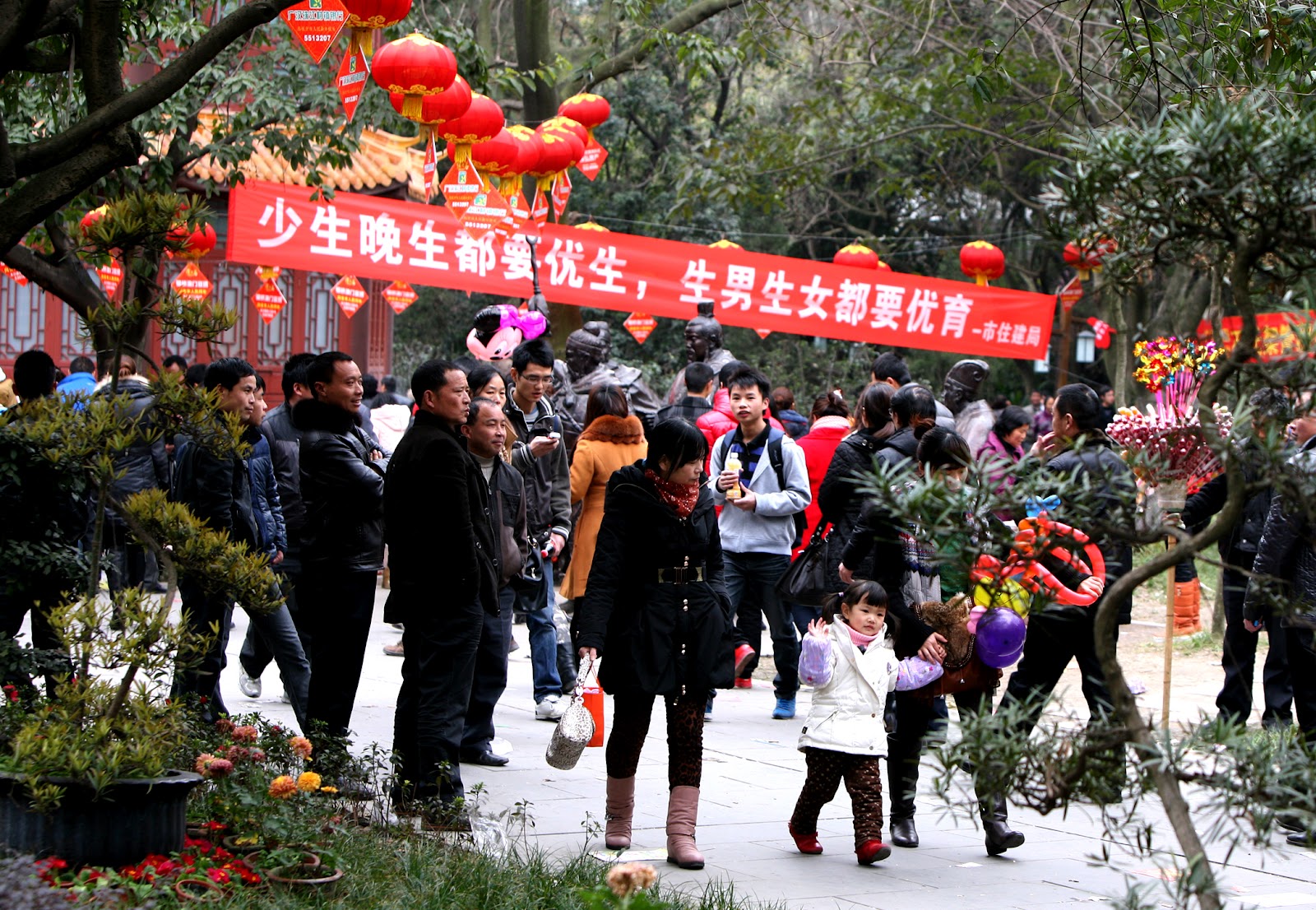
Once you’re there, you find yourself walking through thick crowds that are multi-tiered and eyeing all of the prospective candidates like meat in a market. But don't assume that a person automatically gets to be one of these sort-of-godparents. It's not that simple. You have to be selected. Or more accurately put, you have to be dragged off by strangers.

A relative or a paid finder literally handpicks their target from the teeming crowd and drags them through the masses to meet the child. And in my case, as in all the others, as the dragging began, the crowds quickly parted to let us through. Then after we'd passed, the crowds closed behind us again with a near audible thud. All the while the man who had taken hold of my arm was yelling, “来了! 来了!” She’s arrived, she’s arrived.


This is probably the closest I will ever come to experiencing the insanity that comes with fame, the thousands of eyes trained on you, along with their cameras. There was a lot of excited shouting and I quickly learned that if I raised my hand, or gave a whoop, the crowd responded by ratcheting up their own hoots and hollers. 

I felt like I was on the floor of a stadium and the crowd was doing the wave, except that I was the one crossing the space, and the peak of the wave -- that cresting surge of standing and screaming -- never moved from the front of my face.


There is no way to accurately express what it feels like to have a wall of people part to let you through while at the same time pressing in to see you more closely. Along the way I was also pulled aside to hug children, was interviewed on camera, and took a photo with a man who told me this was the first time he had ever seen an American.

I didn’t see any other non-Chinese in Guanghan that day and when I walked down the sidewalk people would literally turn and stare. Even from across the street I could read their lips: 外国人. Foreigner. I was visiting the city with two of my Chinese teachers and one of them told me that after she had been separated from our group it was very easy to ask random strangers where the foreigner was. When she’d started to describe me further they would cut her off and say, "The foreigner went that way."

It’s exactly that foreigner aspect that made me an attractive candidate to “adopt” the little girl. And it’s the same foreignness that made the crowd hoot and holler. I could say I felt like a victorious gladiator before a roaring crowd, but I’m guessing I more closely resembled a dancing bear, or better yet, a unicorn – something rarely seen but said to have special powers.


The TV crew that trotted alongside me first asked if I spoke Chinese. After I said yes the reporter asked a series of questions including what I thought of the event? I said it was really interesting and a lot of fun. I didn’t mention that I appreciated the irony in placing one of the government’s omnipresent slogan posters, a red banner with white lettering, immediately inside the park's entrance. It read: 少生晚生 都要优生 生男生女 都要优育 or very roughly, "Having fewer children is awesome and remember that having a daughter is just as nice as having a son."


Despite the festive atmosphere, some passersby actually put up a fight at being selected. I imagine this is because for the newly minted Chinese “godparents” this new relationship can actually involve a commitment of time and money. They're expected to occasionally telephone and check in on the child, or to give them small gifts each year. But for me, most of these expectations are lifted.

The "adoption" process was very simple: I gave my four-year old new relative a big hug and a simple gift (a lollipop) to cement the relationship, and then we were officially registered in the town's logbook. Another hug and that was that. Now I just need to think of Tang Ci Yan each year on 保保节. And I will.


Later that night when I was watching the news I learned that the man who paired me with Tang Ci Yan is a sort of professional dragger who makes money from relatives for finding a suitable candidate. Good to know that even the professionals thought I was a good catch. 

But the part of the news that I really wanted to see, I missed.

According to one of my teachers, once we were back in Chengdu she turned on the nightly news and there I was, being interviewed as I moved through the crowd. I was speaking Chinese and per her account I made no mistakes. Zero.

She went so far as to tell my other teacher that I had never spoken Chinese as well as this and that my tones were a lot less “weird” than usual. Yes, she actually used the Chinese word for weird: 奇怪. Coming from her this is high praise.


As for my new Chinese relative, the most important thing is that a big, strong stranger is thinking of her at least once a year and sending good vibes her way.


Happy 保保节 Tang Ci Yan!

chinese road trip scenery


Looked out the car window and saw this barreling down the road next to us. Definitely don't want to know where he's headed.

04 February 2012

in expert hands


They call it an alley but it’s really just a small stretch of street so crammed with bicycles, and cars, and random people who’ve stopped to sell one kind of fruit or another, that the already small space narrows into something smaller and more intimate. The alley is really a neighborhood, a trillion-celled organism that thrives in the heart of a giant city, and both sides of this stretch are relentlessly packed with restaurants ranging in size from small to tiny.

It was raining when we went there for lunch this week. We were walking through something between a fine mist and heavy drops and we just kept walking until we almost reached the end. This is where you find the restaurant that Shi-wen came home talking about last week.  

We sat on plastic stools and ordered off the menu on the wall. Or better said, we asked the 10-year old server some questions and listened as his mother yelled answers from the kitchen. Together they figured out what the foreigners wanted and then brought the plates to our table.

I absolutely got what I wanted: 辣面, spicy noodles, the foundational fast food of Sichuan and of my lunches. I eat them so often that I’m used to explaining to waiters and restaurant owners that despite being a foreigner I somehow still manage to eat spicy food. And because we foreigners are still so memorable here, and because I have a habit of going back to the same places, I find it both kind of charming and kind of alarming how quickly the staff at these places remember me and what I like to eat. They see me and ask, “Spicy noodles?,” and I nod, yes. And if there is someone I don’t know working that day, any person I do know will automatically pre-empt the inevitable question, telling their colleague that yes, yes, this foreigner does eat spicy food.

It could just be me but I find people here to be friendly and warm, especially when you’re obviously in need of Chinese attention. Like when I was trying to mix up my noodles in the alley. My efforts caught the attention of the waiter’s mother, the cook, who was already interested in me because I was one of those peculiar foreigners who take pictures of their food. 

As I was mixing up my noodles she stepped in and told me that I needed to do a better job. I needed to whirl that pile of deliciousness sitting on top of my noodles into the depths of the pile. In essence, I needed to be able to use chopsticks, and use them to manage multiple meters of noodles, with much more finesse.


But there was a better solution. She took my chopsticks from me, and standing beside our table made what can only be described as beautiful love to my noodles. She carefully stretched them, rolled them, lifted and spun them. Her rhythms were regular with occasional surges, and I’ll be damned if by the time she was done those noodles hadn’t been transformed, each length now coated in its own beautiful cloak of spice and meat. "See," she said, "every noodle now has the flavor."

And they did. They absolutely did. Every bite was what she promised, a balanced mix of spice and salt, with slashes of cilantro and nut. And after I told her how much I loved them she returned to the kitchen, satisfied. We were then left alone to eat while her waiter ran around out front with another kid. At one point the two boys were tossing a coin back and forth and it found its way into the hood of my coat before tumbling onto the floor. The boy apologized, and through my noodles I garbled, “没关系,” no problem.


This is exactly what I like about these places. They’re normal. But they’re a different kind of normal. A normal I’d never before been a part of, but that’s now just down the street. Chengdu normal.