

The striking landscape printed on the back of China’s ¥20 bill is equal parts geographic fortune and
artistic vision. Cash registers, pockets, and purses across China are stuffed
with these limestone formations climbing from their shallow river. How many
times a day does this scenery change hands? Billions upon billions?
Everybody here knows the scene, just as Americans know the
face of a penny. They also know where to find it: wedged in the Li River, 90 km
south of Guilin.
Last weekend we jetted off in pursuit of these exotic
scrapes of rock and I suppose that in the most generous and general way you could
say that we found them… problem being that as we traveled the length of the
river we realized our goal was a moving target that was literally shifting at
the pace of the river.
While everyone will tell you that the ¥20 view is along the Li River (漓江), no one can
tell you exactly where. Determining the exact location is a lot like trying to
hammer down where your Grandma first laid eyes on your Grandpa – there’s a great
story that everyone tells but no way to pin down the precise geographic
coordinates. So, as is often the case when traveling in China, it’s best to drop any scientific expectations you might have and instead go with the flow of the story.
This means that if, while you’re floating along the river enjoying
an endless parade of karst rocks and smooth waters, someone tells you with
complete and stone-faced confidence that at that very moment, that at that very
second, you are staring at the one and only famous ¥20
scene, just go ahead and believe them.
We believed them three different times.
 The first time was on the raft we hired to travel down the
river from Yang Di (杨堤). The raft was
made of big plastic tubes rather than bamboo and was operated by a man who was far
more interested in his cell phone than he was the scenery. It was clear he’d
been doing this for a while.
The first time was on the raft we hired to travel down the
river from Yang Di (杨堤). The raft was
made of big plastic tubes rather than bamboo and was operated by a man who was far
more interested in his cell phone than he was the scenery. It was clear he’d
been doing this for a while.
Before we left the dock in Yang Di he had masterfully fashioned
a funnel out of an empty water bottle and then used it to fill the engine with
gas. He then used said engine to scoot us along the river at a goodly pace. Any
whispers of charm that might have come with personally rowing along at a leisurely
pace had evaporated at about the same time as the engine had arrived.
He knew his way along the river and from his seat at the
back of the raft he not only pointed out when the famous scene was in front of
us, but had also chimed in to offer advice as Shi-wen engineered a photo of the
two of us with the scenery in the background.
Shi-wen couldn’t see the shot he was framing up, and could
only extend his arm while pointing the camera back in our direction, but the
driver had a clear view of the camera’s display screen. So while Shi-wen
stretched and angled, the driver glanced at the screen, looked at us and then
at the rocks, pointed a little to the left, then a touch to the right. Then
gave us the thumbs-up, perfect.


The scenery itself was imperfect but if you looked at it
with artistic license, and some squinting of the eyes, you could make out something
like the famous view. Also, our driver had been quick to inform us that the
view on the bill was actually an edited version of this scene, the craggy
outcrops squeezed closer together to make for a more dramatic scene. This was a
nice touch to his story and smoothed any conflicts that arose when comparing
the ¥20 bill to the reality of what was in
front of our faces.
This was the first time we saw the scene. The second was
along the shore.

After our journey down the river we disembarked from our
raft and started down a main road that ran along the river. Along the way we noticed
a neglected-looking sign hidden in an unassuming alcove off the road. It had a
picture of the ¥20 note and seemed to be
saying that if we went down the flight of stairs behind the sign we would see the famous
scene.


So we did.
For those paying attention to simple concepts like space and
time it was really clear that this scene was unrelated to the one we’d seen from
the river. In fact, it was facing the opposite direction. But the oddest part
was not the location of the scene but rather the lack of other people checking
out what is supposed to be one of China’s most famous natural landscapes.
There was just one other family standing there on the
landing. Not that either of us wanted to be sharing the small wooden structure
with a larger crowd of people, but skeptics might wonder why, if this was
really “the” view, there weren’t as many people here as we’d seen floating down
the river?


Not unexpectedly, the second view was about as convincing as
the first – which is to say that neither was particularly convincing. (Although
this view got points for having an actual sign.)
The third viewing came after lunch which was a very, and
unfortunately, enlightening meal.

After our view from the landing we made our way to Xing Ping (兴坪), a place where if you happen to trundle down the right streets is a great chance to see a certain slice of small town life. We wandered their alleys for a bit, glancing in doorways and windows, watching as people sat at tables playing cards as their TVs played nonsense in the background. We lost count of the number of Mao portraits we saw displayed in homes and the number of times we saw pomelo rinds drying in the sun.


As we wandered down quiet passageways we also found a public restroom. It was beneath the branches of an old reaching tree and sat beside a small, quiet stretch of water. As one might imagine, this dirt-floored open-air shed added to the “you are no longer in the big city” atmosphere, as did the water buffalo lounging around outside in the stream.


We eventually came around a corner and found a restaurant doing a brisk business with several tables of Chinese tourists. We asked for a menu and were handed a version in English. Shi-wen wisely recommended I also grab the Chinese menu for comparison.
I grabbed a Chinese version from behind the counter and we
compared the offerings and prices. Both areas had fairly drastic deviations. If
we were being nice we’d say that this establishment had included the price of English
translation services in its English menu prices. If we were being less generous
we might say they were taking advantage of people who don’t speak Chinese.
Seeing as we speak Chinese, and on good days can read a Chinese
menu, we ordered off the Chinese version. This was as much for the prices as
the selection. We ordered soy-sauced tofu with tomatoes and peppers, along with
a dish of bitter melon and egg. The bitter melon dish was actually one of the
items mysteriously absent from the English menu.


The meal was good but as we were leaving the restaurant
Shi-wen saw something that made us very happy we hadn’t ordered any meat.
As we passed a waitress in the process of cleaning up another
table, Shi-wen saw that she was carefully removing uneaten meat from the plates
and placing the pieces in a separate clean dish. It was kind of shocking but
kind of not, and based on the reactions people had to my telling of this
anecdote, it seems that Chinese really like to think this woman was saving the
pork for her dog.


After lunch we endeavored to find a way to a well-known
fishing village (鱼村) that can only be reached via a long hike
or a river cruise. We opted for the cruise but first had to navigate a mess of
vaguely bureaucratic confusion in which the ticket office next to the dock
refused to sell us tickets for the outing. They also refused to say why.
It was infuriating: there were passengers boarding a boat within
eyesight of the office but the workers inside just kept dancing around our
request to buy tickets.
In the middle of this frustrating scene were two local women
we couldn’t shake. They kept insisting they would “help” buy our tickets. These
were the same women who had come running at us as we first approached the dock,
peppering us with questions about where we were going and how many tickets we needed.
The whole thing was suspicious, but we eventually discovered
that in an alternate universe kind of way this was the best way to get tickets.
We learned this because as we were asking passengers
boarding the boat how they managed to buy tickets we ran into a Chinese tour guide
who offered to take us over to the ticket office. Once we got there she tried
to convince the workers to sell us tickets. Again, they refused.
She then offered to buy the tickets on our behalf. The
office at first refused even this but then eventually agreed to sell her our tickets
for ¥168 each.
As we got ready to buy the tickets, the two women who had
been following us around the dock insisted on “helpfully” purchasing our tickets
for us at the discount price of ¥100 each. The
reason for the discount was unclear, but what was absolutely, crystal clear was
that this little exchange was exactly what the ticket office had wanted all
along.
We were worried the boat was going to leave without us so we
gave up understanding and gave them our money.
There’s no way to know if this little operation is related
to corruption (Chinese are the first to suggest this angle) or to generating
income for locals (naturally the touts are the ones suggesting this) but as a
Chinese language student I’m just glad that our exasperation was related to the
confusions of culture rather than language.
When we finally boarded the boat we realized we had spent so
much time fighting to buy a ticket that we had forgotten to ask where we were
going. But it was too late, we were already sandwiched in with the crowd of other
tourists.
Shi-wen and I had window seats facing each other across a
small table. A pair of Chinese tourists sat next to us, sharing the table, and by
the end of the tour each had handed his camera across the table to his friend
and asked to have his photo taken with the foreigner sitting next to him.
 My new joke, when asked to take a photo with a stranger, is
to say with genuine concern, “You know I am not famous, right?” Everyone laughs,
but then they still want to take the photo.
My new joke, when asked to take a photo with a stranger, is
to say with genuine concern, “You know I am not famous, right?” Everyone laughs,
but then they still want to take the photo.
The main topic of Shi-wen and my conversations while riding
the boat – aside from the beautiful scenery which, in the spirit of there’s a
first time for everything, even included a pair of amorous water buffalo – was the
odds on whether or not the boat would actually be stopping at the fishing
village.
Even though our tickets said we were headed to the village
we knew better than to assume this somehow ensured we were stopping there. Live
in China for two days and you’ll realize that everything is fluid, so it’s best
to keep your expectations equally so.
The good news was that we did stop at the village.
The bad news was that our visit was to be managed Chinese
tour group style.
One of the boat’s employees, a megaphone-wielding woman who
had previously used her electronically-amplified voice to extol the benefits of
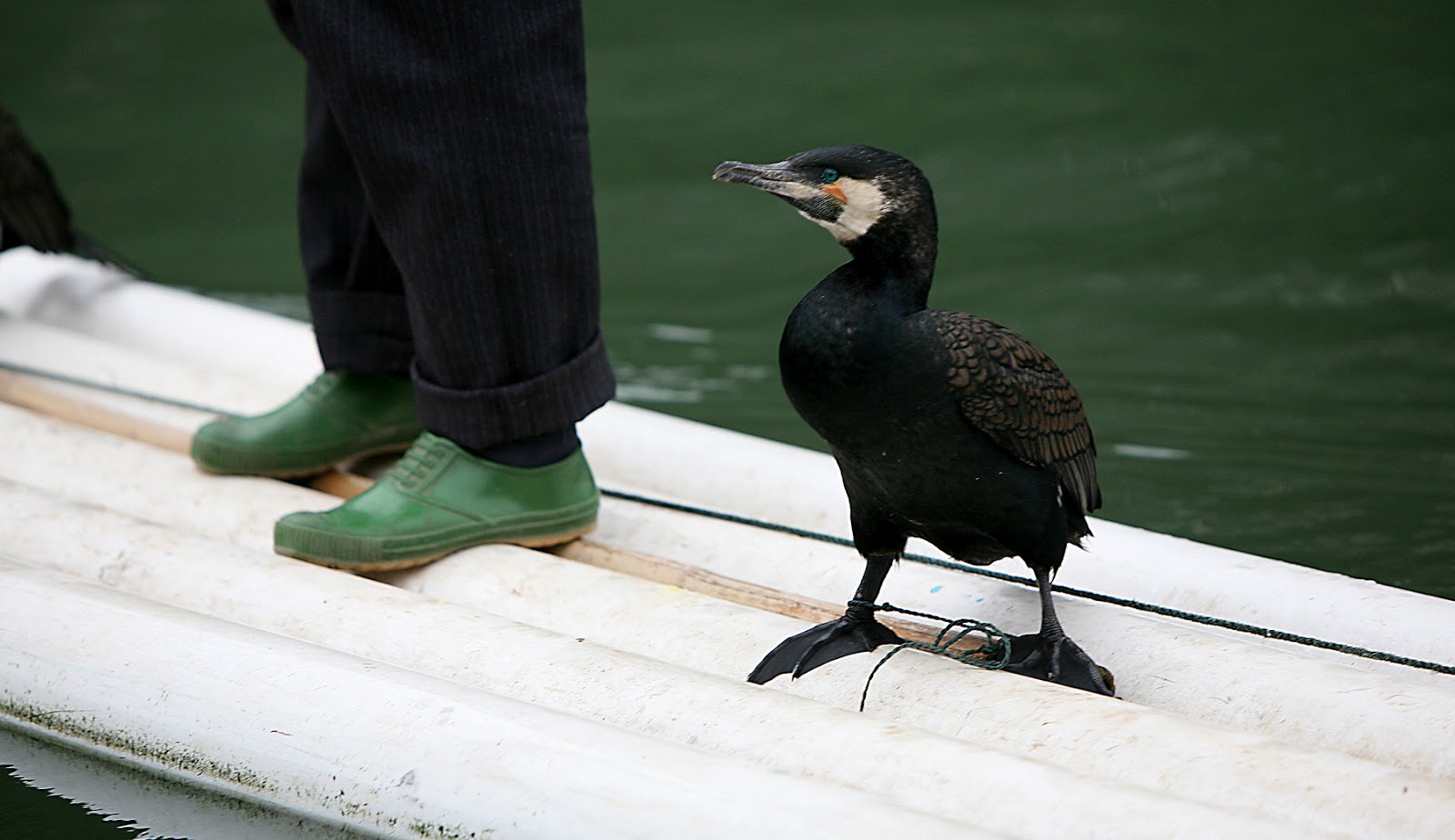
having your photo taken with cormorant fishing birds for the low, low price of ¥12, now announced
that we had 15 minutes to look around the village. She concluded the screeching
announcement with an ominous warning: If you don’t return in time we will definitely
leave without you.


We looked at our watches and then scurried around the lonely
village, taking photos that reminded us of some of the more desolate towns we
had visited in Italy. In the small mess of corridors we quickly ran into our
seatmates who said they were heading back, there wasn’t enough time. We
eventually followed, but not before taking several more photos of village chickens
and one of pomelos taped to a tree.


Once we were all back on the boat, it started making its way
back to town and we were allowed to hang out on the roof. It was at this point
that we saw the third version of the famous scenery.
Shi-wen and I were standing at the back when a tour guide
who had been talking with us earlier pointed to the right and said, “This is
it, this is the famous view!” People around us starting pulling our their ¥20’s and taking photos, so we did the same.


Of the three this seemed the least convincing but since everyone
else was so enthusiastic it felt odd not joining in. And what if the third time
was the charm?
After our day on the river we took the public bus back to
Yang Shuo (阳朔) for about a dollar and the hour’s drive
through the countryside was worth far more than that.
Living in a big Chinese city you are exposed to a certain kind
of China. And while people living in these cities face their own urban
challenges, these are nothing like the challenges faced by the people who live
outside of China’s urban sprawl. Coming to places like this you can finally
understand why.

We saw homes with dirt floors and no running water. Women carried live chickens by their feet at bus stops, farmers in rice paddies used their hands to work through the mud, and workers headed home along the roadside with hoes and shovels propped on a shoulder.


Kids rode in wheelbarrows attached to bicycles, tractors chugged along with their motors exposed, and farmers in slippers led oxen down the side of the road. Dogs stood in the middle of main drags eating road kill while cars and trucks and buses flew past in both directions.


On Sunday we drove some 150 km to Long Sheng(龙胜)and spent three hours on these roads, really feeling the pattern and rhythm of rural space. We were speeding through the countryside, zooming past ultra-green rice paddies in the near and limestone towers as sharp as shark teeth in the far.
The car was going fast, passing buses and trucks, and honking
to let the scooters and the bikes know we were close. We’re blurring along and
then we come to a town, a small blip of a center on this path, and so we slow.
We drive down the main drag and see what a main drag in this life looks like.
It’s a slow drag, a different drag… the kind of drag where
women sit outside holding babies on their laps watching traffic. There are
people working and sometimes there is a hill of oranges that a dump truck has released,
and there are men and women filling gusset bags with oranges and filling the
air with a sweet citrus smell that the car grabs and traps and takes along for
a few fragrant seconds.
There are things burning, always things burning… Out of mill
chimneys and in the fields and on the road’s edge next to the children playing
in the dust. Black smoke and white smoke and grey smoke. It all rises and
dissipates.
But somehow still the air is clear and clean. And even
though driving behind a slow-moving bus or a sputtering truck will clog and
taint the clarity, it is still not like the air in Chengdu.
This neglected countryside lacks infrastructure but at least
it has the sky. Out here there is more of it, more air, more breath. So you take
it in with deeper drags.
It’s a long jarring ride from Yang Shuo to Long Sheng, a
township about 90km north of Guilin (桂林). I say jarring because as you draw closer to
Long Sheng you start to climb the sorts of mountain roads with rock slides, the
kinds of mountain roads with drivers laying on horns that make a sound as much
about hope as warning.


We saw only one accident. Buses that had been traveling in
opposite directions had passed too closely and scraped into each other. It
had happened before we got there, and there was just enough space for us to
squeeze by and continue on our way.


We went to Long Sheng to visit the famous LongJi TiTian (龙脊梯田),
the Dragon Spine Rice Terraces, and we chose to explore the Da Zhai (大寨) terrace area
which we’d heard was quieter and less overrun than the other choices. Once we
were there we concluded that the relative quiet might be due to the fact that
you actually have to hike your way up to the postcard views.


There is one exception. People who are unwilling or unable
to hike can pay to be carried up the winding paths on a sedan chair. We only
learned this when Shi-wen glanced over the side of the hill and noted,
“Someone’s being carried up on a chair!”


Shortly thereafter a not un-large woman was presented to us in
a reclined position. Aside from the woman, her bags, as well as those of her
friends, were also being transported by locals. They carried the backpacks and
purses in over-sized woven baskets on their backs.
As we stood there sweating through our clothes, the basket
carriers made climbing up steep, slender paths look perfectly normal. And they
were not young; the lady tasked with hauling the gear of the reclining tourist was a good decade older at least.


Reclining tourists aside, the hike was stunningly beautiful.
The terraces are configured out of mountains and mud, with a quiet trickle of water
escaping from each paddy.
To weave between the levels and the pools – to see farmers
slapping mud on the walls to make them taller and to see the footprints they’ve
left in the silt-y floors of the unplanted paddies – makes you realize these
are nothing less than agricultural art.


These terraces are something that only hands can make out of
mountains. And to see it before the green rice plants are forced into the mud,
to see it with only the water in its basins, is like seeing a thousand
undulating mirrors pointed to the sky.
It is beautiful and quiet and strange. They hug the
mountains and turn with the terrain. And because the sky was cloudy silver they
reflected the glow rather than letting you see the rich mud at their floors.


As we came back down we passed through a bamboo-forested
patch and could finally understand why so many poems have been written of
bamboo and bamboo glades. The quiet and the lift of bamboo is wholly different
from the strength and weight of America’s oaks and pines.
As we walked down this stream-ridden path pairs of locals occasionally
came up. They wore traditional clothes and rubber boots and carried farming
tools on their shoulders. We would say, “你们好” and they would
respond in kind. Who knew what they thought of us, all sweaty with legs
shaking, as they sailed through their upward climb.


The town had what you might expect of a small cove nestled
in the big mountains: a shop that sold ice cream to tourists, a Party office
with China’s one-child policy outlined on a large poster out front, and a basketball
court where a donkey tied to the basket had recently relieved himself.


Of course the town was made up of more than ice cream and donkeys,
and the truth is that it really reminded us of Switzerland. The entire hike
did. Not only because of the stunning natural scenery but also because of the
style of architecture.


The easiest way to describe the wooden structures that
dotted the terraced hills would be to call them Chinese chalets. Made of wood, they're at the same time resilient and welcoming. Seeing how the aesthetics of China
and Switzerland can have so much in common really highlights the heavy hand
that nature plays in guiding culture.
As we left Da Zhai we stopped at one of the smaller villages
along the road to look around, and noticed a pair of local women washing their
long hair in the stream.


It was a disarmingly private moment and we quietly watched
as one of the women dipped her head deep into the flowing water and then raised
it out, combing the long swath of hair as it left the water. It was quiet and
beautiful, a small personal moment in the midst of a giant space.


Where we had stayed in Yang Shuo was also sweepingly silent.
It was outside of town and at night there were only the voices of crickets and
frogs. It was a pitch-black swath of land and had it not been so cloudy I’m
convinced we might have seen the Milky Way.
Galaxies aside, we were surprised by how many must-see
Chinese wonders we were able to cross off our lists in one go. The only question
is whether or not we get extra credit for seeing the ¥20
scenery three times.
But I suppose that wouldn’t be fair… seeing as I’m not quite
sure we can confirm we ever saw it at all.


