29 March 2007

clocks and clusone


Why do we love Clusone? Is it the frescoes? The clock? The mountains? Yes, yes and yes but... it's also the people. There's the restaurant owner who cracked open his front door to lean out and bellow a friend's name towards the clock tower. And the young man at the cheese shop who carefully wrapped each of our cheese chunks in wax paper and then gently transcribed the name of each cheese on its paper-wrapper. And the shopkeeper who gave us spoonfuls of the bitter honey that her husband had collected in Sardinia.

Clusone was everything our Italian small town guidebook predicted. It was quaint and charming, a hamlet lingering in the hills. With snow caps rising in the distance and air that's fresh and crisp. We arrived there by bus from Bergamo, our travel time from Milan totaling about 2 hours with train and bus rides added together. But Milan felt light years away.


We spent the morning shopping for fabulous foods (pastries, cheeses, bread) because we've learned that if you don't explore shops before the lunchtime closing you may not get to explore them at all. Saturdays after 1:00pm are far from ideal for shopping in this country. If you're lucky, a store might open again around 3:30 or 4pm when the owner returns from a splendid lunch taken casually over a period of several hours. And if you're not lucky, you'll be on your bus headed home wondering why you didn't get pastries when you had the chance.

When we finally made our way to lunch - in an empty but nevertheless homey trattoria - we were happy to take a break and sit down to a giant plate of meats and cheese. And lardo. Ever heard of it? Unfortunately, it's exactly what it sounds like. The white strips in the center of the photo, sprinkled delicately with salt and pepper, are basically thin strips of fat. While you might be thinking, "oh the horror!" I'd advise you to open your mind and take a bite. It's a fine flavor and quite good on a freshly grilled pieces of piadina. I vowed that when I came to Italy I wouldn't let food opportunities pass me by and so lardo has indeed entered my food vocabulary. And I give it a thumbs up... although maybe not a seal of approval from the American Heart Association or any group of physicians for that matter.


It was while eating lunch that fate fed us what was to be our afternoon. The owner, after telling us of his other restaurant on Lago d'Iseo went on to tell us that if the the world-famous clock in the piazza just outside of his restaurant was not covered with scaffolding, we might have had the opportunity for a tour with his friend - the man who winds the clock. But then, somehow, the next thing we knew he yelled out the front door and disappeared into the piazza. When he came back, minutes later, he was happy to announce that the tour was on.

There there was the small matter of the mayor swinging through for lunch and our introduction to him as the people from Chicago. When he left I told him it was a pleasure to meet him and that he had a nice city. Or maybe I said a nice country. You never really know with my Italian. Either way, I intended it as a compliment.

Our companion for the remainder of the afternoon arrived next. At the urging of the restaurant owner we followed our guide out of the restaurant and on towards the clock that his family has maintained for a century. He took us to see the inner workings of the clock with its swirling cogs and clicking gears. Allowed us to climb on its supports, angling ourselves out over the edge so that we could see the heavy balancing stones hovering above. Showed us photos of his father with the clock, and then actually proceeded to wind the clock - the same way he does every day. And has done for years.


This clock, by the way, is no ordinary clock. It's world-famous and apparently quite beautiful. We've never seen the full clock though. That's the small miracle. You see, it's currently undergoing renovation and is hidden behind scaffolding and netting. And when we'd arrived in the piazza that morning to find the clock covered, we'd been mildly heartbroken. It's true that after living in Italy for a year we're quite used to things we want to see either being under construction or renovation (ie Dante's Tomb, Milan's Duomo... the list goes on) but still... we'd wanted to see the clock.

It tells not only the time but the month, day, duration of night and day, signs of the zodiac, phases of the moon, and more. All with one hand. And all made in 1583. 1583! Anyone out there remember when the United States became a country? A good chunk of time after the creation of this clock.


So when we stood among the turning wheels of the clock, listening to the perfect metronome tick of the gears, we were thrilled and shocked. People will tell you that small towns are different, that the people there are different... And it seems they are. In Clusone they're so nice that they'll take you up to their clocks and let you stand there listening to the 500 year old tick. And then - and here's the real kicker - they'll take you out on the scaffolding to stand at eye level with the clock face.


We climbed out a small window - you can see it to the right of the clock face in the above photo I found on an Italian website. See the rounded window to the side? We climbed out of that and onto the scaffolding. And there was the clock. And there we were... out on the scaffolding, with the clock keeper, in front of an ancient clock, in Clusone. How lucky can you get?


After our tour of the clock was over, and we'd heard its chimes and the preceding quickening of the gears, our guide took us on a tour of the rest of the town which included visits to locked churches and hello's to all of his neighbors along the way. A friend of his let us into a couple of closed churches and turned on the lights so that we could see the frescoes and art. Is there a grander tour than that?

Clusone is also known for two very famous fifteenth-century frescoes upliftingly titled "The Triumph of Death" and "The Dance of Death." As you might guess, there are skeletons involved. The colors in these frescoes are shockingly vivid and the imagery dramatic. These scenes look out over a pebbled piazza, surrounded by churches and mountains. On our Saturday the air was crisp and rain was coming, a certain grayness was pouring into town - and there we were. With our new friend and his friend and a small town full of their neighbors.


Our guide wanted us to see the town museum before we left on our bus but as it didn't open until 3:30pm (as I mentioned lunchtime is no joke in Italy) we stopped in a bar for coffee. He must have seen 3 neighbors on the way, and said hello to them all by name. He'd already told us that he considered this the most special part of a small town like Clusone, that you actually know your neighbors and are not just strangers on the street. After our coffee, we waited for the lady with the keys to arrive at the Museum, the town's clock watcher consulting his own watch several times and wondering why she was so late...

But can you really be late in Clusone when the town clock is covered and the clock-keeper's out for a walk with some folks from Chicago?

20 March 2007

and Rome makes nine


After four and a half+ long hours, and a can of Pringles, we arrived in Rome's Termini train station on Friday night for our turbo marathon weekend. It was nearly midnight and after wading through crowds of intoxicated and indecipherable Irishmen we got to our hotel, which also featured a large population of intoxicated Irish. (Saturday was the miraculous confluence of St. Patrick's Day and an Ireland-Italy rugby match; folks started celebrating in earnest on Friday, if not Thursday.)

Saturday morning we arrived at the marathon expo with my doctor's note in hand. And yes, I did say doctor's note. An adult is not allowed to run the Rome marathon without a permission slip signed by a doctor. This slip vouches for the runner's fitness and in no uncertain terms places full responsibility on the doctor should said adult become a casualty of this mighty race. And let me tell you, that helps to scare off the doctors.

In fact there's an obscene racket in Italy wherein special "sports medicine" centers charge 75 euro to take your EKG and then sign your form. Please note that a permission slip signed by a health club "doctor" after the mandatory 50 euro physical exam one endures to join an Italian health club is not acceptable. That's somehow a different exam and usually ends with the doctor discussing how best to address Italy's #1 health problem: cellulite. I speak from experience.

Luckily, I found a doctor who upon declaring the permission slip "fascist" was happy to sign it. I won't even go into how difficult it is to actually register for the race but it basically boils down to standing in line at the post office. Don't let the marathon website fool you.

The marathon expo was fairly large and offered samples, with the best being handed out by McDonalds - certainly the first company that comes to mind when contemplating marathon running and healthy living! I suppose their fruit and yogurt samples were healthier than the milk cartons being handed out by the cheerful staff at the dairy booth. One guess as to what kind of milk was in there. Oh, yes... full fat. Those cartons were filled with cream, baby. And they came with a straw.

Another quaint shocker was the separation of the sexes. I'm used to male and female runners being organized in one big glop, names intermingling on registration lists and bib numbers indecently sharing the same space. As you enter the Rome marathon expo, however, the women's names are displayed separately from the men's and while there are 34 sheets of women's names there are over 173 sheets of men. Small difference there, huh? And when I went to pick up my bib number I naturally went to the pick-up area corresponding to the number on my bib. Oh no no signorina! I was quickly waved off in another direction - to the smaller area reserved for the female runners. Are you kidding me? If there's some tangible benefit to this system please let me know.


The other oddity of the expo was the smokers lighting up outside. Usually, it's random family members and friends who find themselves falling prey to their cigarettes despite being at an athletic expo filled with items touting good health and exercise. But in Italy, it's the runners! With their bib numbers and goody bags in hand these individuals are obviously running the race - they're even wearing track suits. Smoking! Sometimes one cigarette after another. There's nothing left to do but take a picture.

We spent the rest of Saturday eating amazing food and sitting in piazzas with a friend who lives in Rome. Our meal was down a small side street and most excellent. Warm grilled vegetables with balls of buffalo mozzarella and sliced meats. Spaghetti carbonara that was creamy and crispy and out of control. Chocolate cake with real cream.


I was off my feet by 6pm and watching satellite tv in the hotel room. Soul Plane was playing in english and while it might not be on my must-watch list normally, you can never underestimate the value of a movie in your own language while in a foreign country. Stefano left on a dinner mission and brought back a great Napolitano style pizza for my pre-marathon dinner. Then it was time for more English TV and a spot of rugby in Italian. (The Irish won.)

One of the great things about the Italian marathon is its late start. It begins at the leisurely hour of 9:00 am. And because of its relatively small size (15,000 runners), the bathroom lines are much shorter than the other races I've run. Although that doesn't stop people -- wholly men -- from relieving themselves on the ancient monuments surrounding the start. I can happily report that none of the female runners - who at this point were allowed to commingle freely with the males - were relieving themselves anywhere but in the bathrooms. Go ladies! Maybe that's why we get special numbers.

The race starts and ends at the Coliseum, that famous face of postcards and guidebooks. We queued around its base to start and circled around it again to finish. In the midst of all the excitement and spectacle, all the worries that precede a marathon and the fatigue that ends it, the Coliseum was awe-inspiring and inspirational. And what a luxury - who gets to run around the Coliseum? I guess I do.


The race itself was an interesting sociological study and was nothing like the races in Chicago, New York or London. There were fewer runners, fewer fans and far more body odor.

The Italian audience seemed to have two general responses to the race: confusion/indifference and aggravation/agitation. The confused/indifferent group would stand at the side of the road, bemused but not really saying anything. These were the same people who would wander onto the course, thinking that crossing the path of 15,000 people could be accomplished with simple hope and a certain nonchalance. The even more indifferent among them were the folks lounging at café tables along the route; these true cheerleaders would just sort of glance in the direction of the race, take a drag from their cigarette, and mutter "bravo." Only in Italy.

The aggravated and agitated instead would stand at the side of the road cursing at the policemen and demanding that they be allowed to drive their cars through the race. While I saw no cars actually on the route there were plenty at intersections with their complaining drivers making their case to the attending official. I heard several people on cell phones along the side of the road explaining to their friends that they were caught in some sort of race and couldn't reach their destination on time. Believe me, they weren't saying how happy they were to have found this great sporting event. I especially liked when a woman who seemed to be leading a school group trapped behind the race route said to the kids that the runners were "gia destrutti" -- already destroyed. I especially liked that she said this as I ran past.

As for active spectators, there were far more Norwegians at the side of the road than Italians. There were more Finns for that matter. The Italians who were at the side of the road for cheering purposes, and maybe there were 30 along the way, seemed to be dressed in the same outfits as their compatriots -- as if bright red sweatsuits with green stripes somehow attracted other bright red sweatsuits with green stripes. And that this combination produced a modicum of cheering and encouragement. But never too much.

My biggest problem of all was the concept of kilometers. Just how many kilometers are there in a marathon? I didn't know Sunday but I know today. That's because I had to run past 42 signs - each indicating the passing of a single kilometer - before I finished. 42 signs is a lot of signs. Especially when you're used to 26; one for each mile.

Had I known there were 42 kilometers in a marathon, instead of running blindly, my results might have been different. But because I didn't know, and couldn't follow a strict mental plan of how far to get and in how much time, I just ran.

It was liberating. And in the end, exhilarating. Because I got a time that surprised me. 4:24. A great time for me. A time I got just by running. Not by planning. Not by staring at my watch every time I saw a mile marker. Just by running. Amazing.

There were incredible views along the way. We ran straight at St Peter's Basilica for a long stretch. It was gorgeous and there was a uniformed band playing in front - enough to bring tears to your eyes. We ran past the Trevi Fountain and through Piazza Navona and over enough cobblestones to last a lifetime.

The drama and history are almost enough to make you forget about the drab miles run along the grey highway; and the on-ramp we had to crest to get up there. And ending at the Coliseum - at the one and only Coliseum - is enough to make you forget the last half-kilometer of uphill brutality you're forced to run to get there.


A new thing for me: sponges. I have never seen so many sponges and so many people so excited to get sponges. At a certain point we were getting more sponges than Gatorade. These square foam chunks were lighter than air and soaked in cold water. Perfect for rubbing across your face to wipe off the salt crystals. Perfect for keeping a bella figura even while running a marathon. And everyone knows the bella figura is most important in Italy.

The race also sported a feature we'd never even heard of before: bicycle psychologists. In the guide that came with the marathon t-shirt there was an announcement that these people would be present on the racecourse to assist and encourage athletes to finish the race. Psychologists. On bikes! Telling you why you should finish the race that you signed up for. Again, only in Italy.

Other important information gleamed Sunday: Giuseppe was the most popular name among race participants, the song "Final Countdown" is only inspirational until the lyrics actually start and Nike running shoes are rarely worn by anyone other than Americans.

Stefano was able to find me at three points in the race. Our first meeting point changed along the way as the map that we'd used to plot our meeting points was incorrect. This map was posted on the marathon website and listed as the course map. I'd like to say that this mistake was a real shocker and that we couldn't believe the Rome Marathon would have the wrong course map posted on their own website, but we've lived here for too long. I just called Stefano from the 5k mark (where we thought he would be) and rescheduled for where he was actually standing (somewhere around mile 8). That's why running with a cell phone is clever.


After the race I hobbled with Stefano and our friend to the metro and after one stop we took a cab to her apartment. When I stumbled out of the cab our friend explained to the driver that I'd just run the marathon and pointed out my medal. Being the 13th running of the Rome Marathon, the medal has "13" written on one side. The taxi driver was excited and congratulated me on placing 13th in the race. That shows you how much the average Italian knows about Marathons. Anyone who thinks I'm the 13th fastest person running any race is maybe a tad new to the sport.

So, in honor of my 13th place finish we ate heaping piles of homemade pancakes with butter and syrup and old-fashioned bacon. We watched silly satellite TV shows like Everyone Loves Raymond and played with a giant golden Labrador retriever.

And talked about how cool it is to run a marathon in Rome. Even if it is 42 kilometers instead of the usual 26 miles.

13 March 2007

torino two times


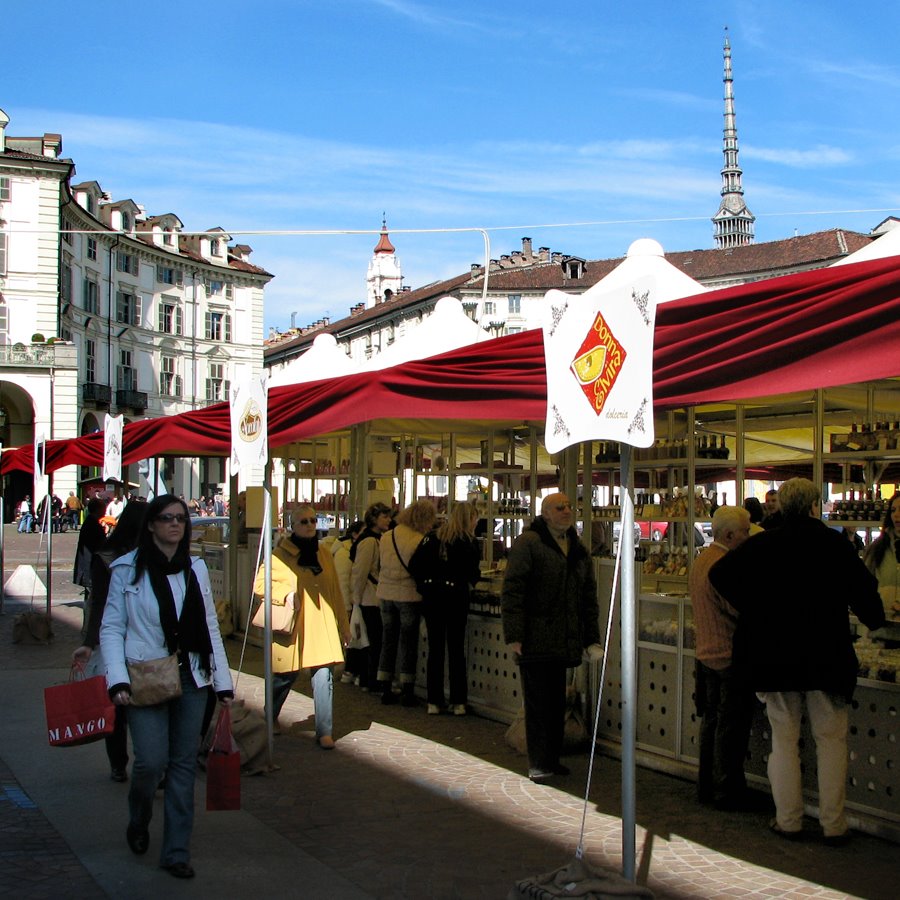
We headed to Torino for the chocolate festival this weekend and did our best to honor the spirit of the event -- indulging in samples and skads of wanton chocolate purchasing. While it wasn't in the same piazza as last year (we know because we were there) it was almost as good. We couldn't find the smoked chocolate, and the salted chocolate (our favorite) was only available in the smaller, and more expensive, bars. But we did find a flourless chocolate cake, the size of a dessert plate and heavy as a brick, that's now in our kitchen waiting to be devoured.

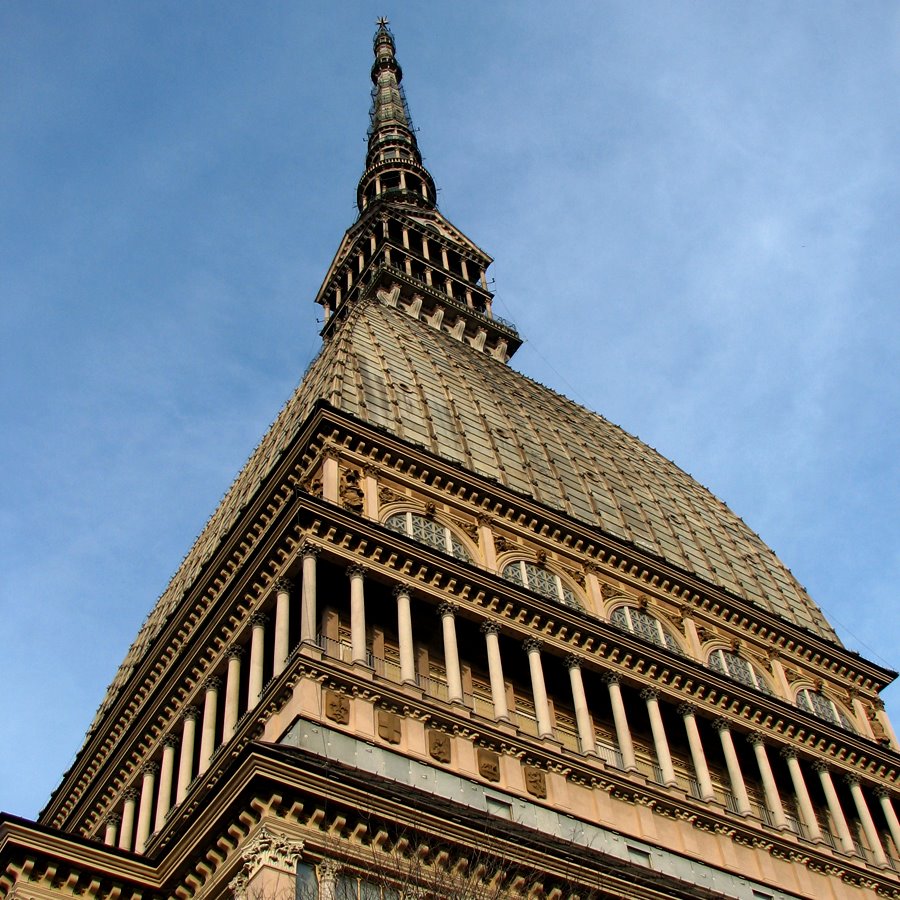
Reaching into the sky above Torino is a spired tower that can be seen from almost every piazza and open space in the city. You could see it from the chocolate fest - and it shows up on the right in the first photo. This symbol of Torino is popularly known as "The Mole" and was finished in 1889; at 167 meters many claim it be the tallest structure in Italy. What was originally intended to be a synagogue is today a well-known observation point whose main building houses the Torino Cinema Museum.


The view from the tower is a good one although the elevator ride to the top is the real adventure. Twenty seconds of glass-walled lift through open space. No girders, no elevator shaft, just a glass elevator gliding up, up, up along its cables. Sheer exhilaration.

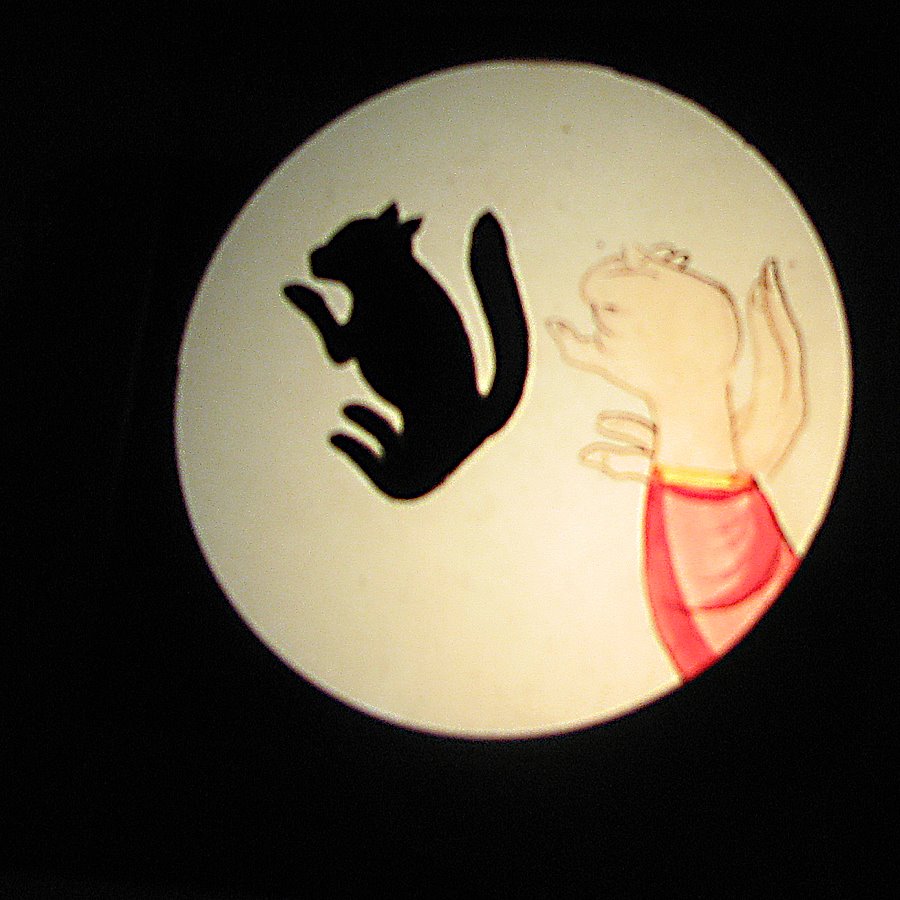
The cinema museum is excellent. Starting with the simple play between light and shadow and reaching into today's technologies, the museum traces the development of cinema over time. In our attempts to enter the museum, and our wanderings within it, three themes made themselves brilliantly clear: 1. the domination of Hollywood in the film world, 2. how very cool a museum can be, and 3. a certain nonchalance towards customer service.


The museum is basically an opportunity to see never-ending examples of film and its precursors. The space is surprisingly interactive and you find yourself exploring the many floors and exhibits, watching clips from every genre, era and style. There were surreal films playing in a giant refrigerator with toilets as the theater seats. Experimental films screening in a mad scientist's laboratory, TVs glowing in the sinks and stove. Horror films presented in a haunted mansion complete with a coffin under the floor.


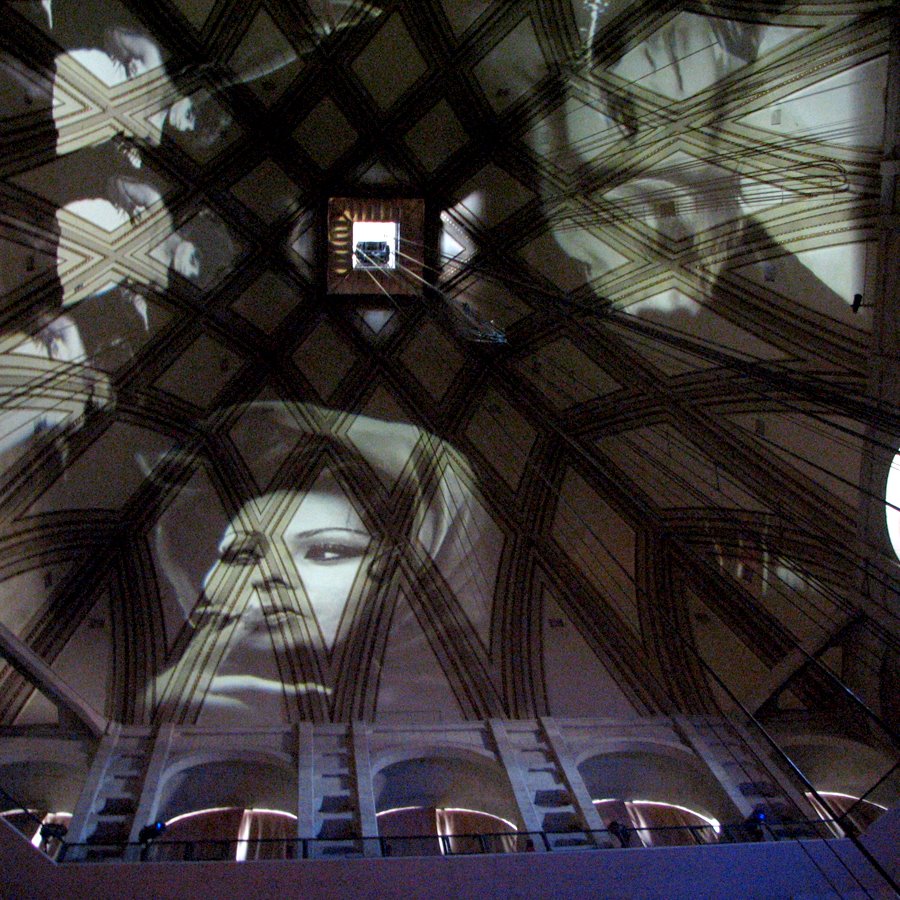
In the center of the museum, in the large space under the tower with the elevator rising directly above, is a theater where guests recline in lounger seats with speakers at their heads, watching films play on giant screens in front of them and, intermittently, projected on the interior of the tower. The vaulted ceiling becomes a giant screen, with the stick-straight cables leading into a small hole in the roof through which the elevator reaches the spire. As you might imagine, it's quite dramatic.

It's true that a majority of the films will be easily-recognizable to Americans. You can't escape the fact that Hollywood churns out more than a few of the world's most popular films. And you'll see clips of them at every turn. Even in the screening room we couldn't quite figure out -- its theme had something to do with love and you have to lay down on a giant, circular, red velvet bed to see the film clips which were playing on the ceiling. We found ourselves laying there with a young Italian couple, watching films play in the muted light. Once we got up, we were replaced by a quintet of silver-haired ladies who giggled as they lay down.


I should mention that we waited in two lines to enter the museum. First, the "wrong" line which could easily have been avoided if the young lady manning the cash register had been more interested in us rather than her pile of un-counted euro pennies. Which she proceeded to count as we stood in front of her. And count. And count. She finally told us we had to go wait in the other line. And once we finally did reach the other cashier - after 30 minutes standing in the sun - our previous "helper" double-checked with her cashier colleague that we had actually waited in the line. (As if we'd been hiding in some dark corner of the museum for half an hour and had only just then popped out to cut in line.)

Additionally, there was a staff member at the top of a very, very long spiraling ramp who let us know, in no uncertain terms, that our understanding of the museum layout was quite off and that we were to head right back down that long spiraling ramp until we were back at the bottom. And that was that. No more discussion about it.

I will say, though, that even though the customer is never right, especially at the cinema museum, it behooves the customer to visit the cinema museum. Because it is so very cool. Especially when you've got chocolate in your pockets.

07 March 2007

we (heart) italy

Last week marked our one year anniversary in Italy. Time has a way of speeding up when you're in the middle of a good thing... And going at light speed when you're living something great.

In honor of our little "something great" that's raced past at the speed of light here are four of the myriad things to (heart) about Italy.


Fashion, for lack of a more nuanced descriptor

Some call it fashion, others are less generous, but there is definitely a love of following recent trends. Of buying what's on the racks and throwing it on your body. Of putting on jeans that read "RICH" across the bottom, and then walking around with a boyfriend who's wearing the exact same pants. And should there be any question of whether these two identically-dressed individuals are together there's always a healthy display of public affection to make their intentions clear.


Dogs in every shop, restaurant and mode of transport

Whether you have two legs or four, you're welcome in most any Italian establishment. While having a morning coffee at the bar, a visitor can count on at least one dog nosing around their feet, eating brioche crumbs off the floor. Riding the Metro is not only for people-watching, but pooch-watching as well. And in the high end fashion stores there will almost certainly be a small pup nosing around its own business while its owner attends to some luxury purchases.


Dogs and bicycles: two great tastes that taste great together

It's the Italian version of chocolate and peanut butter. Dogs + bikes = happiness for everyone. "Walk" your dog while riding a bicycle! Put your dog in your bicycle basket and tool around town! Who knew that dogs and bicycles were such natural cohorts? The Italians, of course.


The hands-clasped-behind-the-back saunter

Reserved for well-dressed men over 70, this casual stroll epitomizes the Italian way of life. It's slow, it wanders with no clear direction, and it's well-dressed. You will find these men at all times of day, alone or in groups, slowly walking around town. Their arms are always behind their backs and they are always moving languidly. If you don't have anywhere to be, it's beautiful. If you need to get to work on time, and this man and three of his friends happen to be on the sidewalk in front of you, it's a tad less glorious. (But charming nevertheless.)

Italy is everything people tell you. It is beautiful and passionate and full of laundry drying outside. It has fresh fruit available only in season and buffalo mozzarella that must be tasted to be understood. There are glorious wines, heaps of beautiful people, and a musical language. And for 365+ days we've been here too.

Eating, watching, living... and looking for the perfect pair of RICH jeans. On second thought, make that two pair.

05 March 2007

Ravenna


The train system in Italy is excellent by any standard. It is (generally) on time. It is (for the most part) affordable. And it is quite far-reaching. However, after spending a grand total of 6+ hours on the train yesterday I think that both Stefano and I are feeling a little less love for the train today. We just need a little time away - absence makes the heart grow fonder and all.

Ravenna, yesterday's destination, is about 3 hours from Milan. If you take the 7:00am Eurostar from Milan to Bologna, and then the 8:45am regional train from Bologna to Ravenna - you will be in Ravenna at about half past ten in the morning. And what, you might ask, warrants a trek to Ravenna (beyond our quest to see as much of Italy as we can in the time that we have)?

Aside from being one of Italy's small charmers, Ravenna is apparently the "home of the most celebrated mosaics in Western art." I'm quoting directly from 1,000 Places to See Before you Die; A Traveler's Life List. It boasts a gigantic section on Italy and every time we visit a new city we check to see if it, by chance, warranted an official place on the list. I'm happy to report that our little visit to Ravenna allowed us to cross one more destination off of the 1,000.


We landed at Ravenna's train station and immediately headed out in quest of coffee and pastry. This is our usual system. We work up an appetite on the train by alternating between cat naps and extreme boredom and then burst into town with a need for caffeine and sugar. We shared a small café with an older lady reading the paper in the corner. We drank coffee while Stefano launched blizzards of powdered sugar off of his brioche and onto his clothes. My Nutella pastry was less messy but no less sweet. And with that recharge we were headed into town.

One of the best things about Italy is the concept of the piazza. The piazza is the town square, the center, the place through which everyone passes and in which everything happens. All roads lead to the piazza and arriving in an Italian town a traveler can simply follow the flow into the main piazza. No map needed. It's a beautiful thing.


These piazzas are always filled with people milling about chatting, drinking coffee at small tables, passing through. They are filled with bicycles and babies and dogs. Fountains and columns and people holding hands. They are wonderful slices of life and immediately project the personality of the place into the public sphere. Ravenna's Piazza del Popolo is no different and in the course of the day featured a wedding (arborio rice being thrown at the bride and groom), a presentation by the local ambulance crew (clad in their neon orange uniforms), and a host of people just living their lives.

From the piazza we headed in search of mosaics. The mosaics for which Ravenna is known are found in various locations - each location putting up a good fight in the battle for the most unassuming exterior. However, it's the luxuriously decorated interiors of these 5th and 6th century structures that are astounding. Absolutely astounding.


Craning your head back in the Basilica di San Vitale, which was completed in 548 AD and was the inspiration for the Hagia Sofia built 10 years later in Constantinople, gives an extraordinary view. The mosaics are stunning and beautiful vistas that sparkle with color and light. It's very difficult to understand how 1,500 year old flecks of marble and stone can add up to these incredible scenes so many years later. I am by no means a mosaic expert but I will say that these mosaics are beyond pretty. And that anyone putting these things together 1,500 years ago had to have been some kind of genius. The turquoise color alone is well worth the visit.

(P.S. I think we also found the name of our future dog among the mosaics. Now to the small matter of figuring out which kind of puppy our allergic Stefano just might be able to tolerate.)

A short walk away is the Mausoleo di Galla Placidia, a small 5th century mausoleum said to house the tomb of Galla Placidia, sister of Rome's last emperor. It's small and dark and the light that does filter in through the alabaster-slabbed windows catches the mosaics, making them twinkle. The vaulted ceiling is covered in stars and the walls feature everything from flying cows to celestial visions. Again, the age of the place and the marvelous condition it's in is simply overwhelming.


The Battistero Neoniano (5th century) and the Basilica di San Apollinare Nuovo (6th century) are also covered in mosaics. It's best to just take a seat (if one is available) and let your eyes wander over the intricate designs. You start to think about the history here. About how Ravenna was the western capital of the Byzantine empire for 200 years. How it had also been a capital of eastern Rome during its fall. Sitting in that place, 1,500 years later, looking at tiny bits of stone stuck to an ancient ceiling, you start to think of how very new the United States is. And how amazing it is to be in a place that's so very old.

Dante's tomb is also in Ravenna and let me warn you - the tomb, like half of Italy, is currently under renovation. So while we can say we were within five feet of Dante's grave, we cannot say that we saw it. It's behind obligatory construction netting, like half of Italy, and we were not permitted even a glimpse.


We ate in an excellent osteria and I had one of the finest glasses of wine I've had in this country. In our wanderings we managed to find milkshakes (hallelujah!) and an excellent rosemary piadina -- an unleavened bread that is unique to this area. We also stumbled across the salted dark chocolate that we have been looking for since first tasting it almost a year ago at the Torino chocolate fest. Turns out it's produced in this region and so by wandering into a random sweetshop we were able to be reunited with our long lost chocolate love.


Special mention should also be made that Ravenna is a bicycle town. There are strips of light stone running down the centers of the pedestrian streets and this is where the bikes roam. There are entire families, and older folks, and ladies in high heels. There are baskets filled with flowers, with grocery shopping, with dogs. People are smoking cigarettes, talking on cell phones, ringing their bells at the walkers they're about to run into. But no one ever runs into anyone. And little kids wield their balloon swords while Mom peddles and grandmas wear their fur coats magically keeping them out of the gears. And life surges on. A life found only in Italian streets. And Italian piazzas.

Ravenna was wonderful for its mosaics but it was more wonderful for its people. Its flavor. And its piazza. There's just something about a piazza...

25 February 2007

quiet night


This was our first overnight trip to Venice and so was also our first time wandering its honeycombs after dark. I say "honeycombs" because for me Venice is a city built of miniature quadrants and pathways.

Petite canals turning around corners, isolating buildings and pathways. Diminutive bridges connecting one cube of land to the next. An ingenious webbing of tiny plots that as a whole becomes Venice.

And at night, the cracks and corners are illuminated. Hidden light crosses the canals and skitters across the surface. Boat traffic slows and the waters still. Windows at water's edge spill a mystery glow into the night.


All the while your footfalls bounce off of surrounding walls and thin corridors spill you into dark piazzas with long-quiet wells closed with heavy iron lids. The canals, now quiet murky mirrors, stay still and silent.

You know you will find your hotel - know that it must be out there somewhere - but it still feels as if Venice might just have swallowed it whole. And now waits quietly for you to discover its mischief.

wandering venice


Wandering around the streets of Venice last weekend was not only an exercise in not getting lost, but also in costume admiration. Peppered into the crowd of regularly-dressed people were those in full costume. These costumed moving targets render all of Venice into an obstacle course of sorts because as they make their way through any crowd, inevitably the crowd will stop. It will part. It will reassemble in an unpredictable way with camera-wielding individuals moving at the costumed revelers and all others moving away. Now this scenario is easy to picture on a large throughway, even an average Milano sidewalk. But in Venice where you're navigating tiny spaces and out of the way bridges, this is a challenge. Enjoyable, yes. But a challenge.


The quest through Carnevale in itself is also somewhat exhausting. It warrants quiet time here and there. A rest. A break. Some people are able to recharge in the sunshine on a bench. Others, like us, go to the Guggenheim or the Palazzo Grassi to view modern and contemporary art. Nothing like a steer suspended in formaldehyde to get those energy levels back up!


For some reason, children in costume never seem to tire. They are always able to dig into their bag of confetti to hurl that one last fistful at an unsuspecting adult. Going over one of the main bridges we were ideally placed behind a 10-year old cowboy-hat-wearing cowgirl who just couldn't resist throwing confetti at everyone. And for some reason, probably because we were all packed so close together on the bridge, none of the adults saw it coming. Not a one. Each recoiled as the colorful paper bits hit them in the face. And then they would look around to find the assailant as if that mattered. By the time they caught a glimpse of her she was on to her next target.


There seemed to be a few regulars wandering around town. Older folks with dogs. With newspapers. With a walk that said they knew exactly where they were. Though they were the rarity it was nice to see them there, to know that not everyone was just passing through.


To live in Venice can't be easy. The gondola traffic alone has got to drive you mad. All of the striped gondoliers shuttling couples past romantic vistas. It's a real world vision of Disney World's "It's a Small World" ride. And then there are the couples drinking wine along the canals, eating plates of the wonderful little tapas so popular in Venice.


Wait a minute... that was us. A wine glass perched at the canal's edge. Watching passers-by make their way up and over the bridge. Wondering why we'd never had an anchovy on top of a pearl onion before. And wondering if we should go back into the bar and get another.

We didn't. But only because there was a gelato shop next door. So we went in there instead.

Carnevale a Venezia


Carnevale in Venezia is well-attended and well worth the effort. The city may be packed with tourists, and you may need to flee to the modern art museums during the day for breathing space (as we did), but Carnevale in Venice is too grand an event not to warrant a visit.


What exactly is Carnevale, you ask? I'm not sure. By the looks of it, Carnevale involves wandering the city dressed head-to-toe in elaborate costume and occasionally lifting your mask a bit to enjoy a 10:00am glass of wine at the coffee bar. If you're a child it's your opportunity to unabashedly launch handfuls of confetti at all passers-by while if you're a young adult your aim is to launch, instead, bottles of wine down your throat.


For all of the Bacchanalean behavior, it's a somewhat organized affair. You wind your way down to the Piazza San Marco -- the Piazza of postcards and pigeons fame -- and either strut around showing yourself off, or stand around watching the others strut. There are also performances scheduled throughout the day and night; the most enthralling involving either rock music or fire. (It's hard not to be impressed by a 15 foot flaming stick figure. I should also mention that the early 90's dance music leading up to the performance was top rate. I don't know when I last heard Rhythm is a Dancer, Mr. Vain, and Show Me Love in one continuous set. We weren't ashamed to shake a tail feather in the Piazza.)


You can watch giant men, in giant ball gowns with hoop skirts underneath, work their way through the crowds. You can watch tiny, adorable Winnie the Poohs charm everyone in their path. (We couldn't get a good shot of Pooh because everywhere he went the crowd converged around him. Even drunken teens were enamoured and would stop dancing to crouch down and give him a tap on the head or take his picture.) And you can watch Little Red Riding Hood and the Wolf take a load off and rest a while.


Piazza San Marco was covered in confetti and crammed with people. The mood was joyful and the folks in costume would pause to let everyone else take their photos. There was impromptu singing and long conga lines of young people swirling through the crowds -- the line getting longer and longer with each spiral around the square. Vendors with carts covered in masks lurked at the edges while husbands balanced cameras on their wive's heads in order to steady the nighttime shots.


What a wonderful place to be. With art and illustrations projected on these historic buildings and the bell tower. With live music and dance. With wine and fire and confetti fluttering in the air. The nights were crisp and clear and Stefano and I stood in the midst of it all, soaking it in.


And after the concert the crowds filtered out into the maze of tiny Venetian streets. Costumes drifting over the pavement, the canals reflecting color and light. Is there a better place for Carnevale to unfold?

12 February 2007

pompeii is for lovers (of history)


On August 29th, 79 A.D. Pompeii disappeared under a catastrophic heap of hot mud and volcanic ash. Mount Vesuvius had been threatening smoke and ash for several days and when it finally erupted a 30 foot blanket of volcanic rubble fell to earth and choked the life out of Pompeii. What had been a fully-functioning Roman city of 20,000 instead became Roman life brought to a halt.

Discovered in the 1600s, excavations didn't start until 1748 and continue still today. Pompeii is estimated to cover 164 acres with 75% officially unearthed. What you can see, and explore, is shocking for its modernity and artistic development. And also for its resemblance to the cities we all still wander today.


When you walk the streets of Pompeii, you are actually walking on paved streets. There are sidewalks and water troughs and ruts where wagons ran the road raw. There are doorways, and tiling, and political slogans crawling across walls in elongated red script. There are bakeries with ovens and large grindstone mills that once transformed wheat to flour.

Pompeii is a ghost town and you really feel the absence of its inhabitants. There are tourists - speaking every language - and the smart ones have brought a picnic lunch. (We only brought cookies and water.) But there is no one there who looks the part. No one running the flour mills. No one leading a wagon through the wheel ruts. What you feel is the absence of life and the absence of those who called this place home. This is no Williamsburg.


There is amazing art to be found in Pompeii and you get the sense that Pompeiians were great fans of art and life in general. There's a gusto lying beneath the dustiness and the sun-bleached rock. There are murals painted in vivid colors and complex mosaics with shocking detail. It's hard to believe that this city's moment in the spectrum of time was 2000 years ago. 2000 years... A lot has happened since then but as they say, a lot has stayed the same.

It's hard not to mention that the world's oldest profession was well underway 2000 years ago. There are the frescos and stone slab beds to prove it. In fact, one of the only - if not the only - buildings in all of Pompeii to be outfitted with electrical power (to aid the visitor's sightseeing abilities) is one of the brothels. The erotic illustrations above the various rooms are highly illuminated and very visible. Not all the art in Pompeii is what one might term high art. Some of it gets pretty low.


There are, though, the frescoes within the Villa of the Mysteries. This villa, slightly off the beaten path but worth the detour, features rooms brimming with color and majesty -- four walls covered in ancient storytelling and beautifully tiled floors skating along below. The art in the above room is said to depict the the initiation rite for females into the cult of Dionysus. With the marble flooring and gorgeous painting there is nothing about this place that says 2000 years ago. You spend your day re-examining your understanding and assumptions of ancient history. And wondering where, exactly, all the dogs came from.

It's the one thing I remember clearly about my visit to Pompeii with my sister over 10 years ago: the sun-stricken dogs laying all over the place. And they're still there. Just lazing about. Another thing I remember clearly is that we took a ride with an Italian family in their very small car, with its cardboard floor, to get to Pompeii. Apparently we had wandered very far off track in trying to find the main gate and this family just picked us up and took us there. You would call it hitch-hiking except we didn't ask for the ride. It just sort of happened. But I digress.

There are grand baths at Pompeii, separated into sections for women and men. There are columns and temples. Cemeteries and theaters. A giant coliseum with seats rising towards the sky. This place is complex and immense and you get exhausted wandering its streets.


There are casts of the human victims whose shapes were preserved under the ash. The faces are tormented and the bodies contorted. They are in contrast to the elegance of the art with which their lives had been surrounded, natural disaster reducing them to the basic elements once again. Its a blunt reality check. That on these streets there had been people selling their wares, walking their children, drinking their wine and then one day it all went away.

How these places have been extracted from the ash I do not know. But here they are, standing again. And standing in strength. You realize that the loss of Pompeii and its people in 79 A.D. is a gift to us today. Where else can you feel, actually touch, the way ancient Romans lived. Where can you lay a hand to the stones that paved their streets? Linger an eye along the frescos that decorated their lives?


Pompeii is one of those places. And as much as it feels old, and disturbing, and historic, it feels - at its heart - real. And this is the best part. We read history books. We hear lectures and lessons. But in Pompeii we walk Roman streets and walk through Roman doorways.

And keep a Roman eye on that volcano in the distance.