Showing posts with label chinese. Show all posts

17 November 2013

Not the city

If you’re feeling frustrated with Chengdu you can leave it for an afternoon and come back feeling much better. Mainly because venturing outside of the city will remind you that things can be much worse. But also much better.


In the much worse category we can go ahead and list all of the ways that driving on mountain roads can take days off your life. What with the toddlers toddling into traffic or being fed their meals at the side of the road; the elder generations walking three abreast in the road – balancing oversized baskets, muddy hoes, or small children somewhere on their bodies; the barely-moving tractors dragging saggy lengths of rebar up the mountain; and a lone cyclist hogging the road back down – it’s not easy to get where you’re going.


There’s a lot of “Oh crap, did you see that?,” followed by “Oh hell, get your eyes back on the road.” In fact, leave the city for half a minute and you’ll realize that the outlying roads are marvelously un-conducive to driving. They take the surreal inconveniences of city driving and run them over. Twice. With a tractor driven by a five year old.


And while these roads may lead to where you’re going – in our case a mountain town called Shangli 上里 – you start to notice what they’re missing along the way. We couldn’t find a bank. Didn’t see a grocery store. Witnessed neither gas stations nor libraries.

We did see children scuttling in the dust with chickens, enormous tree trunks resting on their sides, and a family that happily fished a vegetable out of the gutter.


The farther you get from the cities, the harder life gets. It’s the unfortunate combination of more challenges met with fewer opportunities. And if you asked people what holds them back most in these places, I doubt they’d say the lack of a Starbucks. The most basic of services still haven’t reached these areas. A sidewalk would be a shock.

But you will also find things that the city lacks. There are streams and waterfalls and bamboo trees. There are mountain passes and rice fields and flowers drying in the sun. And parking lot attendants who step over to the field to explain to you that this is the countryside and that people who live here are farmers, all before guessing you are way younger than you are. “You’re just a little off,” I responded, “just a little off.”


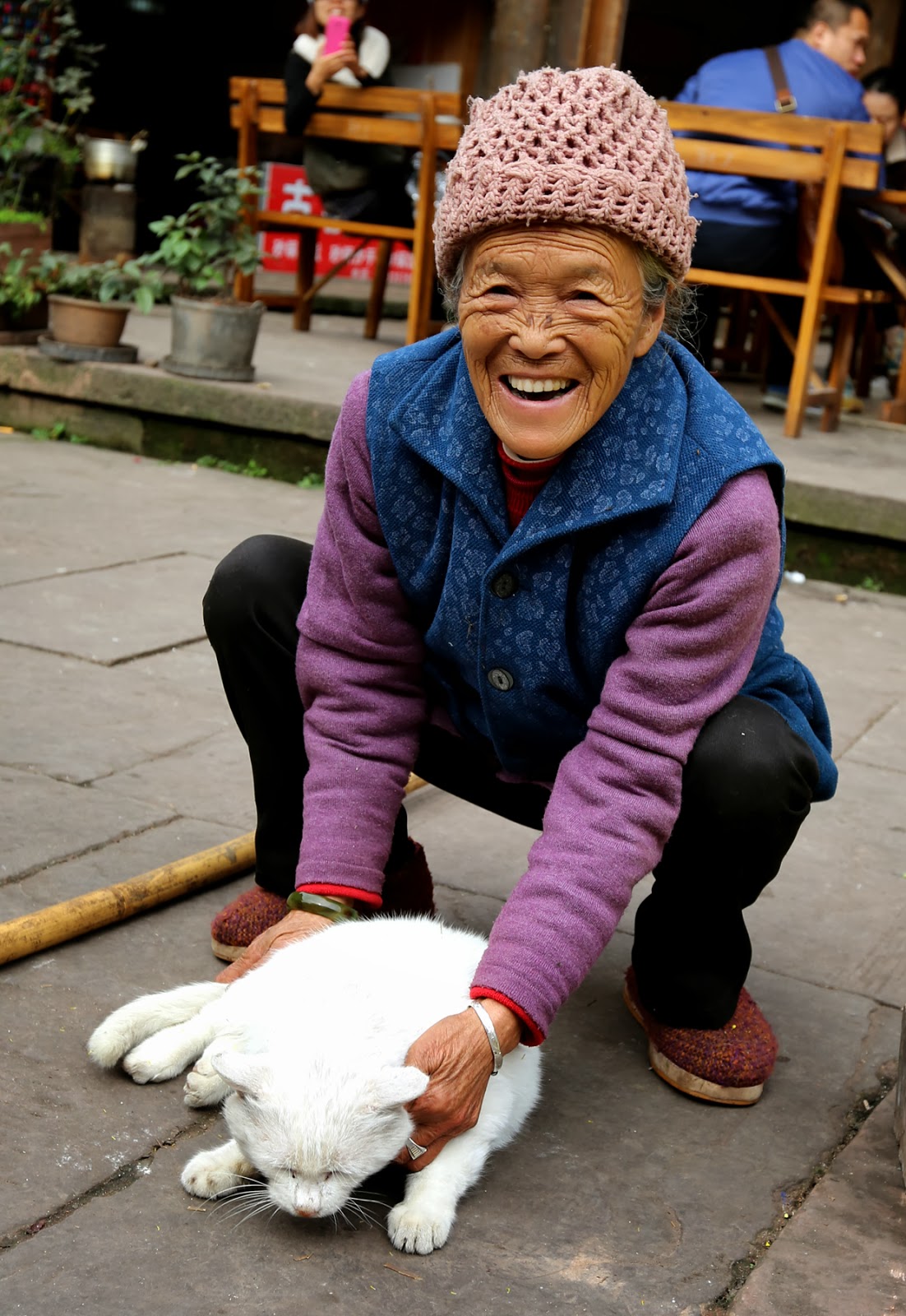
I wonder if he would have guessed the correct age of the cat laying next to the flowers in the main square. The lady tending the drying blooms lay her rake down to pet him, pulling his ears back and explaining he was twenty years old.


I say “he” but I have no clue whether it was a him or a her. In Chinese there may be different written words for him 他 and her  and it 它 but they are said exactly the same. So he is twenty and she is twenty and it is twenty.

And twenty may be the number of times Xiao GuaiGuai was held, photographed, or complimented by strangers... often with a single individual doing all three. Such a popular exhibit was this “big eyed” “precious” “doll” (all their own words) that it was hard to eat our noodle lunch without someone stopping by for a viewing. It happens in Chengdu too, but the smaller the place and the farther afield you are, the more akin to a rockstar a non-Chinese baby becomes.


I didn’t take any photos of foreign babies but I did get a shot of a babied dog. Whose owner in turn got a shot of Xiao GuaiGuai.


We were very happy with the noodles we happened to get for lunch. We ordered them because the people sitting at the table next to us had ordered them too. These noodles were the house specialty and they’d been thrown and swung before being deposited into a steaming cauldron of boiling liquid. They were then raised en masse and coiled into a bowl with leafy greens and fatty hunks of meat and la jiao 辣椒, the spicy pepper found in so many of Sichuan's dishes. Did we want la jiao? they’d asked while taking our order. As if we would say no.


There were some other questions posed to our table but they remained unintelligible on account of being asked in the local dialect. A few sentences the chef rattled at us in quick succession made no sense until he turned to the people at the other table and said, in perfect Mandarin Chinese, “they don’t understand.”  听不懂. We understood that.


And when the chef concentrated on speaking to us in Mandarin it seemed he was most eager to learn one thing: Why do we speak Chinese?


It was the first time I’d ever been asked that question. Usually people ask how we learned Chinese, or where we learned, or when. But never why.

I suppose the why is that we live in China. The why is that without Chinese we wouldn’t be traveling to small towns to see this country outside of its cities. The why is that when you can talk to people you can start to understand.

But it’s only a start.

(Next time I’ll remember to ask the gender of the cat.)

23 April 2012

harbin was my teacher

A snippet of what I learned in Harbin the week before last.


Winter stays for a while

Per the advice of my instructors I’d begrudgingly dragged a winter coat and a scarf, some gloves and a hat on this trip. The bulk of it felt out of place in balmy Chengdu but turns out that in Harbin this kind of gear is still really necessary. One morning’s dismal rain even turned into big fluffy snow. My teacher and I paused our discussion to look out the window, both saying how much we love snow. Just not necessarily in April.

Central heating is not year-round

The radiator in my classroom was as cold as the curb outside. But I know from my time in Chengdu (which has zero central heating) that China’s air conditioners, often mounted high on the wall, are also heaters. The problem with my classroom’s unit was that the plug was too short to reach the outlet below. So I buried myself in my coat and scarf and took breaks from intensive Chinese immersion to wish the distance between the cord and plug might spontaneously shrink. When I didn't eat lunch (due to an unrelated stomach issue) and I wore a coat and scarf all day I think my teachers got worried. The next morning I walked into a toasty classroom to discover that a magical item had arrived overnight – an extension cord.


There’s bad air quality and there’s BAD air quality

Sometimes when it’s sunny in Chengdu the air glows, but in Harbin the air actually gets in your eyes. One morning I walked the half-hour to school and then spent a full day trying to rub particulate matter out of my head. It must have been 10pm before my eyeballs felt smooth again.

Just because it looks like a nuclear reactor doesn’t mean it is one

A few years ago when Shi-wen and I first visited Harbin we caught a glimpse of a cooling tower and thought that China had plopped a nuclear plant in the middle of a major metropolitan city. Better yet, on this most recent visit the view from my hotel room featured two of these beauties. An instructor told me that they’re part of a coal-burning plant and laughed at the idea that something so dangerous as a nuclear reactor might be used in the center of a major Chinese city. To avoid possible notes of irony, we did not discuss the effects of placing a coal-burning plant in the center of a major Chinese city.


Harbin is close to Shenyang

I knew Shenyang was up north but I became more familiar with the nuances of Chinese geography when our plane landed there instead of Harbin. We were diverted to Shenyang because our destination was in the throes of a sandstorm and happily no was was insisting we land in zero visibility conditions. Instead we spent four hours in the Shenyang airport killing time, but not before I got to count cooling towers as we came in for a landing. I think I got to nine before we touched down.

Harbin kind of knows its Russians

In Chengdu I’m regularly asked if I’m from Russia. But in Harbin where they have a historically and physically close relationship with Russia, and have actual Russians living there, there wasn’t this kind of confusion. Although waiting in line for security at the airport, there was a group of Chinese guys who asked where I was from. Before I said anything I asked if they thought I looked Russian. The guy closest to me said, “I don’t know, you all look alike.”


You will never win against a tiger

The tiger preserve in the shadows of this big city is one of the more surreal places I’ve visited. It’s grey, dismal, and teeming with tigers and their feline relations. But in a vibrant twist, visitors can buy live animals to feed to the inhabitants. It goes something like this: your bus drives out to the big open plain and stops. A large SUV with bars covering the windows and tires rolls up. The SUV’s driver rolls down the window just long enough to quickly shove a chicken onto the roof. Before you can look away a tiger is standing on the roof with the chicken in its mouth. If you're of the mindset that in the event of a tiger chase all you'd have to do is run faster than the slowest member of your group and you'd be just fine, it might be time for a re-think. 


Telephone Chinese is the hardest

My first night in the hotel I called the front desk to request a wake up call for the next morning. Because I didn’t know how to say "wake-up call" our Chinese conversation went something like this:

Me:  Hello, can you please call me tomorrow at 6am to wake me up?

Front Desk:  You want to make a phone call?

Me:  No, I would like you to call me.

Front Desk:  Why do you want me to call you?

Me:  So that I wake up.

Front Desk:  To make a phone call from your room, first you dial …

Me:  I don’t want to make a phone call.

Front Desk:  What do you want?

Me:  I want you to call me.

Front Desk:  Why do you want me to call you?

We went around like this for several minutes before she finally asked if I wanted a “morning” call? Using English felt like cheating but I said yes, go ahead and give me a morning call. I’d be lying if I said I wasn’t surprised when the phone rang at 6 the next morning.


“No smoking” means “take off your shirt before smoking”  

Based on signage, I was staying on a no smoking floor. However, each night when I’d return to my room, or leave it to head out for a bit, I’d have to pass a stretch of hallway that was thick and hazy with smoke. Several rooms would be loud and hopping, their doors propped open and their insides stuffed with topless Chinese men. The guys were milling around, or lounging on the beds, all drinking and smoking and wearing the slippers we all got with our rooms. I couldn’t decide if I was staying at a bar or at the beach but I clearly needed to buy some cigarettes.

The hotel is not a Bed, Bath and Beyond

The checkout process where I stayed was fairly standard except that before the front desk would let you leave they sent someone to your room to take inventory. As you waited, and as all the people behind you waited, there was someone scurrying around your room counting the towels. Except I don't think the person was doing any scurrying because it took a good 7-10 minutes for them to call the front desk with their report. Then when the woman at the front desk finally got off the phone she dead-seriously informed me that a cup and a spoon were missing from my room. I thought she was kidding but then I actually had to say: I do not have your cup and I do not have your spoon. What should we do about this? In the end she let me leave but I heard that later she’d demanded a classmate of mine explain a missing face towel. Whoever's using this hotel to stock up on basic household items had better quit it. You're ruining it for the rest of us.


Mahjong is never the same

Playing mahjong in Chengdu is hard enough but then I had to go and learn how to play it in Harbin. No one told me the rules would be completely different. Except they were, and the only record that I have of these new rules is a set of notes in Chinese scrawled across a chalkboard. Nothing like taking something hard and making it harder.

It’s the music, not the words

We were heading to Harbin’s airport when the cabbie plugged in his MP3 player. After some fiddling with the player the car was suddenly full of Celine Dion belting out that swelling Titanic song. Then a song by Bob Marley. He told me these were his favorites. Several more played and he chewed his cantaloupe gum and the outskirts of Harbin kept going past in a big grey blur. I recognized all of the songs and he recognized them too, just in a different way: he’d already asked me if one of them was in English.

07 March 2012

the chengdu commute


A lot of us commute. We start at Point A and we move to Point B, and at the end of the day we head back. But there are lots of ways to get there from here -- some methods requiring more balance than others. And here in Chengdu a lot of commuters need a whole lot of balance.


Most grandparents tote their grandkids to school on the backs of bicycles. My personal faves are the self-contained caravans that ferry their passenger around in a protective mini-tent.

There are motor scooter cabbies who share their seats with paying strangers and friends balancing a buddy on their bike racks. The bike rack method is way harder than it looks – we've tried.


Commuters also embrace a very functional approach to fashion. By now I'm used to seeing moped riders wearing an extra coat (on backwards), but the first time one of these whizzed past it was fairly disorienting. When they're going at a good clip it's hard to tell which is facing the wrong way – the coat or the driver.


As for the kid balled up in winter gear on the back of Dad’s scooter… it could be that it's still cold here  or it might be a way to help keep the pollution out. But the most unusual aspect of her outfit isn't the multiple coats, it's the helmet – a flat-out rarity here.


When it’s especially frigid, drivers wrap themselves in so many scarves and hats that all you can see is a narrow slice of face. These wrappings also include the most popular facial accessory of all: the face mask.


Chengdu is also teeming with pedestrians. Some are walking with a purpose, others are dawdling through their grey mornings. 


Some are trying to hail a cab and a good many are downing a steamed bun and warm soymilk for breakfast.

Lots of people are waiting for buses and still others are waiting for the market to open so they can get first crack at the vegetables.


I’m usually out there too.

I’m the one thumbing through Chinese flashcards, trying to find a way to remember the tones of Chinese characters without losing my mind. This is a different kind of balance – one that makes riding a bike, even with multiple passengers, seem easy. 

12 February 2012

my chinese family tree


It's true. I've acquired a Chinese relative.

As of Tuesday I’m tangentially related to a little girl named Tang Ci Yan. I don’t know where she lives, and I’m not super clear on which Chinese characters make up her name, but it’s all been recorded in the town register so I guess it’s official. Or at least as official as these sorts of holiday-driven-godparent-like-pseudo-adoptions of strangers’ children go.


There isn’t a parent in any country that doesn’t want their kid to grow up big and strong, to find their way to a long and prosperous life. And here in China, where by law most people are only allowed to have one child, there is a traditional holiday, 保保节, BaoBaoJie, that pairs children with strong-looking strangers in the hopes of drawing on that strength to give the child some additional life-long protection.


To become one of these “godparents” you have to travel to the one town in all of China that still celebrates the holiday with fervor --- 广汉 Guanghan. And fortunately for us, Guanghan is only an hour’s drive from Chengdu. So on Tuesday we drove over and went straight to the park where the event was being held.


Once you’re there, you find yourself walking through thick crowds that are multi-tiered and eyeing all of the prospective candidates like meat in a market. But don't assume that a person automatically gets to be one of these sort-of-godparents. It's not that simple. You have to be selected. Or more accurately put, you have to be dragged off by strangers.

A relative or a paid finder literally handpicks their target from the teeming crowd and drags them through the masses to meet the child. And in my case, as in all the others, as the dragging began, the crowds quickly parted to let us through. Then after we'd passed, the crowds closed behind us again with a near audible thud. All the while the man who had taken hold of my arm was yelling, “来了! 来了!” She’s arrived, she’s arrived.


This is probably the closest I will ever come to experiencing the insanity that comes with fame, the thousands of eyes trained on you, along with their cameras. There was a lot of excited shouting and I quickly learned that if I raised my hand, or gave a whoop, the crowd responded by ratcheting up their own hoots and hollers. 

I felt like I was on the floor of a stadium and the crowd was doing the wave, except that I was the one crossing the space, and the peak of the wave -- that cresting surge of standing and screaming -- never moved from the front of my face.


There is no way to accurately express what it feels like to have a wall of people part to let you through while at the same time pressing in to see you more closely. Along the way I was also pulled aside to hug children, was interviewed on camera, and took a photo with a man who told me this was the first time he had ever seen an American.

I didn’t see any other non-Chinese in Guanghan that day and when I walked down the sidewalk people would literally turn and stare. Even from across the street I could read their lips: 外国人. Foreigner. I was visiting the city with two of my Chinese teachers and one of them told me that after she had been separated from our group it was very easy to ask random strangers where the foreigner was. When she’d started to describe me further they would cut her off and say, "The foreigner went that way."

It’s exactly that foreigner aspect that made me an attractive candidate to “adopt” the little girl. And it’s the same foreignness that made the crowd hoot and holler. I could say I felt like a victorious gladiator before a roaring crowd, but I’m guessing I more closely resembled a dancing bear, or better yet, a unicorn – something rarely seen but said to have special powers.


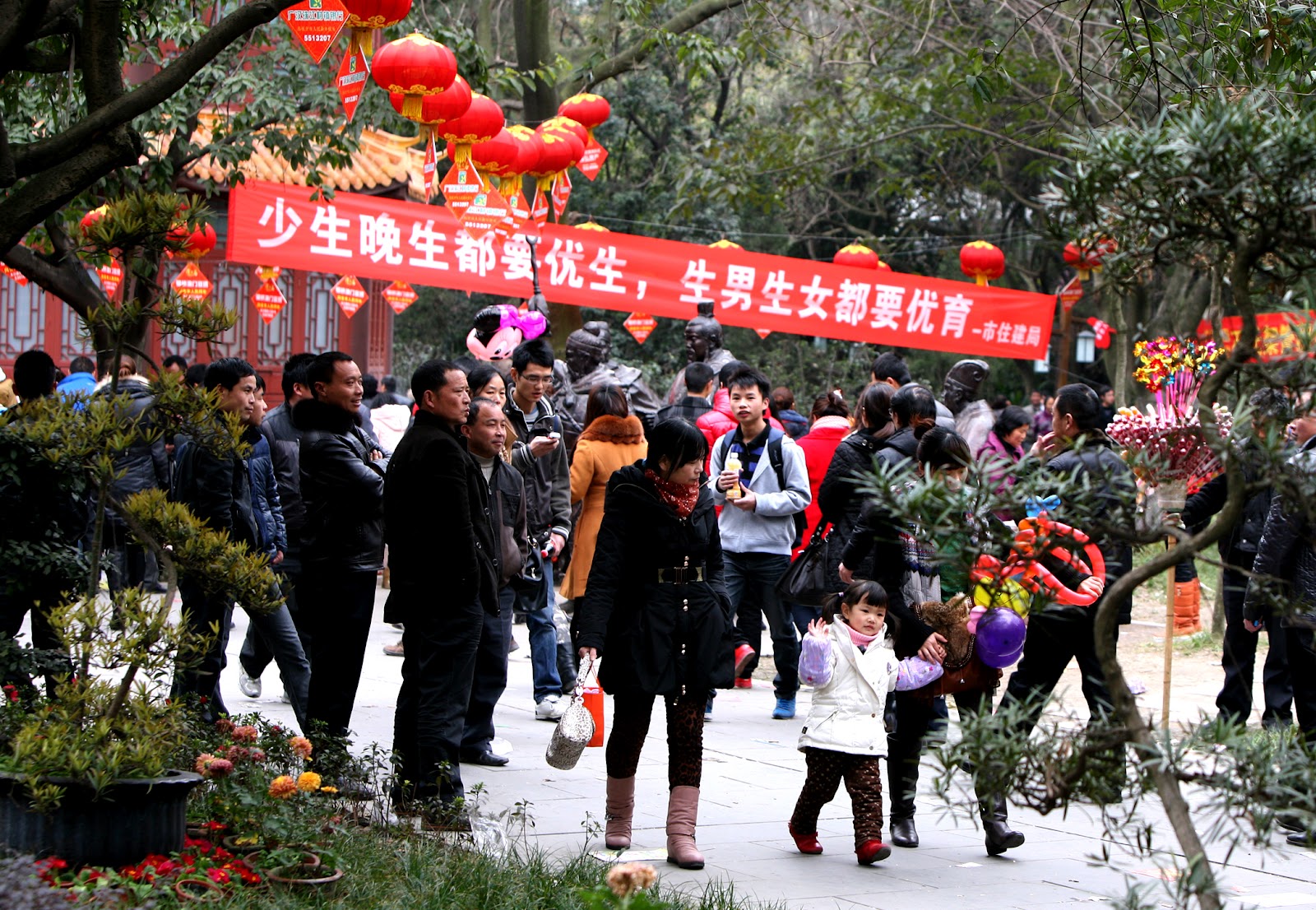
The TV crew that trotted alongside me first asked if I spoke Chinese. After I said yes the reporter asked a series of questions including what I thought of the event? I said it was really interesting and a lot of fun. I didn’t mention that I appreciated the irony in placing one of the government’s omnipresent slogan posters, a red banner with white lettering, immediately inside the park's entrance. It read: 少生晚生 都要优生 生男生女 都要优育 or very roughly, "Having fewer children is awesome and remember that having a daughter is just as nice as having a son."


Despite the festive atmosphere, some passersby actually put up a fight at being selected. I imagine this is because for the newly minted Chinese “godparents” this new relationship can actually involve a commitment of time and money. They're expected to occasionally telephone and check in on the child, or to give them small gifts each year. But for me, most of these expectations are lifted.

The "adoption" process was very simple: I gave my four-year old new relative a big hug and a simple gift (a lollipop) to cement the relationship, and then we were officially registered in the town's logbook. Another hug and that was that. Now I just need to think of Tang Ci Yan each year on 保保节. And I will.


Later that night when I was watching the news I learned that the man who paired me with Tang Ci Yan is a sort of professional dragger who makes money from relatives for finding a suitable candidate. Good to know that even the professionals thought I was a good catch. 

But the part of the news that I really wanted to see, I missed.

According to one of my teachers, once we were back in Chengdu she turned on the nightly news and there I was, being interviewed as I moved through the crowd. I was speaking Chinese and per her account I made no mistakes. Zero.

She went so far as to tell my other teacher that I had never spoken Chinese as well as this and that my tones were a lot less “weird” than usual. Yes, she actually used the Chinese word for weird: 奇怪. Coming from her this is high praise.


As for my new Chinese relative, the most important thing is that a big, strong stranger is thinking of her at least once a year and sending good vibes her way.


Happy 保保节 Tang Ci Yan!

11 September 2011

same old new


Adjusting to a new place is always a dance between the good and the bad. It’s about discovering how much you really like this, only to get slapped in the face by how much you hate that. Back and forth. Happy and hating. The main issue being that everything is different. All of it.

Take language. In a new place you can lose the ability to represent who you are via the spoken word. You find your voice lacks nuance and rhythm, and the things that come out of your mouth will never be confused with the perfect songs of sentences you used to love to say. You are well aware that saying, “This food is good” makes you sound like a second grader, except that unlike your standard Chinese second grader, you can’t even name the vegetables on the table.

And shoes? Even though you live with 1.3 billion other people who all need shoes – and who also produce the rest of the world’s shoes – there are no shoes in your size. (Or at least no women with feet as big as yours.)

The water? Don’t drink it. If you use it to wash your vegetables – along with soap because you really don't want to know how they fertilize crops in China – then after washing your vegetables with tap water, you have to wash them again with distilled water to wash off the tap water. Yes, I said wash off the water.


As for crossing the street? The walk sign says it’s your turn but don't be fooled. China's drivers have unanimously agreed to disagree on the rules of the road. So don't put a foot past the gutter until you've done an Exorcist-esque head spin to assess the likelihood of being run down. Look for trucks, bicycles, buses. And thousands upon thousands of deathly silent electric scooters.

Make sure there isn't a delivery truck barreling down the sidewalk or a taxi short-cutting its way up the wrong side of the road. And you wouldn't naturally worry about this, but you should also look out for drivers ignoring their own red light in order to turn left and force their way through oncoming traffic –  from the far right lane.

Amidst all of the new there is one thing that survives on the idea of staying the same: Starbucks. If you buy enough coffee (or if your awkward Chinese draws enough attention while you're there) there will come a day when the folks who make your mocha will see you coming and already know your order. And when they ask if you want your usual – that drink you could find in Seoul, and then went on to order in Washington, D.C., and now drink right here in Chengdu – it makes things feel a little bit normal. The no shoes and the don’t drink the water and the sounding like a second grader all take a back seat to the fact that this place is becoming your home. And you like it.

At least until you have to cross the street.

25 August 2011

miracle in chinese


I called the restaurant with my cell phone. I told the person who answered that I wanted these three things. I said I would pick them up. Then I went to the restaurant and picked up my order. It had these three things.

20 August 2011

mystery breakfast


This dumpling has something to do with vegetables. We know that because last Sunday morning when we said the Chinese word for vegetables to the lady behind the wall of steaming baskets, she pointed at the steaming basket with these dumplings inside. Then she packed some into a wimpy plastic bag.

The dumplings were awesome. Soft and savory. As for the actual ingredients, that's a real mystery. But it always is. Under ideal mealtime circumstances we're usually working with a best guess level of understanding. At worst we discover a secret Santa level of surprise. As long as you're free of allergies and not a vegetarian it usually works out ok.

18 August 2011

learning


We were taught how to play mahjong (麻将) a few weekends ago and it was fairly straightforward: memorize the pieces and what they’re called, learn how to arrange them in the proper groups. I can recognize and remember the pieces. And I know what I have to do. But I have no strategy, nothing that shows I organically understand what I’m doing. In other words, I know enough to sit down at the table but I don’t know enough to win. It’s like my Chinese. The real players, the born players, could easily run me over and take their win. But so far they just offer encouragement. It's the best kind of beginner's luck.

15 August 2011

how to say takeout (打包)


When you’re speaking Chinese in China you have to not mind blathering on in front of wide-eyed strangers all focused on you like you’re the one monkey at the zoo. You have to not mind because within that group of people is the one person who may eventually figure out the riddle of what you’re trying to say. When it starts happening you can feel the tilt of understanding tip in your favor: she’s crazy… she’s crazy… she’s crazy… wait a minute, I think she means fish-fragrant eggplant! And with that discovery the crazy evaporates and they invite you inside.

It’s a wonderful moment, and you have to work for it – and wait for it – because it doesn’t come easy. But once it does, once that communal light bulb goes on in all of your heads, the butchering of the language and the over-sized pantomime is worth it. You’ve communicated.


In fact, a few days ago I was standing outside a restaurant doing this very thing, and once the group of seven or so restaurant staff finally figured out I was trying to order take-out we were really rolling. It only took five more minutes, along with the help of a translation app on my iPhone and the restaurant's picture menu, to figure out what I wanted to eat. In my personal China this is defined as success – and I say that without a single note of sarcasm.

Once the food was ordered I was invited inside to wait while it was prepared. I’m convinced this is because at the time I was sweating more than anyone else in Chengdu and they were worried I might die. So I followed their suggestion and sat down in front of an air conditioner which they so nicely pointed right at me. I was presented with hot tea and one of the staff talked to me about how much he loves watching American wrestling. I understood at least half of what he was saying which by my current standards of communication is pretty awesome.

And the food… the food was incredible. The top layer of the crispy duck rice (脆皮糯米鸭) was perfectly crisped rice, below that was a chewier rice layer and at the very bottom was the rich bacon-y layer of soft smoky duck, with its crisped skin facing bottom. The fish fragrant eggplant(鱼香 茄子)was all sour and hot and sweet, with ginger, chives, pepper, and garlic swarming over silky eggplant, the flavors building to a molasses-tinged burn.

It’s these kinds of things – the guessing, the wrestling, the eggplant – that can really teach you Chinese.

22 July 2011

moving

Moving across the world is a fantastic and ugly adventure.

Fantastic for the opportunity to see, taste and live a whole new everything. Ugly because getting to that point is a long and exhausting haul. Along the way there are needles filled with vaccines and there is sweat because moving in July is ill timed, particularly for the folks who are tasked with dragging your sofa from one continent to the next.

Since your new home uses a new (to you) language there are months of Chinese flashcards, and in an effort to protect against culinary homesickness there are almost as many months of gorging on food favorites you worry won’t be the same where you’re going.

There is also an appointment for the root canal you’ve been avoiding, because as little interest as you have in getting an American root canal, your interest in relying on newly minted language skills to negotiate so much as a Chinese teeth cleaning is even less.

But in the mess of to-do’s and don’t-forgets the only true mandatory is momentum.

More than anything, it’s momentum that moves a life across an ocean. It shoves you past the pile of address changes. It keeps you at a trot through the visa applications. And it makes sure you get on the plane before it pulls away from the gate.

Then during your flight all of the hopeful preparations and small, singular steps come together into something so tangible that your plane lands you right in the middle of it. Later you can thank momentum for carrying you past the jet lag and smack into China.