Showing posts with label road trip. Show all posts

21 May 2014

somewhere else entirely


I’d been told that Guizhou Province was different. That I would notice something special about it.

Colleagues said wait until you get out in the countryside. Once you leave Guiyang you’ll see what we mean.

Guizhou is one of the poorest provinces in China as well as one of its most ethnically diverse but no one explained it this way. Instead they took pains to say that you would only understand once you were there.


It might be that when you arrive at a primary school the welcome committee is a group of schoolchildren cradling communal cups filled with liquor that should be sipped by all guests before entering the grounds.

It could be that the cook who is making your breakfast noodles takes a big swig of the broth in your bowl before slopping in more noodles and handing the steaming meal over to you.

And it might be that the various penalties for letting undocumented visitors into the village are fines that must be paid in foodstuffs rather than in RMB.


Yes, these might be ways you notice something’s different. 

But none of them bests coming to a dead stop on a mountain road because a man dragging a very long rope of live firecrackers is coming your way.


As the fire crackers bounce into the fields and smoke rises up around the car, waves of people in various aspects of traditional dress come forward and pass. There are children and adults and headscarves and rope lines and eventually a hulking wooden casket carried by the crowd.

There’s a body in there, my colleague says from the front seat. This is very special.


Yes, I nod from the back. Very special.


And the villagers continue down the side of the road. 

Slower-movers pull up the rear and we start to crawl forward again, our car tracing the path from where they’ve come. The pop-pop-pop of firecrackers quiets with the growing distance. Paper shreds mark where they have been and where the body has passed.

And this group, along with their deceased, continues down the side of the road making good use of an auspicious day for a burial.

I think I know what they mean when they say things are different here.

17 November 2013

Not the city

If you’re feeling frustrated with Chengdu you can leave it for an afternoon and come back feeling much better. Mainly because venturing outside of the city will remind you that things can be much worse. But also much better.


In the much worse category we can go ahead and list all of the ways that driving on mountain roads can take days off your life. What with the toddlers toddling into traffic or being fed their meals at the side of the road; the elder generations walking three abreast in the road – balancing oversized baskets, muddy hoes, or small children somewhere on their bodies; the barely-moving tractors dragging saggy lengths of rebar up the mountain; and a lone cyclist hogging the road back down – it’s not easy to get where you’re going.


There’s a lot of “Oh crap, did you see that?,” followed by “Oh hell, get your eyes back on the road.” In fact, leave the city for half a minute and you’ll realize that the outlying roads are marvelously un-conducive to driving. They take the surreal inconveniences of city driving and run them over. Twice. With a tractor driven by a five year old.


And while these roads may lead to where you’re going – in our case a mountain town called Shangli 上里 – you start to notice what they’re missing along the way. We couldn’t find a bank. Didn’t see a grocery store. Witnessed neither gas stations nor libraries.

We did see children scuttling in the dust with chickens, enormous tree trunks resting on their sides, and a family that happily fished a vegetable out of the gutter.


The farther you get from the cities, the harder life gets. It’s the unfortunate combination of more challenges met with fewer opportunities. And if you asked people what holds them back most in these places, I doubt they’d say the lack of a Starbucks. The most basic of services still haven’t reached these areas. A sidewalk would be a shock.

But you will also find things that the city lacks. There are streams and waterfalls and bamboo trees. There are mountain passes and rice fields and flowers drying in the sun. And parking lot attendants who step over to the field to explain to you that this is the countryside and that people who live here are farmers, all before guessing you are way younger than you are. “You’re just a little off,” I responded, “just a little off.”


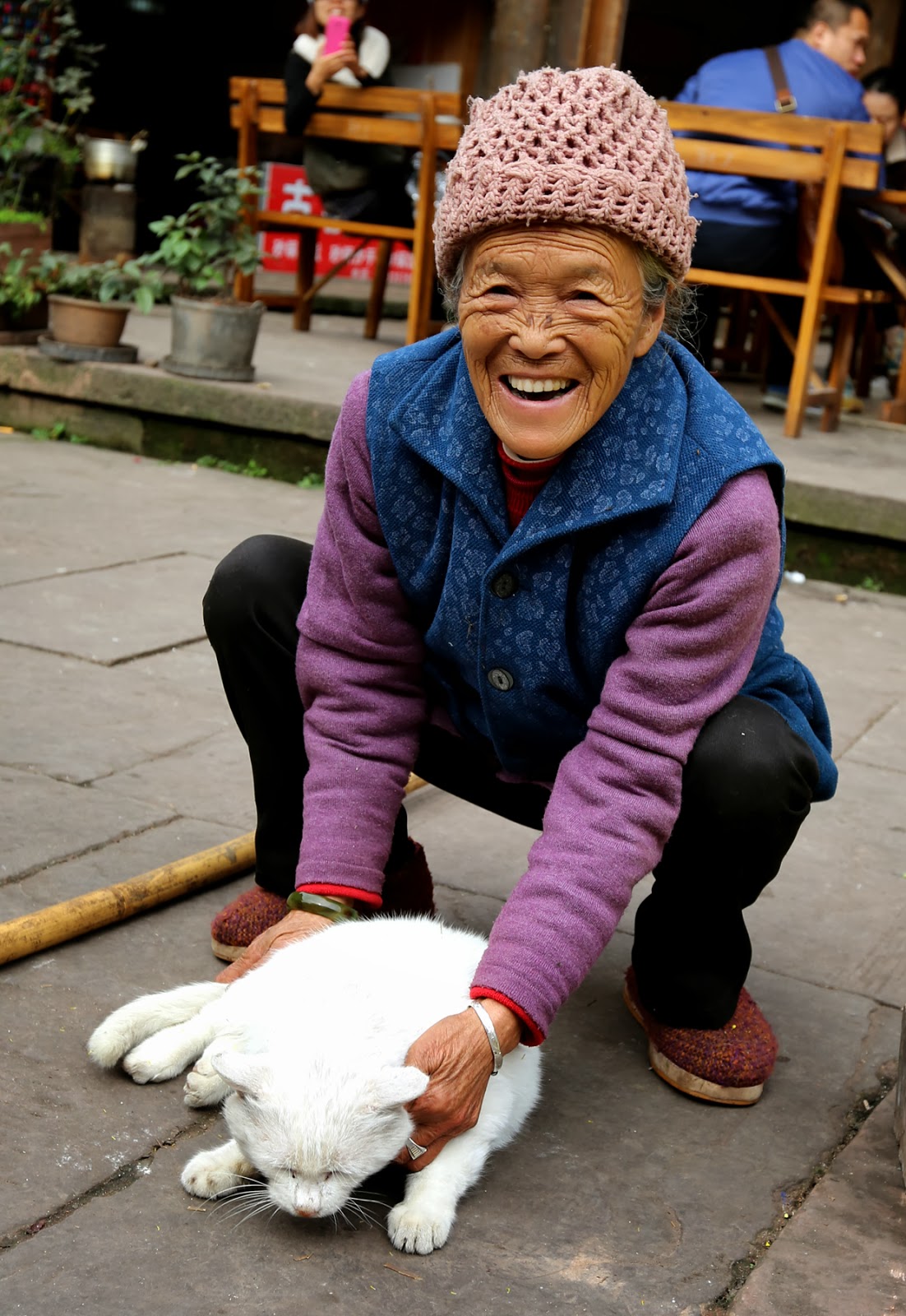
I wonder if he would have guessed the correct age of the cat laying next to the flowers in the main square. The lady tending the drying blooms lay her rake down to pet him, pulling his ears back and explaining he was twenty years old.


I say “he” but I have no clue whether it was a him or a her. In Chinese there may be different written words for him 他 and her  and it 它 but they are said exactly the same. So he is twenty and she is twenty and it is twenty.


And twenty may be the number of times Xiao GuaiGuai was held, photographed, or complimented by strangers... often with a single individual doing all three. Such a popular exhibit was this “big eyed” “precious” “doll” (all their own words) that it was hard to eat our noodle lunch without someone stopping by for a viewing. It happens in Chengdu too, but the smaller the place and the farther afield you are, the more akin to a rockstar a non-Chinese baby becomes.


I didn’t take any photos of foreign babies but I did get a shot of a babied dog. Whose owner in turn got a shot of Xiao GuaiGuai.


We were very happy with the noodles we happened to get for lunch. We ordered them because the people sitting at the table next to us had ordered them too. These noodles were the house specialty and they’d been thrown and swung before being deposited into a steaming cauldron of boiling liquid. They were then raised en masse and coiled into a bowl with leafy greens and fatty hunks of meat and la jiao 辣椒, the spicy pepper found in so many of Sichuan's dishes. Did we want la jiao? they’d asked while taking our order. As if we would say no.


There were some other questions posed to our table but they remained unintelligible on account of being asked in the local dialect. A few sentences the chef rattled at us in quick succession made no sense until he turned to the people at the other table and said, in perfect Mandarin Chinese, “they don’t understand.”  听不懂. We understood that.


And when the chef concentrated on speaking to us in Mandarin it seemed he was most eager to learn one thing: Why do we speak Chinese?


It was the first time I’d ever been asked that question. Usually people ask how we learned Chinese, or where we learned, or when. But never why.

I suppose the why is that we live in China. The why is that without Chinese we wouldn’t be traveling to small towns to see this country outside of its cities. The why is that when you can talk to people you can start to understand.

But it’s only a start.

(Next time I’ll remember to ask the gender of the cat.)

20 September 2013

road-tripping with Chinese characteristics


We can cross "road trip" off our Southwest China must-do list. 

As well as: "Decide against using gravel road with no guardrails to descend mountain." 

And: "Rely on gas station good samaritan to lead us to impossible-to-find highway."

Our caravan left Chengdu on Saturday morning and went 200+ miles to the Southern Sichuan Bamboo Sea in a not entirely direct manner due to a quick pass through the city of Neijiang. My visiting parents and our infant son had all begged to see Neijiang (not really) and when we took a wrong turn on the way to Zigong their dreams came true.

We might have turned back onto the correct path sooner had several advertised rest stops not been blocked off due to not being constructed yet. Note: Perhaps it would be best not to put signs on the highway announcing rest stops that don't exist. But then again I went on a Chinese road trip with neither a map nor a functioning GPS so maybe I'm not the best person to comment on travel management.

On our way to the forest we had lunch in Yibin with a table full of dishes that my parents really liked. And this brings us to the next item to cross off the list: Leave our own fork -- a fork that we had taken from our house that morning so my chopstick-impaired mother wouldn't starve -- at the restaurant. This meant that at subsequent dining locations we had the opportunity to mime the universal hand-sign for fork when the server didn't understand my Chinese. It's basically three fingers pointed downwards making a scooping-up or poking-at motion. Surprisingly the first reaction to this strange pantomime was rarely "bring customer a fork." Turns out I'm bad at both the Chinese language and charades.

When we finally got to the Bamboo Sea it was a rolling swath of dancing green. The name Bamboo Sea kind of gives you the idea but it still doesn't capture what it's like to have crawled slowly up a twisting mountain to look across the sky and see bamboo for miles. The road was a beautiful experience in and of itself. Ferns crawled the sheer walls and when the road wasn't clinging to the mountain it was running beneath an arched tunnel of lithe trunks that looked as if it they had always meant to connect in the middle. 

The paths up the mountain were slender and twisted and dotted with rocks, stray dogs, parked cars, slow moving bamboo trucks, and children. Drivers not infrequently swerved across the yellow line. Sometimes there was oncoming traffic and sometimes there was not. Thankfully we saw no accidents but this was after driving several hours on the highway so we were a bit desensitized to the state of Chinese traffic in general. When you've seen one truck driving with two other trucks on top of it, you've seen them all.

Back at the hotel we had a clown car kind of dinner where room service brought so many dishes, carried by so many people, that my parents reported there wasn't enough space in their room for either. When I finally got there (the server had raised her hand high above her head to ask my parents where the tall person who had ordered the food was) there was a platter of ramen noodles balanced on top of two plates of dumplings on a small coffee table. On the other side of the room the desk was supporting a bitter bamboo dish along with a greens and mushroom dish and a grotesquely large platter of rice. There was also a fork, a successful result of our earlier game of charades. 

The next morning there were giant horned beetles and stick insects in the parking lot. We walked over waterfalls and there were smoked ribs for sale along the wet hilly paths. There were rafts you rowed as a group using what can best be described as oversized croquet mallets. There was a man hiking the path with a small leather portfolio, orange loafers, and a fluffy dog. And there was the aforementioned gravel road which made my stomach sink as we left the park's east gate. All gravel. All steep. No guard rail.

We opted to perform a U-turn that required our car to drive to the edge but not over, and then all the way back through the park to the west gate where the road was slightly less rustic.

While lost in the outskirts of Yibin we experienced our first Chinese rail crossing sitting behind a manually-dropped gate as a long chain of rail cars slugged their way into view. Then they came to a stop. And sat there. And then faster than we could have imagined they reversed back from where they came and the gates went up.

At this point I should mention that on our side of the tracks the cars and scooters were lined up across the full width of the road. It looked like a one-way street. But it wasn't. And the other side looked exactly the same.

But when the gates went up it worked. I still don't know how, but everyone found their way forward. Traffic here is obscene and ludicrous and exceptionally dangerous but it flows and finds its way. And we found our way with it. (And managed not to lose the good samaritan scooter driver who had offered to lead us to the highway after we'd asked directions at the gas station where he was filling up.)

(Oh, and I had Xiao Guaiguai on my lap because we had incorrectly assumed there would be enough time to feed him as we waited for the world's slowest train. Wrong.) 

Coming back to Chengdu was fairly soul crushing. It was like returning to a lunar landscape that was dead and barren and in absolute contrast to the green depths we had just explored. Back in the city it was hard to even remember what we had just seen.

Which reminds me of one last item to cross off the list. "Avoid being bitten by humungous mosquitos in bamboo forest and bamboo forest hotel room only to get bitten inside own home within ten minutes of returning." 

Welcome back to Chengdu.

12 February 2012

my chinese family tree


It's true. I've acquired a Chinese relative.

As of Tuesday I’m tangentially related to a little girl named Tang Ci Yan. I don’t know where she lives, and I’m not super clear on which Chinese characters make up her name, but it’s all been recorded in the town register so I guess it’s official. Or at least as official as these sorts of holiday-driven-godparent-like-pseudo-adoptions of strangers’ children go.


There isn’t a parent in any country that doesn’t want their kid to grow up big and strong, to find their way to a long and prosperous life. And here in China, where by law most people are only allowed to have one child, there is a traditional holiday, 保保节, BaoBaoJie, that pairs children with strong-looking strangers in the hopes of drawing on that strength to give the child some additional life-long protection.


To become one of these “godparents” you have to travel to the one town in all of China that still celebrates the holiday with fervor --- 广汉 Guanghan. And fortunately for us, Guanghan is only an hour’s drive from Chengdu. So on Tuesday we drove over and went straight to the park where the event was being held.


Once you’re there, you find yourself walking through thick crowds that are multi-tiered and eyeing all of the prospective candidates like meat in a market. But don't assume that a person automatically gets to be one of these sort-of-godparents. It's not that simple. You have to be selected. Or more accurately put, you have to be dragged off by strangers.

A relative or a paid finder literally handpicks their target from the teeming crowd and drags them through the masses to meet the child. And in my case, as in all the others, as the dragging began, the crowds quickly parted to let us through. Then after we'd passed, the crowds closed behind us again with a near audible thud. All the while the man who had taken hold of my arm was yelling, “来了! 来了!” She’s arrived, she’s arrived.


This is probably the closest I will ever come to experiencing the insanity that comes with fame, the thousands of eyes trained on you, along with their cameras. There was a lot of excited shouting and I quickly learned that if I raised my hand, or gave a whoop, the crowd responded by ratcheting up their own hoots and hollers. 

I felt like I was on the floor of a stadium and the crowd was doing the wave, except that I was the one crossing the space, and the peak of the wave -- that cresting surge of standing and screaming -- never moved from the front of my face.


There is no way to accurately express what it feels like to have a wall of people part to let you through while at the same time pressing in to see you more closely. Along the way I was also pulled aside to hug children, was interviewed on camera, and took a photo with a man who told me this was the first time he had ever seen an American.

I didn’t see any other non-Chinese in Guanghan that day and when I walked down the sidewalk people would literally turn and stare. Even from across the street I could read their lips: 外国人. Foreigner. I was visiting the city with two of my Chinese teachers and one of them told me that after she had been separated from our group it was very easy to ask random strangers where the foreigner was. When she’d started to describe me further they would cut her off and say, "The foreigner went that way."

It’s exactly that foreigner aspect that made me an attractive candidate to “adopt” the little girl. And it’s the same foreignness that made the crowd hoot and holler. I could say I felt like a victorious gladiator before a roaring crowd, but I’m guessing I more closely resembled a dancing bear, or better yet, a unicorn – something rarely seen but said to have special powers.


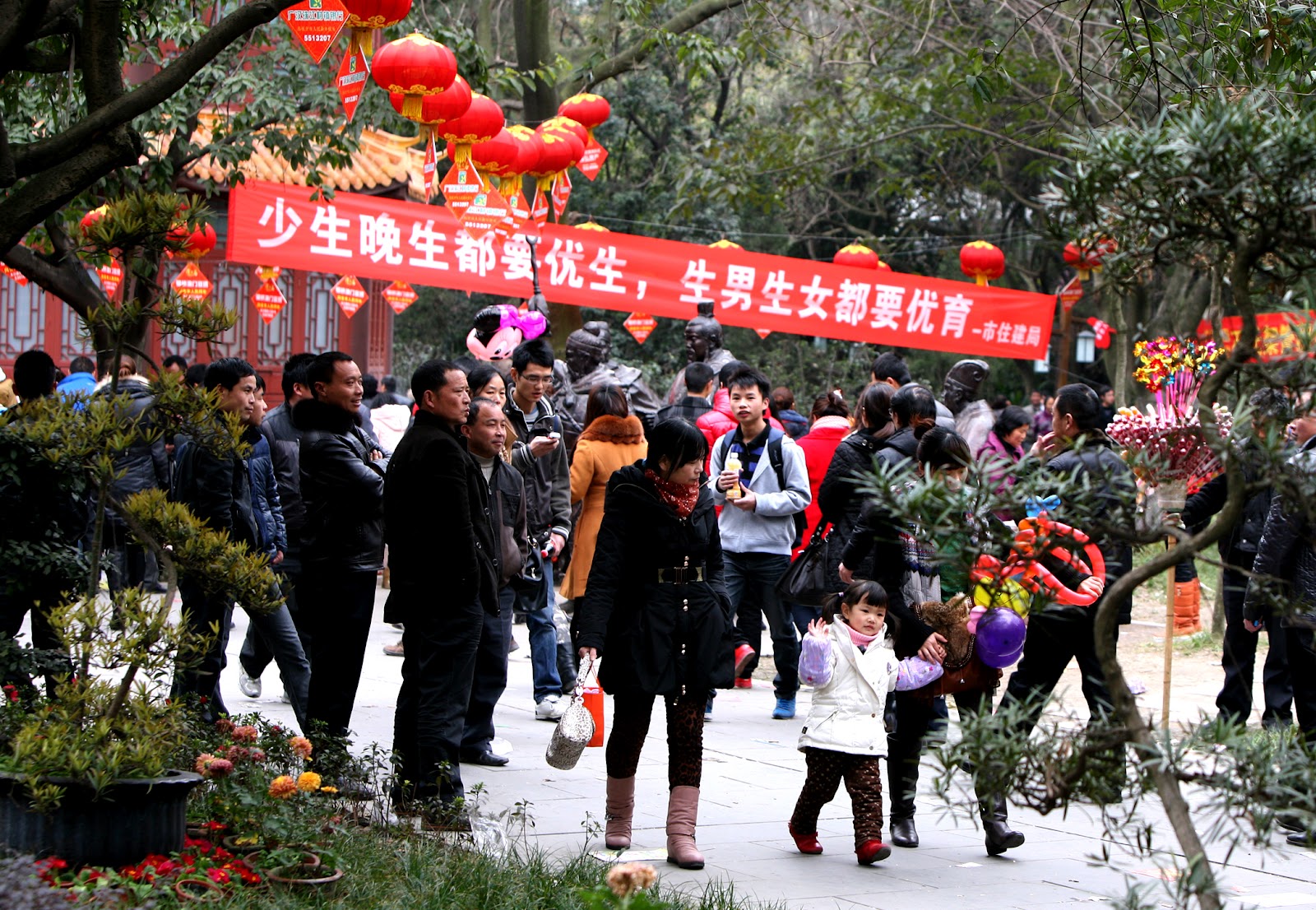
The TV crew that trotted alongside me first asked if I spoke Chinese. After I said yes the reporter asked a series of questions including what I thought of the event? I said it was really interesting and a lot of fun. I didn’t mention that I appreciated the irony in placing one of the government’s omnipresent slogan posters, a red banner with white lettering, immediately inside the park's entrance. It read: 少生晚生 都要优生 生男生女 都要优育 or very roughly, "Having fewer children is awesome and remember that having a daughter is just as nice as having a son."


Despite the festive atmosphere, some passersby actually put up a fight at being selected. I imagine this is because for the newly minted Chinese “godparents” this new relationship can actually involve a commitment of time and money. They're expected to occasionally telephone and check in on the child, or to give them small gifts each year. But for me, most of these expectations are lifted.

The "adoption" process was very simple: I gave my four-year old new relative a big hug and a simple gift (a lollipop) to cement the relationship, and then we were officially registered in the town's logbook. Another hug and that was that. Now I just need to think of Tang Ci Yan each year on 保保节. And I will.


Later that night when I was watching the news I learned that the man who paired me with Tang Ci Yan is a sort of professional dragger who makes money from relatives for finding a suitable candidate. Good to know that even the professionals thought I was a good catch. 

But the part of the news that I really wanted to see, I missed.

According to one of my teachers, once we were back in Chengdu she turned on the nightly news and there I was, being interviewed as I moved through the crowd. I was speaking Chinese and per her account I made no mistakes. Zero.

She went so far as to tell my other teacher that I had never spoken Chinese as well as this and that my tones were a lot less “weird” than usual. Yes, she actually used the Chinese word for weird: 奇怪. Coming from her this is high praise.


As for my new Chinese relative, the most important thing is that a big, strong stranger is thinking of her at least once a year and sending good vibes her way.


Happy 保保节 Tang Ci Yan!

chinese road trip scenery


Looked out the car window and saw this barreling down the road next to us. Definitely don't want to know where he's headed.

25 August 2007

sagra dei ceci


There are 20 regions in Italy. I'm happy to report that in two days we breezed through 7 of them, and stopped in a foreign country along the way. I'm not quite as happy to report that there was a whole 'lotta time spent in the car.

Our Italian road tripping was all in the name of the mighty cece; or as it's less elegantly referred to in english...the chickpea. Last weekend in the small Abruzzan hilltown of Navelli there was the Sagra dei Ceci, a multi-day celebration of the chickpea with an additional spotlight on saffron. Think children dressed in chickpea outfits, donkeys racing in dusty circles, and a menu focused on all things chickpea and saffron.

Getting there was a long haul taking nearly 12 hours. For a healthy chunk of that time we sat in beach traffic that crawled to a complete stop. But during moments of great excitement our car would begin to move, creeping alongside cars filled with beach balls and beach towels, and bored children antagonizing small dogs.

When we couldn't take another minute in the car we had a late lunch in another country. Really. We went to San Marino. It's a small republic in the mid/northwest of Italy that seems to exist solely for tourism and motorcycle racing. I'm not sure where they do the motorcycle racing that dominates their banners and billboards, but I sure didn't have a problem finding the tourists.

Before long we were driving through mountain tunnels cutting through the Abruzzan hills. One tunnel was over 10 kilometers long and it was a few kilometers into this tunnel that our driver felt the need to tell us about the time his car exploded into a wall of fire midway through New York's Holland Tunnel. A wall of fire you say? In a tunnel? Thanks a lot.

A childhood friend of our friend lives in Navelli so we had a very warm welcome from the start. And despite it being a very small town (population 625) we spent healthy amounts of time meeting the locals and eating chick peas with them. (After they'd spent all day cooking and preparing the food.)


We ate in a large piazza filled with plastic chairs and tables that slowly filled to capacity as nightfall came. Eventually, each table was heaped with plates of food and plastic tumblers of wine. All foods featured either chick peas or saffron or were some version of a local favorite. Chick pea soup. Chick pea pasta. Chick peas toasted in sugar. Saffron risotto. Pasta with saffron cream. Porchetta. And grilled lamb. And salsiccia after 6pm.


Children ran around and the band played late into the night. It was a street party at its best. And it's also the first place we've seen a scorpion in Italy. Come to think of it, it's the first time I've ever seen a scorpion outside of a cage. And you'd better believe we checked under the pillows that night before going to bed.


Part of Navelli is built into the hills and when you follow the rising and curving maze of pathways, you find homes damaged and deserted during World War II. Bombed out and never re-inhabited, their interiors are overgrown with grass and weeds. Crumbled staircases are carpeted by brush and rise to second floors defined by walls with gaping holes. And some floors have just tumbled away, leaving behind their skeletal supporting beams to bleach in the sun.

You find chickens pecking at the dirt and tall white geese stretching their necks in the dark shadows. But turn in another direction and you wander towards residences where life goes on, where there's the smell of roasted peppers on the breeze. And the locals and artists who keep this place alive peek out of their beaded curtains to check on the strangers.


All the while, staring back from the the crest of hills facing town are the remains of a burned forest. Like a donkey's ragged mane they stood black and scratchy against the blue sky. Only weeks ago the hills had gone up in flames. And the flames had poured down the hills and rushed the town. They were stopped, but not before damaging the forests where the festival was traditionally held. This year's Ceci Festival became not only a way for the town to come together but also an opportunity to raise money to restore what was lost.

Our Sunday lunch was too good to be true. We ate at the home of our hosts. There were eight of us around a long table, with a checked cloth laid between us. There was lasagna al forno made by Nonna (Grandma). And grilled eggplant in olive oil made by Nonna. And a soft chocolate cake made by Nonna. And I was sitting next to Nonna and she kept saying to me, with true desire in her voice, "Mangia! Mangia!" Eat! Eat!
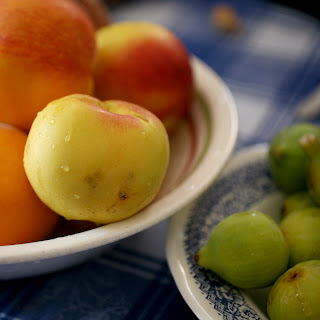


And Nonno (Grandpa) was hard of hearing so people had to shout, "Nonno! Do you want mortadella?!" And of course he did. And when the fruit came, after the mortadella, it was the sweetest softest fruit I've ever had. It was laid out in colorful piles, with water still clinging to the skins. The peaches were bright apricot inside and the figs were so soft that they nearly poured out of their skins. And the watermelon was a delicious round of heavy wet fuschia.

Oh my, si mangia bene a Navelli.


After lunch we sat on kitchen chairs alongside the house as the wind rushed by. We were told that the wind comes up like that every afternoon. There was a tiny kitten tripping through the flower beds; its mother a sleek Siamese that couldn't care less. And when we tried to feed the chickens, they didn't want our watermelon rinds.

Nonno showed us his storeroom and the sacks of almonds collected from his daily walks. There were laundry lines hung with drying onions next to buckets of chicken feed. And pointing at the gnarled piles of firewood, we found out that Nonno cuts all of that timber himself.


Sunday afternoon's celebrations started with the town children dressing in traditional red and white garb, their costumes edged with dried chickpeas that had been delicately sewn into place. They carried baskets of chickpeas and waited with the rest of the town until a group of donkeys and their riders arrived in the piazza. We then followed the donkeys down through the town until we all arrived in a dusty field.


The Palio was held in a field where any remaining shrubs had been trampled by the crowds. Modeled after the world-famous horse race run in Sienna's main piazza, this was on a smaller and more humble scale. Several donkeys, coached by a rider and a guide both dressed in satiny renaissance ensembles, would run a three lap race. However, to say "run" implies an urgency not shared by the donkeys. For the most part they rambled their way along and ignored the imploring shoves and shouts of their riders. Use this link to view footage of the race: http://ilcentro.repubblica.it/multimedia/home/1079994

As shown in the video above, a winner was eventually found and the crowd was pleased. We then all made our way back to the main piazza to celebrate the winning donkey, the ceci beans, and the fact that summer in Italy is a fine thing.

The way back to Milan took 7 hours (7pm-2am) and featured not only a perfect view of the Big Dipper from the backseat, but a rest stop with a steely Doberman Pincher in addition to the usual overpriced gas. (Note: a tank of gas these days goes for about 60 euro = $89.)

But that 60 euro does get you a breeze-by tour of the big names of Italy: Rome, Florence, Bologna, Milano. We just kept following the highway signs from one big city to the next in the hopes that their lack of beaches would also mean a lack of returning-from-the-beach traffic. Unlike on the way there, we didn't even need a map.

All we needed was more of Nonna's grilled eggplant in olive oil. And guess what... she'd packed us some before we left and insisted we take it along. I guess the motto of Italian grandmas (Mangia! Mangia!) applies even in moving vehicles.