Showing posts with label noodles. Show all posts

17 November 2013

Not the city

If you’re feeling frustrated with Chengdu you can leave it for an afternoon and come back feeling much better. Mainly because venturing outside of the city will remind you that things can be much worse. But also much better.


In the much worse category we can go ahead and list all of the ways that driving on mountain roads can take days off your life. What with the toddlers toddling into traffic or being fed their meals at the side of the road; the elder generations walking three abreast in the road – balancing oversized baskets, muddy hoes, or small children somewhere on their bodies; the barely-moving tractors dragging saggy lengths of rebar up the mountain; and a lone cyclist hogging the road back down – it’s not easy to get where you’re going.


There’s a lot of “Oh crap, did you see that?,” followed by “Oh hell, get your eyes back on the road.” In fact, leave the city for half a minute and you’ll realize that the outlying roads are marvelously un-conducive to driving. They take the surreal inconveniences of city driving and run them over. Twice. With a tractor driven by a five year old.


And while these roads may lead to where you’re going – in our case a mountain town called Shangli 上里 – you start to notice what they’re missing along the way. We couldn’t find a bank. Didn’t see a grocery store. Witnessed neither gas stations nor libraries.

We did see children scuttling in the dust with chickens, enormous tree trunks resting on their sides, and a family that happily fished a vegetable out of the gutter.


The farther you get from the cities, the harder life gets. It’s the unfortunate combination of more challenges met with fewer opportunities. And if you asked people what holds them back most in these places, I doubt they’d say the lack of a Starbucks. The most basic of services still haven’t reached these areas. A sidewalk would be a shock.

But you will also find things that the city lacks. There are streams and waterfalls and bamboo trees. There are mountain passes and rice fields and flowers drying in the sun. And parking lot attendants who step over to the field to explain to you that this is the countryside and that people who live here are farmers, all before guessing you are way younger than you are. “You’re just a little off,” I responded, “just a little off.”


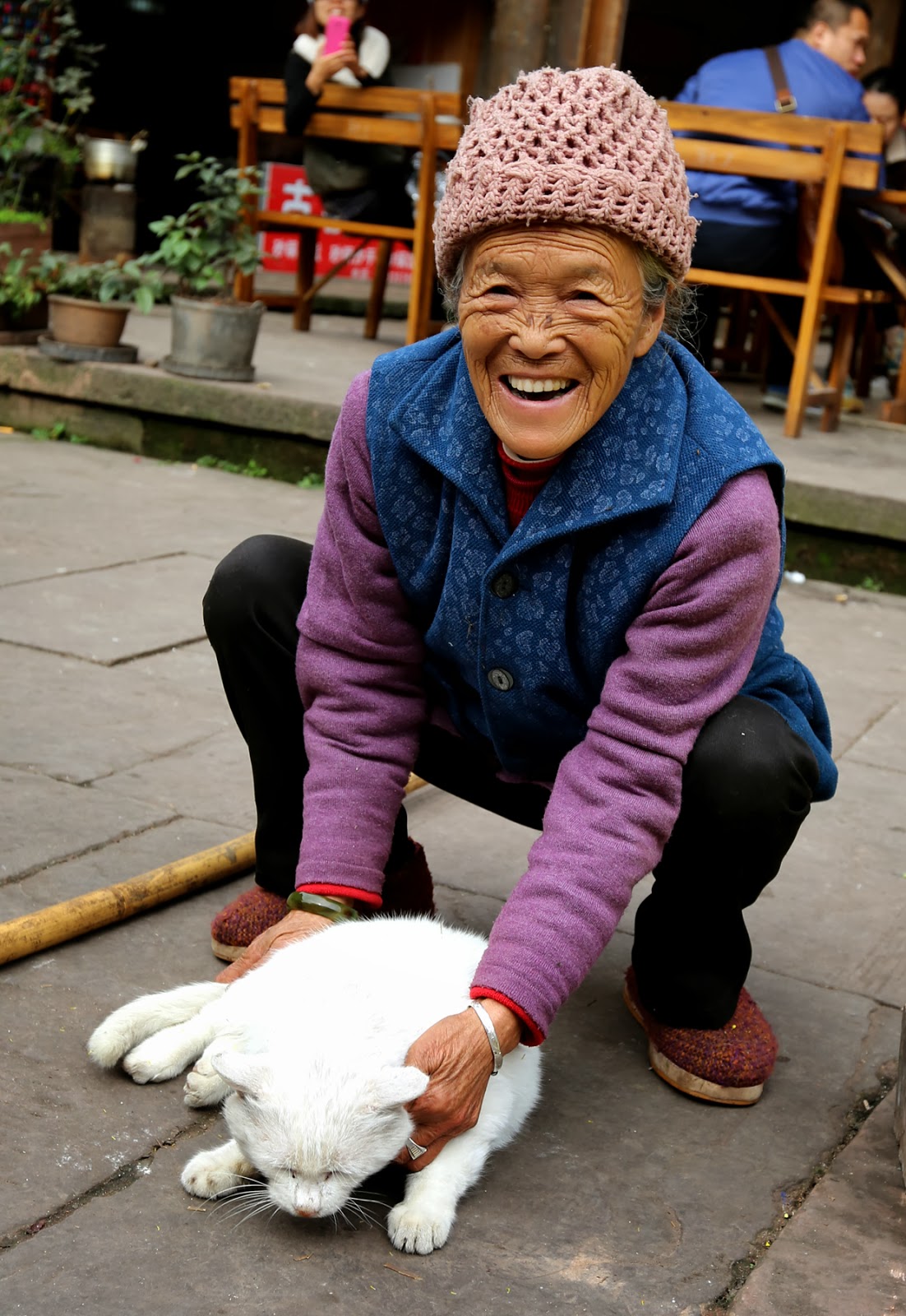
I wonder if he would have guessed the correct age of the cat laying next to the flowers in the main square. The lady tending the drying blooms lay her rake down to pet him, pulling his ears back and explaining he was twenty years old.


I say “he” but I have no clue whether it was a him or a her. In Chinese there may be different written words for him 他 and her 她 and it 它 but they are said exactly the same. So he is twenty and she is twenty and it is twenty.

And twenty may be the number of times Xiao GuaiGuai was held, photographed, or complimented by strangers... often with a single individual doing all three. Such a popular exhibit was this “big eyed” “precious” “doll” (all their own words) that it was hard to eat our noodle lunch without someone stopping by for a viewing. It happens in Chengdu too, but the smaller the place and the farther afield you are, the more akin to a rockstar a non-Chinese baby becomes.


I didn’t take any photos of foreign babies but I did get a shot of a babied dog. Whose owner in turn got a shot of Xiao GuaiGuai.


We were very happy with the noodles we happened to get for lunch. We ordered them because the people sitting at the table next to us had ordered them too. These noodles were the house specialty and they’d been thrown and swung before being deposited into a steaming cauldron of boiling liquid. They were then raised en masse and coiled into a bowl with leafy greens and fatty hunks of meat and la jiao 辣椒, the spicy pepper found in so many of Sichuan's dishes. Did we want la jiao? they’d asked while taking our order. As if we would say no.


There were some other questions posed to our table but they remained unintelligible on account of being asked in the local dialect. A few sentences the chef rattled at us in quick succession made no sense until he turned to the people at the other table and said, in perfect Mandarin Chinese, “they don’t understand.”  听不懂. We understood that.


And when the chef concentrated on speaking to us in Mandarin it seemed he was most eager to learn one thing: Why do we speak Chinese?


It was the first time I’d ever been asked that question. Usually people ask how we learned Chinese, or where we learned, or when. But never why.

I suppose the why is that we live in China. The why is that without Chinese we wouldn’t be traveling to small towns to see this country outside of its cities. The why is that when you can talk to people you can start to understand.

But it’s only a start.

(Next time I’ll remember to ask the gender of the cat.)

04 July 2012

new noodles


This city loves noodles almost as much as it loves tea. And Chengdu looooooves tea. So walk through any neighborhood and you’ll readily find – wedged in with the vegetable shops and the hair dressers and the guys selling who-knows-what – lots and lots of noodle shops. If you live here and you like noodles, it’s easy to be happy at lunchtime.

It’s equally easy to lose track of all of the places you see once by chance and want to eat at later. Our version of this “looks good, need to go back” list grows daily and today we happily sought out and crossed off a noodle shop that was recently added to the list.


This was the first noodle shop we’ve seen where they press the noodles to order. For each bowl, the noodle guy jabs a wad of dough into the press and then lays on the handle until noodles come out of the other end and drop into the water. A lady behind the machine then fishes them out with a wicker strainer and their journey to spicy goodness begins. They’re also a different kind of noodle than we usually see; with their nutty taste and color we’re guessing they're some version of buckwheat.


The noodles that came to our table were swimming in a spicy red pool and flecked with bits of celery and assorted green stems. We liked the noodles but the surprise of the meal was what the guy across from us was eating.


We had noticed them waiting in the steamers out front, but only after seeing them at our table were we temped to get our own. We got two of the soft white orbs and discovered they are filled with pork and delicious. The outer skin is difficult to explain – soft, chewy, and unexplicably reminiscent of cheese. Actually the whole thing is like a mountain delight you would find waiting for you back in town after a hike through the Alps. This means they’re awesome. Really, really awesome.

So we ate the two we ordered and then we ordered two more. This was after we had finished our noodles and a miniature loaf of some kind of rice bread that tasted like brown sugar or beer or something soft and fermented. These had also been lined up in the steamers out front.


A woman who later sat down at our table told us we should buy more of the meat-filled orbs for dinner; just heat them up in the microwave, she said, and they'd still taste great. She also told me to take the oscillating fan next to our table and point it at myself so I wouldn’t be so hot and sweaty. This lady has a lot of good ideas.

So, overall – with the great food and the wise table-mates – today’s visit was a solid success. One down, so many more to go.

04 February 2012

in expert hands


They call it an alley but it’s really just a small stretch of street so crammed with bicycles, and cars, and random people who’ve stopped to sell one kind of fruit or another, that the already small space narrows into something smaller and more intimate. The alley is really a neighborhood, a trillion-celled organism that thrives in the heart of a giant city, and both sides of this stretch are relentlessly packed with restaurants ranging in size from small to tiny.

It was raining when we went there for lunch this week. We were walking through something between a fine mist and heavy drops and we just kept walking until we almost reached the end. This is where you find the restaurant that Shi-wen came home talking about last week.  

We sat on plastic stools and ordered off the menu on the wall. Or better said, we asked the 10-year old server some questions and listened as his mother yelled answers from the kitchen. Together they figured out what the foreigners wanted and then brought the plates to our table.

I absolutely got what I wanted: 辣面, spicy noodles, the foundational fast food of Sichuan and of my lunches. I eat them so often that I’m used to explaining to waiters and restaurant owners that despite being a foreigner I somehow still manage to eat spicy food. And because we foreigners are still so memorable here, and because I have a habit of going back to the same places, I find it both kind of charming and kind of alarming how quickly the staff at these places remember me and what I like to eat. They see me and ask, “Spicy noodles?,” and I nod, yes. And if there is someone I don’t know working that day, any person I do know will automatically pre-empt the inevitable question, telling their colleague that yes, yes, this foreigner does eat spicy food.

It could just be me but I find people here to be friendly and warm, especially when you’re obviously in need of Chinese attention. Like when I was trying to mix up my noodles in the alley. My efforts caught the attention of the waiter’s mother, the cook, who was already interested in me because I was one of those peculiar foreigners who take pictures of their food. 

As I was mixing up my noodles she stepped in and told me that I needed to do a better job. I needed to whirl that pile of deliciousness sitting on top of my noodles into the depths of the pile. In essence, I needed to be able to use chopsticks, and use them to manage multiple meters of noodles, with much more finesse.


But there was a better solution. She took my chopsticks from me, and standing beside our table made what can only be described as beautiful love to my noodles. She carefully stretched them, rolled them, lifted and spun them. Her rhythms were regular with occasional surges, and I’ll be damned if by the time she was done those noodles hadn’t been transformed, each length now coated in its own beautiful cloak of spice and meat. "See," she said, "every noodle now has the flavor."

And they did. They absolutely did. Every bite was what she promised, a balanced mix of spice and salt, with slashes of cilantro and nut. And after I told her how much I loved them she returned to the kitchen, satisfied. We were then left alone to eat while her waiter ran around out front with another kid. At one point the two boys were tossing a coin back and forth and it found its way into the hood of my coat before tumbling onto the floor. The boy apologized, and through my noodles I garbled, “没关系,” no problem.


This is exactly what I like about these places. They’re normal. But they’re a different kind of normal. A normal I’d never before been a part of, but that’s now just down the street. Chengdu normal.

19 June 2008

when in seoul...


When you're roaming around the market on a Sunday afternoon and notice leaning towers of silver noodle bowls rising out front of a packed restaurant it's not difficult to choose a place for lunch. In fact walking past this crowded establishment immediately triggered our trip-wire for eating well around the world: look for locals eating - and then eat there.

The only caveat with this method is that you've got to be ready to go whole hog because when you walk into a place like this, you're walking into a different reality. You're not only going to be eating with the locals, you're going to be eating like the locals. This means zero accommodation for the things you're used to where you're from. And that, my dear friends, is exactly the reason you're here.


You're here to climb the thin staircase to the second floor, take off your shoes, and discover that unlike downstairs there aren't tables and chairs, there are only tables.

You're here to sit on the floor. Which in turn means you're here to keep shifting your body weight around until you can find a position in which your legs, or your feet, or your bottom - or some combination thereof - does not go immediately numb.


You're here to order by pointing at photos on the walls, or food on other people's plates, and then hope that the meal you've gesticulated at and nodded for, actually tastes as good as it looks.

You're here to use a set of chopsticks for your noodles, a spoon for your soup, and the scissors for anything that's too unruly to be tamed by either the chopsticks or the spoon.


You're here to clean your face and hands with thin napkin squares that you find in a bunch on the floor, and throw your garbage in a small pail that just barely fits under the table.


And not only do you get to do these things but you also get to eat the best food on offer, like cold chewy noodles with cucumbers and spicy sauce and a hard-boiled egg on top. You get to slurp the noodles and drink water out of cold metal cups and sit in your socks on the floor. And you get to pretend - for just a moment - that you, of all people, know the best places to eat in Seoul.