14 November 2006

budapest for the weekend


Budapest receives two thumbs way up for it's excellent role in our three-day weekend. The city is gorgeous and in November happens to be fairly devoid of tourists. The wind whipped a little and there were a few raindrops on the way home from our shockingly good Mexican dinner (more on that later) but there was no reason not to be enjoying this fine city along the Danube, in the midst of fall. With autumn colors in the trees and leaves blanketing the sidewalks, Budapest had the November personality that we really miss about Chicago.

The easiest way to describe Budapest is that it is at once cosmopolitan and charming. The Pest side of the river is replete with shopping and stature, Parliament and politicians whereas the Buda side has a castle and cobblestones, coves and corners. Both share the Danube, a gorgeous force of nature shooing boats through and catching light in its rivulets. Crossing the river on one of the many bridges gives not only picture-perfect views of the historic buildings clustered at its edges but also a sense of the current, the speed, and the energy this river possesses.


Little did I know that Budapest is also renowned for it's pastries. I dare say that had I been aware of this small piece of information earlier, things might have been different. But we made up for lost time and sampled a sweet array of delicious creations. The Hungarians don't seem super keen on moderation and their pastries bear the brunt of these leanings - chock full of creams and fillings and marzipan and more. And they are marvelous. Was my favorite the chocolate torte or the marzipan cake? But what of the cheese strudel that fell into the category of fine art? It's like trying to choose your favorite gelato flavor - impossible.


We spent our afternoons not only in bakeries and coffee shops but also in dramatic churches and eye-opening museums. While not nearly as dour as the Museum of the Occupation in Riga the Hungarian National Museum lets it be known that Hungary's history had its periods of great difficulty and terror - but is also filled with examples of the country's long history and culture. The Parliament was closed to the public for the month of November so we were only able to admire it from the outside. And there is much to admire - it sits on the shore of the Danube, stretching in epic proportions and spiking upwards with towers of artistic grace.


There was a large market full of overpriced paprika, stalls of fruits and vegetables, salami and cuts of meat, and upstairs there were stalls selling prepared dishes. We found excellent Hungarian food, doled out in plastic bowls and reheated in the microwave. Go ahead and laugh but it was fabulous ghoulash, and honey chicken with noodles -- all eaten in the midst of little old ladies and other tourists and working men who dined quickly alone. Sometimes food tastes better without the pretense of table clothes and comfortable chairs.

I should also give credit where credit is due and unequivocally state that between Milan and Budapest the award for best Mexican food goes to Budapest. We had an excellent meal at a restaurant called The Iguana, replete with chips and salsa, tacos and burritos. And while in my past life I would have been embarrassed to say that I went purposefully for Mexican food while visiting Hungary, in this life I consider it a victory. Oh, Italians - why don't you understand the dining joys of Mexico? But I digress.


The Hungarian National Gallery is gigantic and full of Hungary's greatest pieces. It sits high above the Danube, looking out on a wonderful view of the Pest side of the river. Up here is also where Matyas church can be found, with colored tiles peppering the roof. And the Fisherman's Bastion, a series of white towers overlooking the river. This is the area of the cobblestones and cozy cafes - and a giant eagle statue that is more than a bit daunting. You can also easily get up to this area on foot; the Funicular seems like the easy answer but at $5 a pop you might as well take the stairs and make up for the non-stop pastry fest that you've found yourself celebrating.

Other recommendations: if you're leaving town at the end of the day - say 8:00pm out of Bergamo - be sure you get on the shuttle to the airport early. We spent more time on the bus trying to get to the airport than we did on the actual plane. We were shocked that the busload of Italians stayed so calm. Turns out they knew something we didn't: all you have to do is get yourself checked-in and then the plane is basically going to have to wait for you to haul your butt up to the gate, no matter how much you dawdle. People who were on the same shuttle bus as we were, and arrived at the check-in at the same time we did, somehow got lost in a time warp and didn't make it to the plane until about 20 minutes late. But rest assured, the plane will wait for you. So please feel free to grab that extra piece of pizza you were eyeing on your way to the security screening line. We can wait.


But overall, it was gloriously easy to visit Budapest. Just a short plane ride away, it's a cultural jewel that we would have loved to have a few more days to explore. And next time we'll bring our bathing suits so that we can go to the famous thermal baths. And we'll bring our bushel baskets of cash so that we can stay in the Four Seasons which sits in arguably one of the most gorgeous buildings on the Danube. And we'll remember that smoking is still allowed in public places in Budapest so we'll be prepared to absorb a fair amount of secondhand smoke. And there's got to be another Mexican restaurant somewhere in Budapest, right? Maybe we can find that too.

07 November 2006

too good


Hot chocolate in Italy is different. Very different. The Italians have taken the phrase very literally and instead of dissolving powder in a cup of water they've gone ahead and actually melted chocolate and put it in a cup.

Hot. Chocolate.

Sunday morning breakfast in Alba consisted of a pastry and a cup of hot chocolate. It was like drinking a chocolate cake. You know those molten tortes that are all the rage these days? Where one nudge with a fork causes the cake to ooze chocolate lava. Well, Sunday's hot chocolate was a lot like that. Except it was in a cup and you were supposed to drink it.

The feeling was sinful. And decadent. And very very right.

When you swirled your spoon in the cup, it was like steering through a silky pudding. It was your own personal cup of warm velvety cake batter - without the raw eggs your mother warned you about.


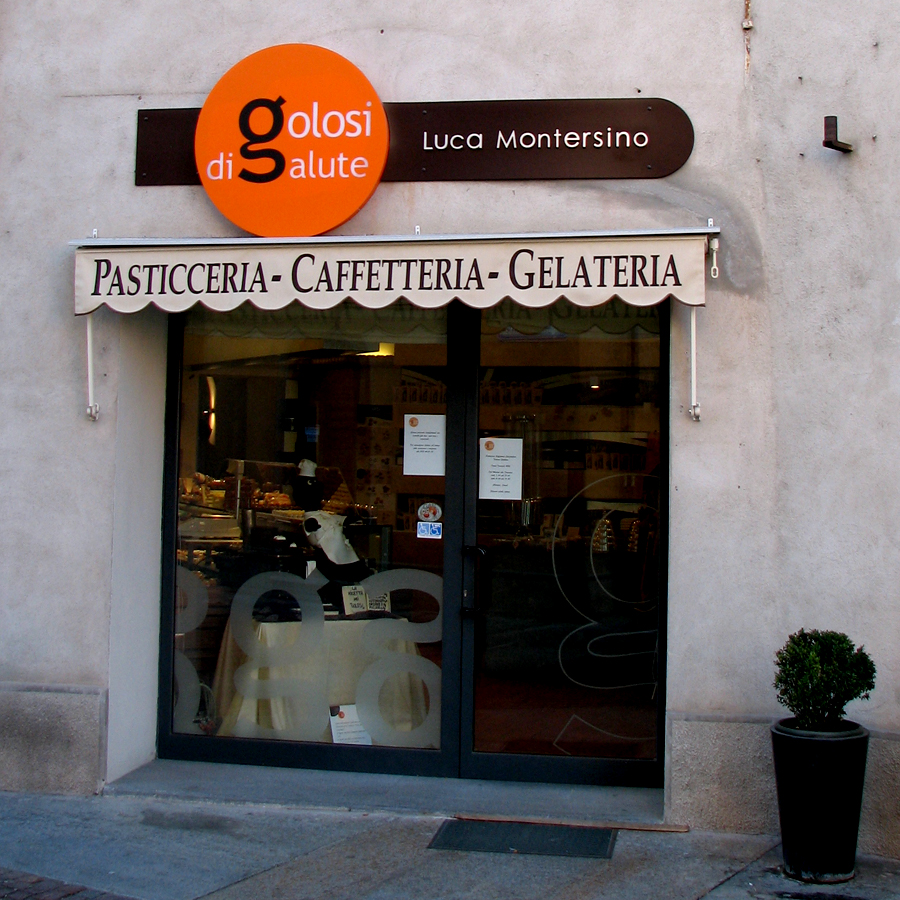
The shop itself is rather new - the owner's wife told us they'd been there for about a year - so you won't find it in the tourism guides. But it's still filling up with people which shouldn't surprise anyone. Saturday afternoon it had been so packed with adoring fans that we couldn't explore as much as we'd wanted. There's a full chocolate shop and bakery overflowing with all manner of sweet delights and a small café in the back. And it's in the perfect location right behind the Duomo.

But when we got there on Sunday morning there was just one other gentleman reading the paper over coffee. And eventually the owner's wife and daughter came in and we got to talking. Talking a little about her family in America. About our family from Italy. Chocolate. Her happy daughter. Life in Alba.

It was a nice conversation. And a nice pasticceria. And a cup of hot chocolate so nice that neither of us could get to the bottom.

Golosi di salute
Piazza Rossetti, 6
12051 Alba (CN)
www.golosidisalute.com

06 November 2006

alba is food love


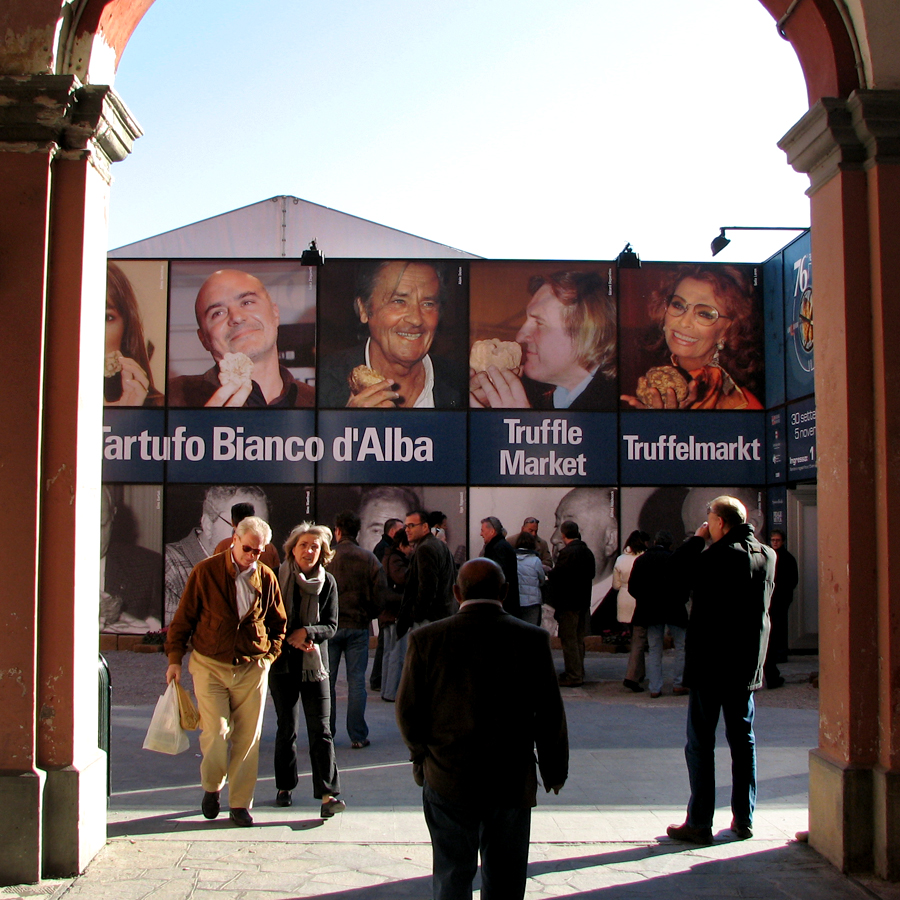
I can't blame the wine - even though we did start drinking shortly after ten in the morning. I can't blame the cheese - even though we sampled enough varieties to seriously harm those allergic to milk. And I can't blame the flourless hazelnut cakes - even though we must have had about five different versions. Our new love for Alba cannot be blamed on one single aspect of the city - no - it must be blamed on all aspects, every single one. Not the least of which was the White Truffle Festival, which from September 30 until today combined all that is glorious about Piemonte's Langhe region into a series of festival halls.

How to begin? Well, first you pay one euro. Just one euro to enter a place that smells more than a little like bad breath. Bad breath, you say? Why would I pay to go in there? Oh, my friend, you will go in there and you will love it. You will marvel over the fact that it was just 1 euro to enter. You will stay there for several hours, wandering the halls, eating and drinking. And when you can finally bring yourself to leave you will roll yourself out with multiple shopping bags in hand, filled with food and wine. It's dangerous... this truffle festival. But it's also divine.


On the map the city of Alba looks fairly close to Milan. And I suppose it is; if you have a car. We took the train and arrived in about three hours, after taking three trains and following what might be kindly-termed a circuitous route. It was more than worth it, though, and as dawn broke we watched wine fields climb the sides of rolling hills, and fall colors sweep across our path. It was gorgeous. And gave us plenty of time to ponder the question of why there's not a more direct route. But I digress.

I'm convinced that I had never been in the presence of a truffle before. Chocolate truffles, yes, I've eaten my share. But truffles that a dog found in the ground? Nope, never. So I didn't know that the smell we came across when we entered the festival was the smell of hundreds of fresh truffles, all of which had been extricated from the ground by skilled truffle-hunters and brought to this market to display and to sell. And I'm sorry, but it's true. The magical fungus that costs obscene amounts of money smells a bit like muted garlic breath.


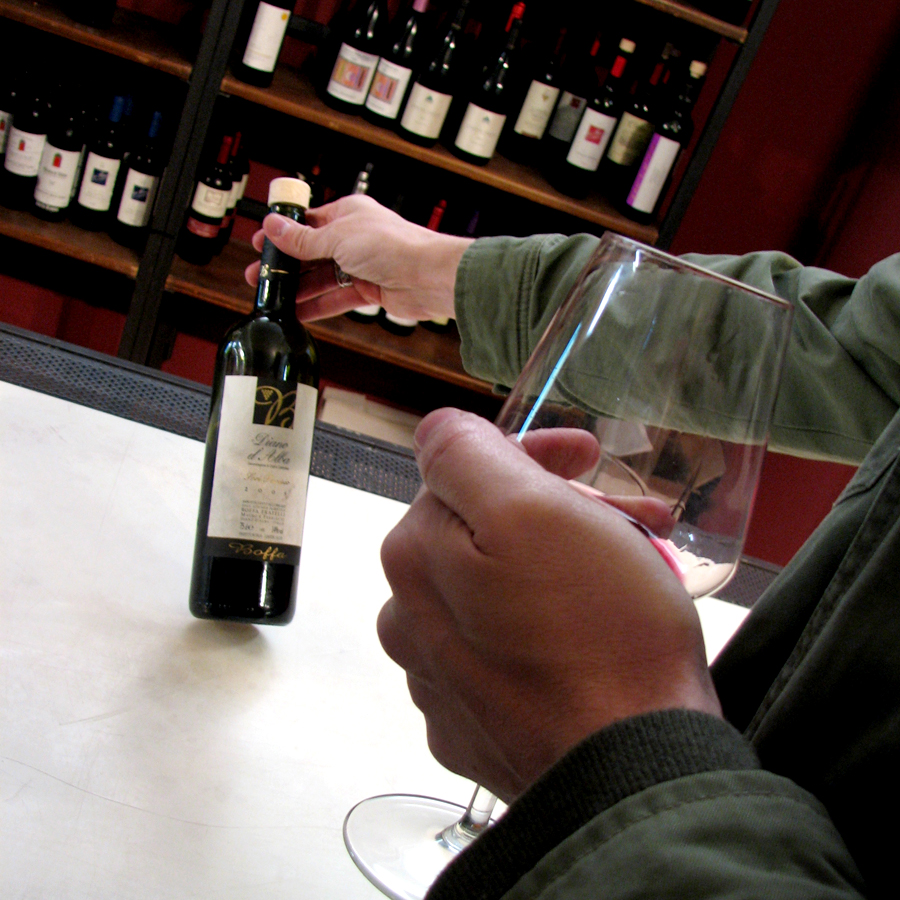
But the wine? First, you're advised to cup the wineglass in your hands in order to warm up the rich red liquid because it's so cold in the festival hall. Then you take a deep sniff to capture the aroma. The Dolcetto smells fruity and earthy and barky and warm. And Asti smells like flowers in the sun, and peaches and apricots and rainbows. And Barolo to me smells meaty and rich.

And the people who run the wineries and who line the festival hall want you to taste these wines. They want you to taste all of the wines. They'll fill your glass and tell you about their grapes, their techniques, and the personality of their soil. And then you'll say thank you and visit someone else who will do the same. It's like pub crawl only the point is not to get drunk and head-butt people in the streets, but rather to taste the magical wines of this silty region and try to grasp what it is that makes them so special. And along the way you're bound to realize there are a hundred reasons why...


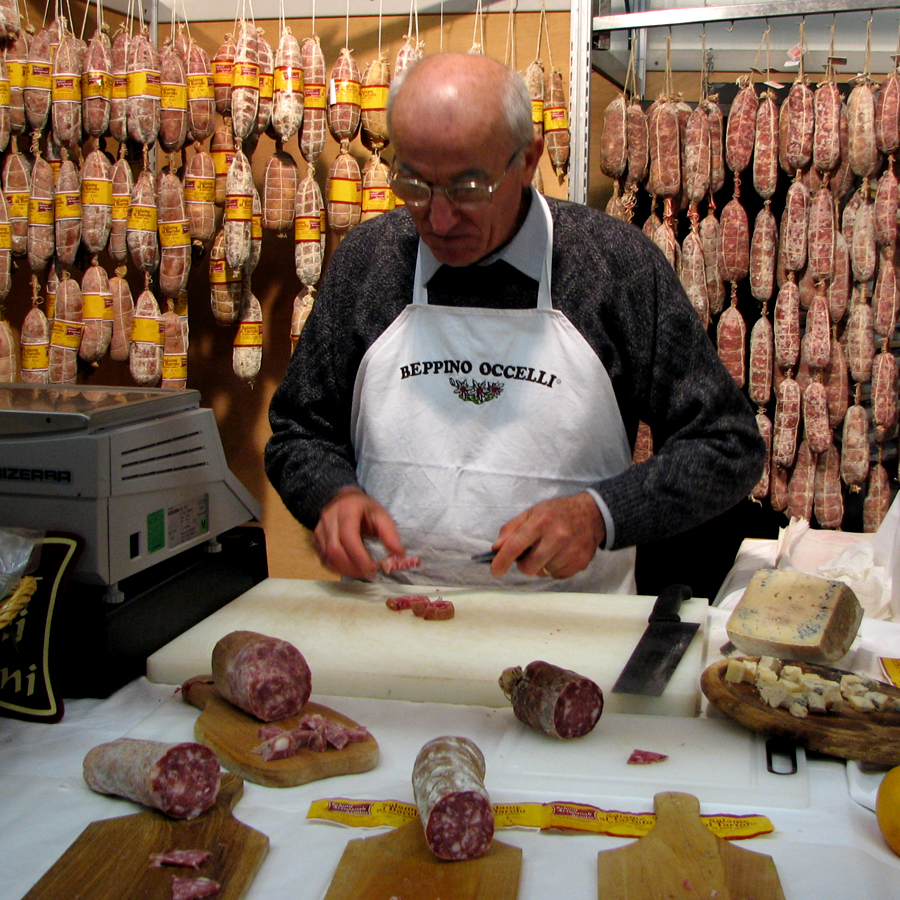
But wait! The cheese people are holding out knives with shavings of cheese on them! And you can't say no because it's cheese. Wonderful cheese! And with so many different kinds - so many textures and flavors, it's almost too good to be true. There is sausage and salami too; hanging along the wall and laid across the table and being cut into bite-sized samples. Not just a paradise for cheese-lovers, but for their meat-loving counterparts as well.


There's also an ungodly amount of cakes, cookies, candies and general sweet ephemera lining the festival. There's the earlier-mentioned flourless hazelnut cake which is moist and not too sweet. And chocolate everywhere; in chunks and bars and elaborate art. There's torrone in bricks large enough to knock out a grown man. And you, as a truffle fest attendee, are obligated to taste everything put before you. Truly. And p.s. there's no shame in going for seconds. I tried.

I will tell you that the one difficulty of the festival is the other festival goers. While we saw very few Americans, there were sackloads of Germans and other Nordic folk. These are not small people - in fact, I'd go so far as to call them quite sturdy. Stefano, who while not being a very heavy fellow is quite tall -- I can usually see him easily across a crowded room -- was absolutely dwarfed by a crowd of men and women who made him look like a toddler. He tried but there was no penetrating the wall of heartiness, and no way for him to reach the salami sample he so badly desired. And while we went back later and Stefano tasted what he claimed was absolutely excellent salami, he still couldn't escape the idea that there are people that large in the world, and that they wouldn't let him near the smoked meats.


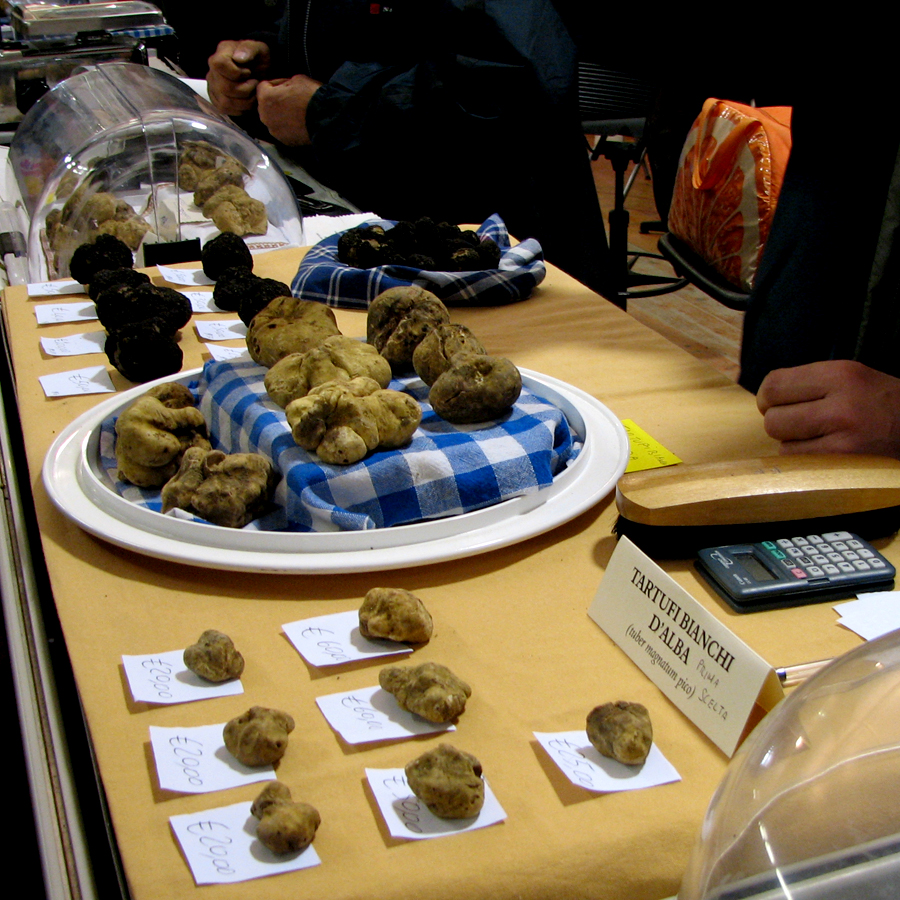
And now we come to the truffles. Oh delicious aromatic fungus. Why haven't we met you before? (Aside from the fact that you're too expensive and kind of rare and all...) The interior of the festival was an area where the truffle hunters lined up at tables, along with their scales and calculators, and displayed their goods. Some simply piled the truffles into little mounds while others preciously laid them out one-by-one. There were white truffles and black truffles and they ranged in size from pretty small to several golf balls large. Very small is almost in our price range, while any larger is definitely not. There was a generously-sized white truffle for 1300 euro which we found almost comical, except for the fact that not everyone in the crowd was pointing and laughing.


As you might imagine, there are very few rag-taggers trotting through the truffle festival. And those who are there as serious buyers are wearing the outfits of the filthy rich. But to be there as a spectator is just as fun. You get to smell the truffles all the same. And you can talk to the truffle-folk about how this line of work found them and their families. We talked to a girl who was there representing the finds of her father -- who truffles at night with his specially-trained dog. He was taught by his father who was taught by his father and so on. We asked her why she didn't hunt for the truffles - and her answer was that she felt it was too dangerous to be wandering around in the middle of the night. A practical girl who then went on to sell several truffles for about 100 euro.

There's definitely an art to knowing a good truffle and we received a brochure that tried to explain it. There's something about the strong garlicky smell of a white truffle originating from all sides of the truffle, and one must also keep an eye out for claw marks from the dog who dug it up. Also, don't buy one that's chock full of parasites or has been reconstituted from multiple small parts by an unscrupulous dealer. Rest assured, though, there's a truffle judging booth at the festival where you can take your prized-purchase to be sure you got your euro's worth.


I have to admit to purchasing our own little truffle. And believe me when I say it's little. But it smells strong and it looks the part. And we're going to shave it thinly and eat it over eggs. That's what everyone else was doing.

If the Alba truffle festival hadn't ended I would encourage everyone to hop onto whatever form of transport was available and get to the festival now. But as today was the final day I can only implore you to plan ahead for next year. This festival was one of the greatest food joys that we've had here in Italy and we're still groaning over its delights. The wine, the cheese, the truffles... The three hour train ride going in circles.

It's all about the goodness of Italy and the lengths people take to enjoy it. Some of us hop on trains and tool around the countryside. Others take their dogs out in the dark of night and hunt for a very special fungus. Still others cultivate grapes with a love that few of us understand. But we all come together every so often and share our energies in a single place. Some of us as wide-eyed visitors, others as wisened producers... at a crisp fall picnic that takes place in Alba.

See you there next year.

22 October 2006

Il mese dei Porcini


It's a sad night when you forget your camera for a great dinner. Sounds silly but it's true. I've become one of those people who take pictures of dinner, shamelessly, at the dinner table. Ask those with whom we've dined.

So last night Stefano made reservations at a place he'd found online via www.ilmangelo.it, a handy restaurant review site for Milan and Rome. All we knew was that All'Osteria dei Vecchi Sapori was recommended as a great place for traditional tastes. We didn't know that it was in the throes of "Porcini Month." Or that last night was the final night of the month-long event. When we walked past the kitchen (visible from outside the restaurant) and saw a heaping pile of porcini mushrooms we were excited. When we saw the flyer pictured above, we were ecstatic.

Of course we both went for the "Il Mese dei Porcini" (Porcini Month) special menu. For those who don't speak Italian, go ahead and give it a read anyway. You'll be surprised by how many words are quite familiar... carpaccio, tortelli, polenta, vino, caffe. "Zigoiner" was a little difficult for us too.

The meal began with a great bottle of red wine and the antipasto: "Carpaccio di Porcini." The uncooked porcini mushrooms had been thinly sliced and lay under a drizzling of olive oil and lemon, with long thin slips of parmesan grated on top. There was a little pepper, a little salt and a lot of fresh throaty flavor.

The primo was "Tortelli Rustici Panna e Porcini" - tortelli with porcini mushrooms and cream. Wow. Just creamy enough. Just salty enough. With woodsy hints in each porcini.

(In dishes like this the Italians truly justify their light portion sizes; had you been served a giant plate of these magnificent tortelli with cream you'd need to be rolled out of the restaurant by a kind stranger upon finishing. But with a smaller plate, hosting a lesser serving, you're able to honor each tortelli with a slow and savored tasting. And when you're finished you've still room for the secondo.)

"Zigoiner di Manzo e Speck con Polenta Taragna e Porcini Trifolati" was the secondo. Basically, this was a delicious bed of soft polenta topped with porcini cooked in oil, garlic and parsley. The most interesting aspect, though, was the giant wooden rod wrapped in grilled meats that was laid across the plate. Think broom handle barbeque. Stefano removed the thin slices of beef and smoked ham from the stick (we'd observed the process other diners had employed) and piled it atop the polenta and porcini. The stick barely sat on the table for a moment before the server whisked it away. The polenta with porcini was wonderful and Stefano vouches for the supremacy of the meats - salty and savory.
At this point we were rather full but soldiered on to enjoy coffee, digestives (Limoncello for me, Sambuca for Stefano) and a selection of light cakes for dessert.

The meal was impeccable and a great opportunity to take advantage of what experts can do with porcini mushrooms. Two brothers who despite their striking similarities are not twins (I asked) run the restaurant and told us that next month will be "Il Mese dei Tartufi," aka Truffle Month.

I think you know where to find us.

-----
All'Osteria dei Vecchi Sapori
Via Carmagnola, 3
Milano
02.66 86 148
www.vecchisapori.it

20 October 2006

two (or more) for the road


There are a lot of motorcycles zipping around Thailand. These don't strike me as the fashion accessory that scooters in Italy are. These cycles are actually The Family Vehicle. And damn if they're not able to fit the whole family on it at once.

At first I was startled by the transporting of very small children at the front of the cycle. Some were just sort of propped there. Others had specially constructed plastic chairs in which they sat. Not many wore helmets, but then not many of their parents did either. Although sometimes they had those kamikaze helmets that you can't help but admire.


People propped their kids on the front of cycles in the morning. At night. In the rain. But you soon realize that's nothing. That's only two people. There are entire families perched on these cyles. I wasn't able to get a shot of a family of four; three was my max. But looking at this photo of three people on the cycle... just take another child and squeeze it between the last person and the driver. This seemed to be the preferred location for infants.


Not only are there families scooting down the highway on motorbikes, there are also uniquely configured cycles that have a transport area added on. Often you see street vendors on this bikes, with their entire food operation packed into the rather large sidecar. But as evidenced by these four guys, those cycles also make for great four-person vehicles.


Lack of helmets or protective gear notwithstanding, the Thais have figured out how to get around. There's no winter in Thailand but there are monsoons and hellish heat. Makes the people driving around in SUVs one person at a time seem a little less rugged.

fruit and farang


Phuket Town is away from the beaches and, if you believe guide books, is the sort of place where a visitor can feel like a local. Let me make a critical point here: you can absorb the ambiance, you can marvel at the smells and sounds, but in Thailand on vacation you will never - ever - feel like a local. There are far too many people pointing at you and laughing, or selling you things for eight times the price. No, really. We were walking to dinner in Chiang Mai and had a motor scooter full of teenagers point at us, yell "farang!" and then laugh their way into the distance.

"Farang" is a word applied to westerners and we've had friends tell us it originally was a word for the French. These days, though, we're all lumped into one big group of funny-acting strangers and the Thais aren't afraid to bandy the word around freely. But back to the point, you can wander around a great smaller place like Phuket Town and get a feel for things without all the commotion and commercialization, but it's hard to sink into the reality when tuk-tuk drivers keep offering to take you to "shopping."


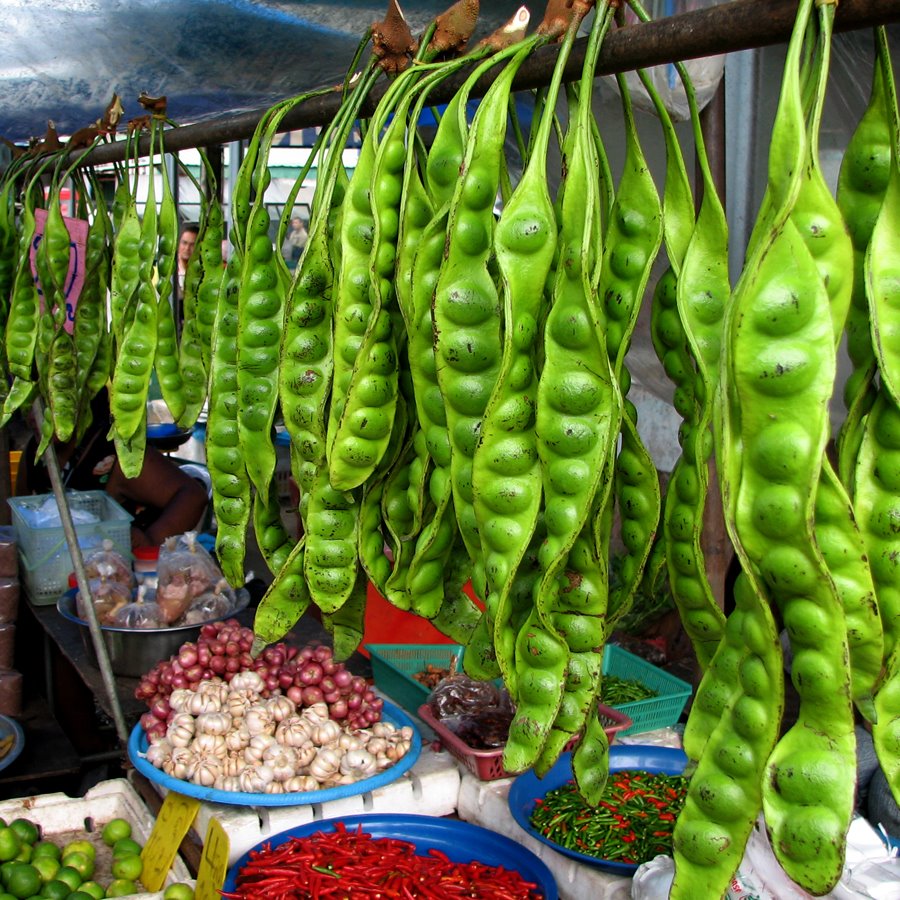
Rather than be suckered into an engineered shopping expedition we meandered around and found a great market. We slowly walked the length of it, submitting to the cacaphony that is Thai produce and dining.

It was a pretty compact space with a main drag of sorts and stalls insistently pressing into the pathway. I have no idea what all of the fruits, vegetables, animals, you name it... were. Can't tell you what the pink and green fruit with the protruding petals is. Can't tell you what kind of small speckled eggs the woman was scooping into plastic bags. I can affirm that there was a stall with very, very sweet items all covered in bees. With a healthy crowd of bees still trying to find a spot.


There were piles of pineapples that still had long, sharp stalks poking out of the bottom. Never seen that before. There were large roaches/beetles ready to eat. Haven't seen that either. Lots of fish laying around on beds of ice bits. Seen that - but their eyes were clear and sharp, being pulled from the water only hours before.

Long florescent beans strung over poles. Hundreds of limes piled into pyramids. Spices, powdered and flaked. Armies of small bananas. And mounds of scarlet chilis that could fell a bear.


And such a delicious commotion. The vendors screaming, laughing, prodding. Children scrambling in tiny open spaces. Bees humming. A garbled TV running off a power cord appearing out of nowhere.

There were giant pots of prepared foods, cauldrons of Thailand's miraculous spice combinations. But we kept walking and let the real locals line up for clear plastic bags filled to the brim and tied off at the top.


Pig faces without bones. Yellow shirts celebrating the beloved king. You really can get anything in a Thai market. And maybe, just maybe, you can get a feel for Thailand without the tourists. Maybe.

18 October 2006

the salty sea


Most everyone has heard of Phuket. And for those who haven't, it's the Thai island that was hard hit by the 2004 tsunami. Other than the Tsunami Escape Route signs that line the winding road along the beaches you wouldn't know what had happened there.

It's a beautiful place with tropical beaches that suit every personality. It's the first time that Stefano and I have purposefully visited a beach for vacation and we stayed in the more secluded area. Something about the non-stop craziness of the other party beaches just didn't sound super appealing. We did, however, find the idea of kayaking in the ocean very appealing.

Our guide, Gai, picked us up early in the morning and took us to the other side of the island where we arrived at a dock area perched on stilts at the water's edge. Everyone else was a local or a very scary half-fish half-reptile mudskipper skirting along the shallows. I can't tell you how disgusting and disturbing these creatures were. They look like angry nasty fish with legs and bug eyes and they sulk along the sandy mud, dragging their tails and stopping only to fight with their disgusting counterparts. I would have jumped on any boat at the dock just just to get away from them.


My openness served us well as we boarded a longtail boat. (Pictured in the first photo of this post.) We'd share the boat with our guide and two teenage drivers who would spend the majority of the trip sleeping in a hammock conveniently draped outside, next to the screaming truck engine powering the boat. Even when the engine was on. And even when it was pouring rain.

Our boat took us out to uninhabited islands covered in jungle and dripping with stalactites. Other islands lurked in the distance, blurry behind layers of fog and mist. Storm clouds hung low but didn't open up until lunchtime. And there were tamarind seeds to eat in the meantime - wresting them from their dried seed pods, chewing off the sticky sweetness and spitting the stripped seeds into the ocean as Gai had.

Before we got into the water with our kayaks for the first time Gai gave us a brief instructional talk on how to paddle. Good thing it made relatively little sense. And that he was screaming over the thrum of the motor. And that I had never been in a kayak before.

Come to think of it, neither of us had not been asked if we knew how to swim, or to wear a life jacket. But that's a true adventure for you. A wooden boat powered by a truck engine and a 15 year old... A life jacket just doesn't fit into that picture.


But three turquoise kayaks do. And so we got into the kayaks and were on our way. The first place we went to test our skills was a cave filled with bats and disturbing rock growths resembling wasp nests. Maybe it would have been less terrifying had we each been carrying a flashlight, instead of just our guide. But there I go again, trying to minimize adventure.

Gai pointed his dim light at the roof of the cave as Stefano and I grappled with the complexities of how one steers a sea kayak in a very small space, edged with sharp oyster shells. The ceiling was awash in bats and the air had a pungent smell that we now know means bats live there. It was amazing to be in that small space, almost like an enclosed and far scarier version of It's A Small World. Only in this ride there are no lights, no sounds, and nothing to stop you from biffing straight into the sea cave wall.

We continued on with our tour of the island's coast. Eagles swooped down from the jungled cliffs above. Herons shot from the ledges and coves created along the waterline where the island had been worn away. We stayed snug along the edges and stalactites dripped onto our heads and the water around us. The ocean lapped at the sides of our kayaks and we tried to find that perfect movement, where your paddle cuts into the water smoothly, yet propels you decidedly forward. When it works, it feels like magic. When it doesn't, it feels like your back or arms might hate you forever for the damage you're inflicting on them.


We didn't see another tourist or another kayak all day long. We did slip past a sleeping fisherman who awoke as we passed and gave a drowsy wave.

At lunchtime we paddled up to the longtail and got back on. Gai suggested a swim before lunch so we turned around and jumped into the ocean. The water was warm and salty, and absolutely perfect. We swam to a cove on the island where the water lapped at a small bit of beach. It was composed entirely of shells. And as the waves came to shore there was the prettiest, most delicate, tinkling. The sound of shells being deposited on top of other shells, and of still others being dragged back down into the water. The noise of wind chimes drifting over from the house across the street.

We stood there alone. On a tiny strip of land, at the side of a deserted island, along the warm salty ocean. Looking out at the longtail, seeing it ride the current. Thinking of our guide. His life. Our lives. And the constant tinkling of the shells.


Our lunch was rice in a plastic bag with some dried seasoned onions. There was also fried chicken and several bags of Oreos. I didn't go for the chicken but I can say that the rice was excellent. Something about the ocean and kayaking all morning makes a plastic bag filled with rice taste better than most anything else. Even the Oreos.

We continued kayaking even as the rain came and eventually paddled into a deep cavern where we were able to park our kayaks along the edge and climb high into the cave. There were rock formations of every shape and size. Sheets draping smoothly along the length of the wall. Others pooling like saucers along the floor. But before we could gawk at the stalactites and stalagmites there was the small matter of tiny creatures that look like water droplets but actually bite. There were several on my leg and at first I couldn't figure out why the water droplets that were running down my ankle were stinging. Except they weren't water droplets. They were miniature sea monsters. And they were biting me. Cue fist raising to nature.


There was a point in the trip where we were in the longtail and Gai had to tie plastic tarps at every angle so that the sheets of rain wouldn't follow us into the boat. And it worked. We sat behind the sheets, listened to the boat's hum, and thought of our teenage captain driving through what by that point had become zero visibility. Again with the adventure.

At the end of our day Gai brought us to a lonely beach to relax. Except we decided to hunt for more shells, chase crabs across the shore, and go in search of giant chickens. All in the beautiful rain.

I still remember how warm the ocean was. How salty the water was when I jumped in. The way the kayak would sometimes ride the water like a racetrack, shooting along. The quiet of spaces where no one else is and where the water works to dissolve the rock walls around it.

So while Thailand has Bangkok and the stories people tell (which I now know could easily be true) ... Thailand also has tiny islands off of other islands in the middle of the ocean. With only jungles and eagles swooping down. And a few turquoise kayaks silently paddling through.

17 October 2006

siamo ritornati


Some 24 hours after leaving our friends' Bangkok apartment, we were back in Milan. They're two different worlds, these places. Two. Different. Worlds.

Bangkok makes Milan look like a quaint town. Makes it smell like an odor-free laboratory. Makes it sound like a home with an only child vs. Bangkok's playground at recess.

Bangkok is a hectic traffic jam of culture and crowds, crazy and sane, low and luxe. It's gorgeous and insistent and stifling hot. And I think I love it.

In fact, I think I love Thailand on the whole. It's been a whirlwind romance between us and I'm about to write my first love letter. About to splay my feelings about this place and it's people. The rain drops and buddhas. The warm ocean and the watermelon juice. The monks in orange and the wats in gold. All the things I can't shake off...

Where do I begin?

05 October 2006

riding the waves


The city of Milan is ravaged by a fairly constant and aggressive onslaught of graffiti. When we first arrived we were shocked by the sheer volume, but I guess we've grown accustomed to the tagging... the calls for anarchy... the giant Gary Coleman heads crawling along the walls. But still, graffiti is so not cool.

But it's like the pollution. The smoking. The lack of lines and order. I don't like it but I've gotten used to it.

And now out of the ugly and useless depths of graffiti come a family of dolphins. Our spray paint perpetrator has transformed barriers meant to keep cars out of pedestrian areas into the fins of frolicking ocean playmates. Shame on you, but as long as you're at it...

The dolphins aren't terrible. In fact, I prefer them to the aforementioned Gary Coleman craniums glued to old buildings. I still, though, would prefer that things were left as they were made. No spray paint. No glue. No messages to the masses.

I, though, will leave one message to the masses tonight: Arrivederci! We leave for Thailand tomorrow and won't be back until next Sunday. In the meantime I imagine there'll be quite a few things to observe in that corner of the world.

Until the 15th...

04 October 2006

above milano


The Duomo is the sun around which all tourists in Milan rotate. It's a grand cathedral, one of the largest in the world, and it's certainly a looker, although various parts - including the ever important face of the building - are sheathed in scaffolding, promising a rejuvenated facade for those visitors who show up sometime in the abstract future.

I have to admit to being fairly crestfallen having arrived in Milan to find the face of the Duomo covered. I had flashbacks to an anticlimatic Parisian experience a decade ago, finding Notre Dame similarly cloaked upon my arrival. But I'm not complaining because Milan's Duomo has a parlor trick that beats most other cathedrals hands down - you can walk on the roof.


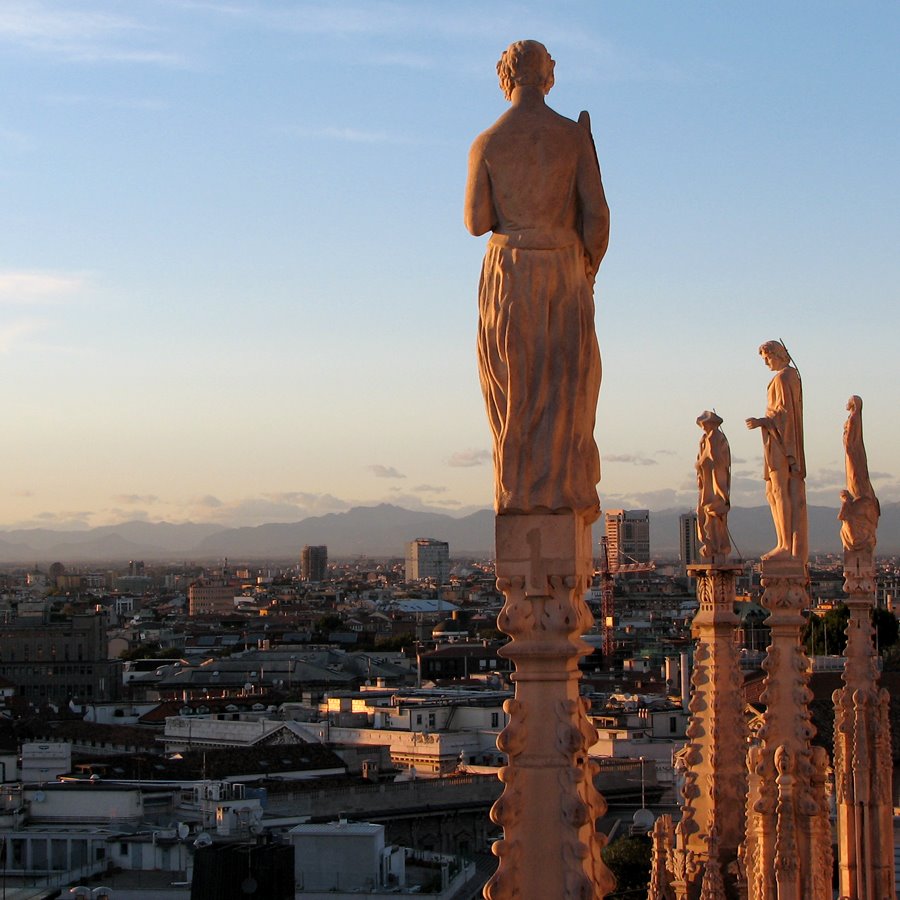
Now, I don't mean you can climb a few flights of steps and peer over a ledge, or go up to the bell tower and check out the panorama. You can actually walk along the length of the Duomo, high about the Piazza, high above the pews, on several levels. It's the opportunity to be both in urban Milan and in the company of the alps; flanked by lines of statues and spires stretching themselves into a surreal skyline.


This summer there was the limited opportunity to visit the Duomo's roof in the early evening before nightfall. The timing was such that you could catch the sunset before being shooed off the roof - watching as the sun sank behind the mountains and the statues took a golden hue. It was a slow melting of the blue of day, the warmth of sunset growing and then evaporating into night. It was slow and instantaneous at once. Picturesque and yet impossible to truly capture.

Milan's Duomo is in the heart of the city and sits on a large piazza generally packed with people and pigeons -- often with little space between them. It shares the neighborhood with department stores, museums, and the famous glass and iron Galleria Vittorio Emmanuele II. The Duomo is fairly integrated into the city and from it's roof you get the sense that it pours people into the arteries of Milan, circling them in the piazza below and pumping them back into the city. It's the lucky ones who've stopped on the roof first.

01 October 2006

C is for castagna


Running in Milan is not as popular as one might think, and I certainly have not been the poster child for committed runners. There are some Italians who run and they seem to like the parks; they also seem to like workout wear from the eighties but who's keeping track?

If you run in Milan, you're running with meandering cyclists, scooters and dogs. And passing through second-hand-smoke clouds every few blocks. An extra bonus is that if you wake up early on the weekends to circle the park, you're definitely going to do battle with the amassing tour groups who huddle on the sidewalk in large confused groups.

I haven't run a marathon in a long time - not since the illustrious 2004 London marathon in which I managed to secure a throbbing sunburn despite London's reputation for an expanse of infinite gray. But there shall be a marathon in my future. Preferably one in Italy. I'm not at the point where I have to figure out where long runs will be found, or choose exactly which Italian carb I will use for carbo-loading but I am at the point where I'm trying to get out there and log some miles.

Now there's a certain family member, who shall remain nameless, who has run a marathon in his sixties and is generally faster on his feet than me. The one thing that can fell this mighty runner is a small oblong bit of nature. His Achilles heel is more like an Achilles acorn and there are stories of somersaults and twisted ankles resulting from these tiny beasts strewn on the path.

In Milan there aren't really acorns. Instead, there are giant thorny chestnuts that come hurtling out of the sky. You can hear them crashing their way through leaves and limbs, so there is warning of their arrival. But looking up to anticipate where the crashing piece of nature might land is really just begging for a chestnut in the head. So I just keep running, looking down, thinking of the unnamed family member and trying to avoid the chestnuts spilled out all over the path.

I should clarify. The chestnuts don't just fall from the tree. The chestnuts fall from the tree sheathed in a thorny suitcase that splits open upon contact with the earth. I ran with the above example for 15 minutes and I had to keep stopping for extra leaves to wrap around the thorns. Because the thorns are so sharp that they kept breaking through the leaves and breaking into my skin. So believe me when I say you don't want one of these lodged in your forehead.

So running in Milan might be unpleasant due to smoking or Vespas or pollution or whatever other part of an urban city gets in your way. Curbs. Lighposts. Whatever. But the real problem is the nature; the tiny small quarters of green you can find in this large city. Because in the parks, in the nature, there are thorny parcels hurtling out of the sky. And these thorny parcels leave behind obstacles that can easily cause a grown man great distress. Just ask my Dad.

He can understand the power of a castagna in the middle of the path.

C é per la castagna.

26 September 2006

B is for bici


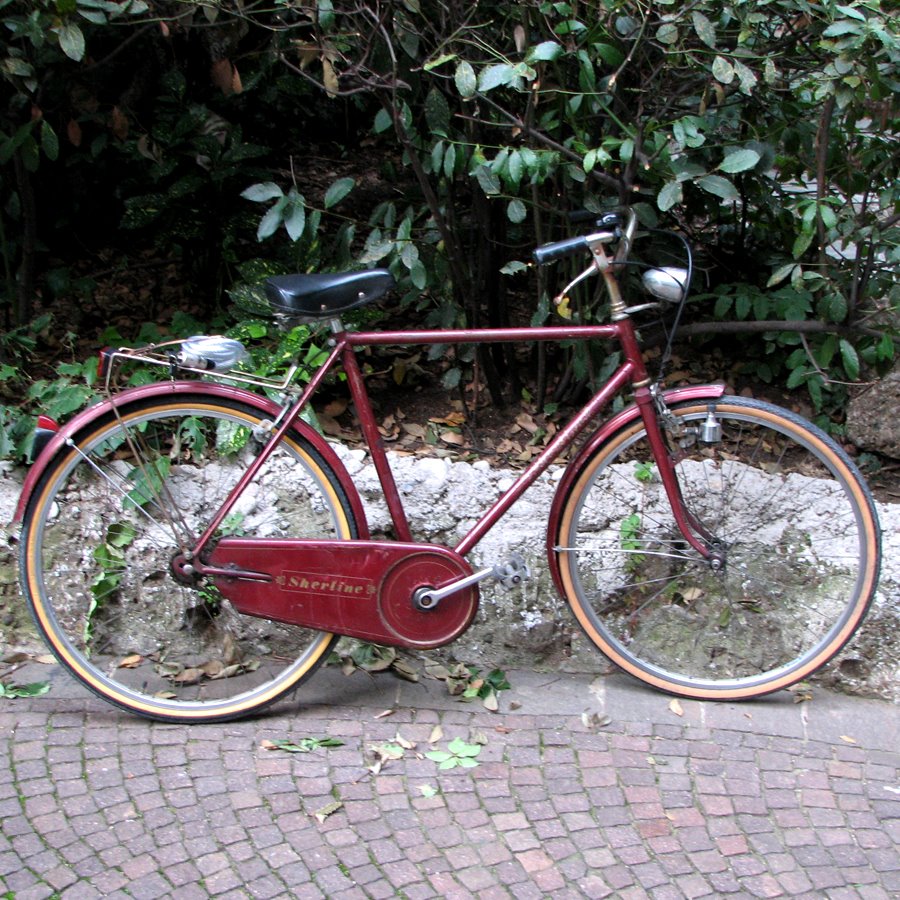
Italians are wild for bicycles. Milano is full of people balancing children, cigarettes, cell phones, and small dogs on bicycles of all shapes and sizes. But the best bikes, the most charming and european and all of the other things that make your heart take a little extra thump... the best bikes are the old bikes. The beaten-up bikes with histories and adventures stored in their rust spots and baskets.

So Stefano being the stalwart and generous gentleman we know him to be went on a noble quest. He knew I wanted an old bicycle and so he went looking for an old bicycle. He called every store he could find in the telephone listings. They said there were no old bikes to be had. He was certainly welcome to purchase a new, shiny bicycle. Of any color he might prefer. But he did not prefer to find a new bicycle.

And then he went to talk to all the people he knows in Milan. He talked to the baker. The student. The man who cares for the building we live in. No one knew where you could buy used bikes. Or if they knew of a friend of a friend who might be able to find one they were always careful to insist that it had not been stolen. And there's nothing like a powerful, unprompted denial to make you start discreetly moving in the opposite direction.

So poor Stefano gave up. He let go of the dream of an old bike for me for today. A special day on which the surprise of an old bike would be absolutely fitting. And after he gave up he went to the bar for a coffee. The bar on the corner that we like to go to. And he asked our friend, the owner, where it is that someone can find an old bike in this town.

An old bike?
Yes, an old bike.
I have one in the back. I'll give it to you.

And with that an old bike was found. Una bici with a story. Una bici from a friend. Una bici for il mio compleanno.

B é per la bici.

24 September 2006

alta and bassa


Following our tradition of treating weekends as an opportunity to explore... yesterday we took the train to Bergamo, a bi-level city about one hour from Milano. We were treated to a gray hazy day, with clouds that hovered low but never quite got around to raining. It was chilly though and both of us, at times, lamented the fact that we had dressed for summer rather than fall. (May I also add, hallelujah for fall! Summer in Italy is no laughing matter.)

Bergamo has a lower section and an upper section. The lower section, Bergamo Bassa, is the modern part of the city where the office buildings and cars congregate. Bergamo Alta is the medieval walled section, about 1200 feet up, which is reached by funicular or steep path. Despite starting our Bergamo visit off with frothy cups of cappuccino and a fair amount of energy, I have to admit to taking the funicular. A good deal at 1 euro, it's also worth pondering exactly how such a thing works as it smoothly climbs the hillside in its own tunnel. (There's a cable running along the ground, and it appears to be pulling the funicular car up along the track but I digress...) No matter how it works, it is apparently "bellissima" which is what the kids who scrambled over us and into the prime viewing spots kept saying. We played the role of mature adults and refrained from informing the children that we had gotten there first and therefore deserved an unencumbered view.

Sitting on high, Bergamo Alta is quaint and charming and has all of the little touches that people like about quaint Italian towns. There are balconies with detailed iron work, flowering plants pouring out of windows, cobblestone streets, breadshops churning out piles of pastries and bread loaves as large as end tables.


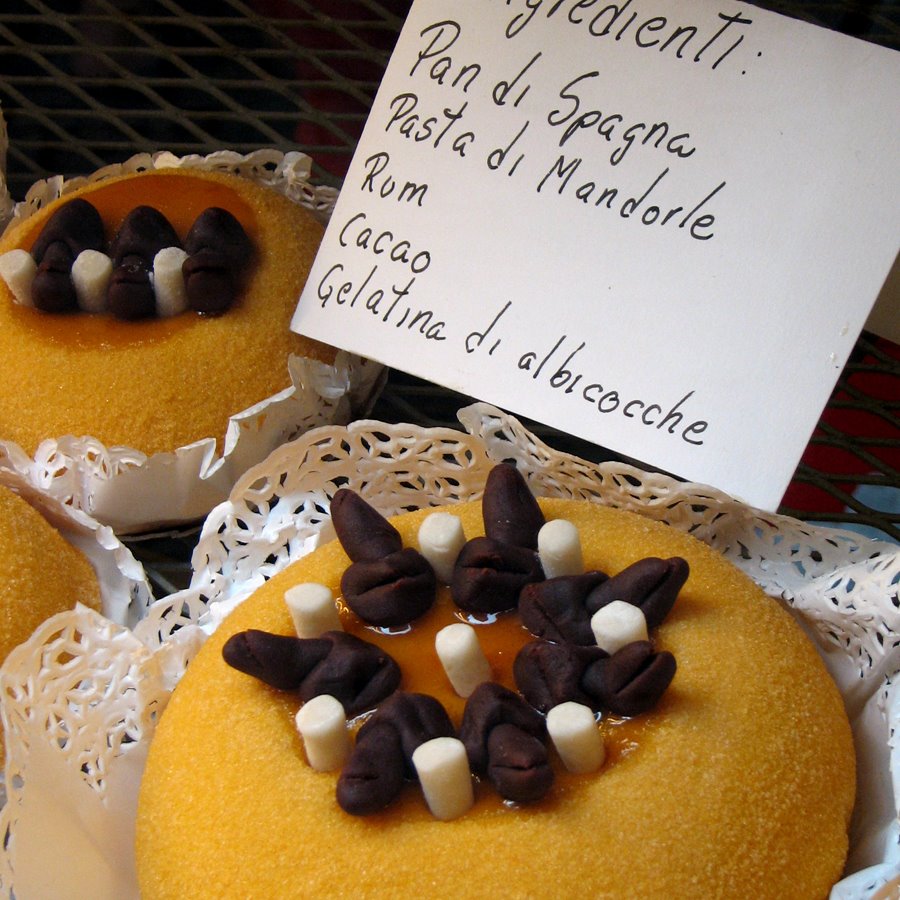
There is also a cake for which Bergamo is specifically known. We tried it for the first time when friends who were staying with us took a day trip to Bergamo and returned with one; we liked it then and we like it now. The cake is called "Polenta e osei" and is made to look like a freshly molded polenta being sampled by a few bold "osei," aka birds. On the inside there are layers of apricot preserves and almond paste and light airy cake and a little chocolate cream. It's very sweet and in its petite way is a bit of a charmer. We bought one for us and one for the man who watches the entry gate to our building. It's hard to leave Bergamo with only one.


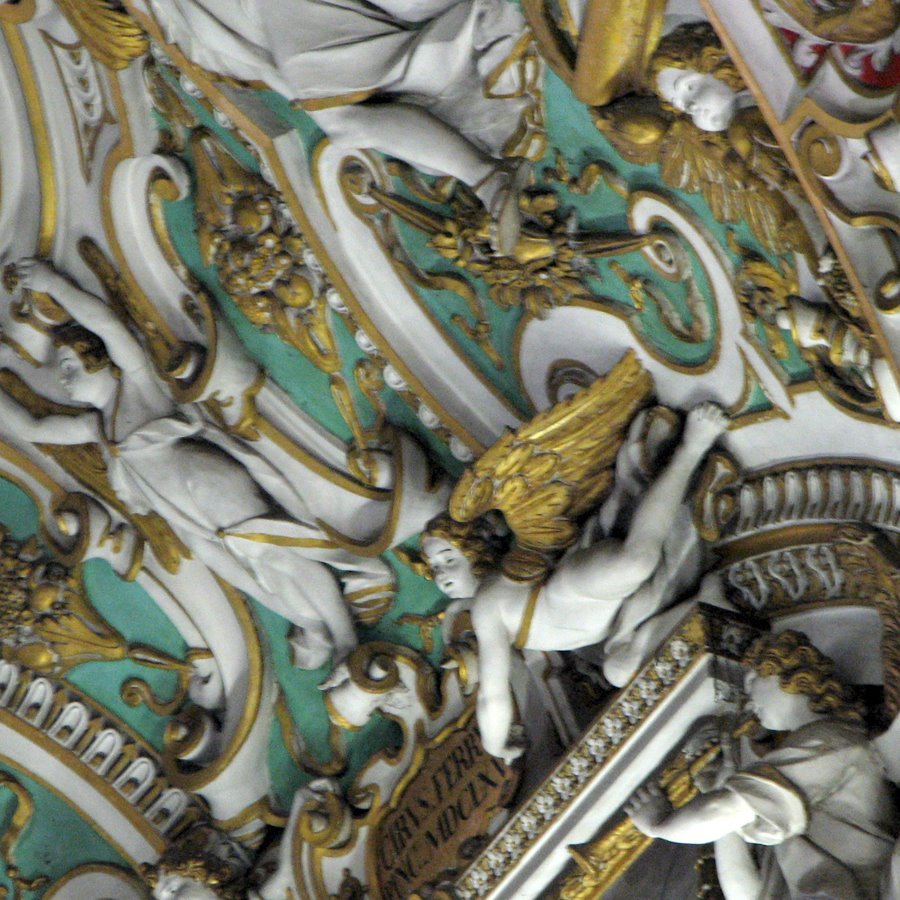
The church of Santa Maria Maggiore is one of the famous sites in Bergamo Alta and for good reason. On the interior it's fairly striking with the entire ceiling covered in the excess artifice for which Baroque style is known. Cherubs and angels and every kind of gilt ornamentation is spread thickly along the vaulted ceilings. It may be garishly gaudy in the eyes of some, and glorious to others - I fall somewhere in the middle, wondering exactly how the builders of this large church managed to not only construct the ceiling but also cover it with an absurd amount of accessories in the process.


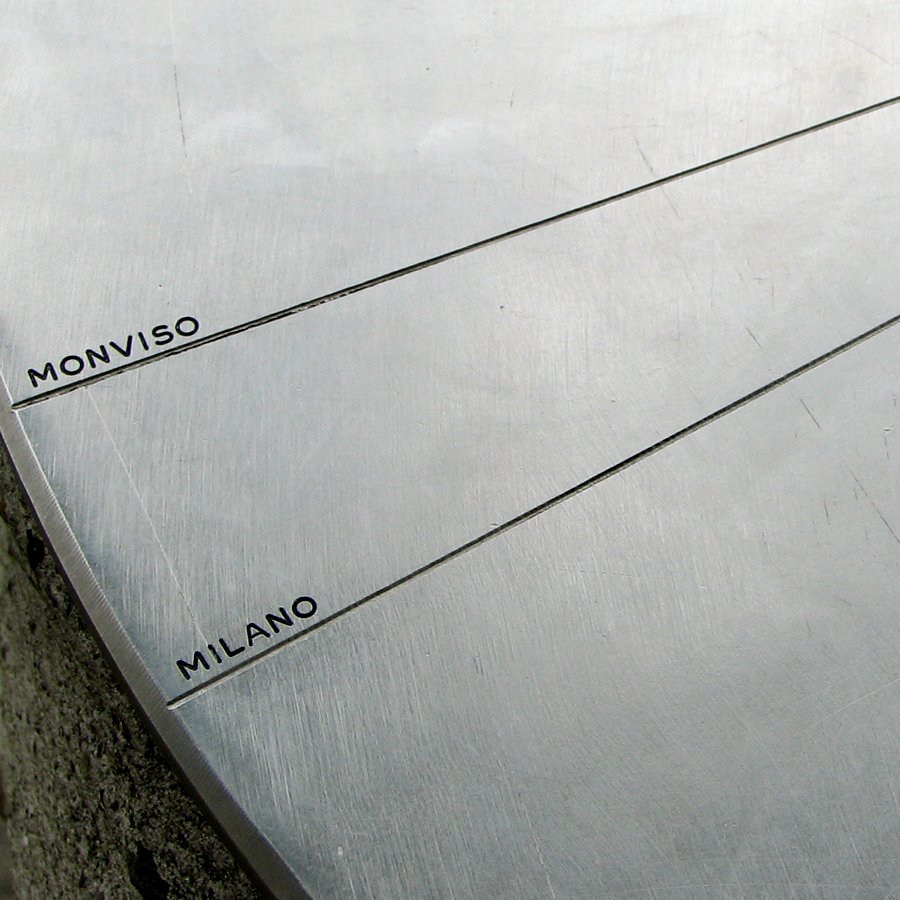
When you're in Bergamo Alta, there's another funicular you can take to reach a still higher part of town featuring an old castle. It's more of a park with the feel of a castle than an honest to goodness castle but on a clear day it's supposed to boast the best view in town. We had a good view of the clouds. There was also a very cool piece of art that at first glance looked like a sundial. Its real purpose is to indicate in which direction various towns and monuments lie. There are guiding lines that lead in the direction of a little mountain range you might have heard of called the Alps and a city that we have a passing familiarity with by the name of Milano. Again, had it been a clear day this tool might have worked a little better but it's the thought that counts.


We took the funicular back down to Bergamo Alta - first level - and found a great place to eat. When we first walked in it looked a little empty. But after we made our way to the outdoor seating area we found quite a crowd settled in under the grapevines, next to the bocce ball courts. The pasta we ordered was good, (I had pear and cheese ravioli) and the grilled polenta was great. But I have to admit that the game of bocce ball that started up late into our meal was the highlight of the dining experience. But more on that in another entry. After all, I'd hate to shortchange a game I know nothing about, played by old men drinking beer and wielding large sticks with chalk on the end.

So for now we'll just celebrate the joys of little cakes that look like polenta. And slabs of grilled polenta eaten under a ceiling of grapevines. And cobblestone streets and garish church ceilings. And funiculars. Lots and lots of funiculars.

17 September 2006

Praga = Prague = Praha


I was lucky enough to be sent to Prague for business last week. The business was great and so was Prague. The #1 question of the month, though, is why haven't we gone there before? The city is gorgeous, the food is good, and the prices are generously more affordable than Milan.

It's a one hour-ish flight from Milan, most of the airtime spent over mountains of one sort or another. Alitalia is kind enough to serve ice cream cones during the flight and also feature Sports Illustrated Swimsuit Issue cover models in first class. Your husband may recognize such models while standing close to them on the tarmac bus, then may go so far as to confirm his assumptions by gawking at their boarding pass. But then, in a sad showcase of jitters, he may refrain from hounding her for a photo -- leaving both your husband and his fantasy football league with a lingering sadness.


Prague, on the other hand, will only make you happy. It is incredibly aesthetically appealing and for a former Communist state there were surprisingly few blocky monstrosities - one of which was our hotel, but I digress. On the whole the city is light and airy with a consistent prickling of spires rising into the sky. These are best seen, and most appreciated, from at least nine floors up. One of our lunches was in the hotel restaurant on the ninth floor and the windows looked onto a garden of spires, sprinkled consistently into the distance.


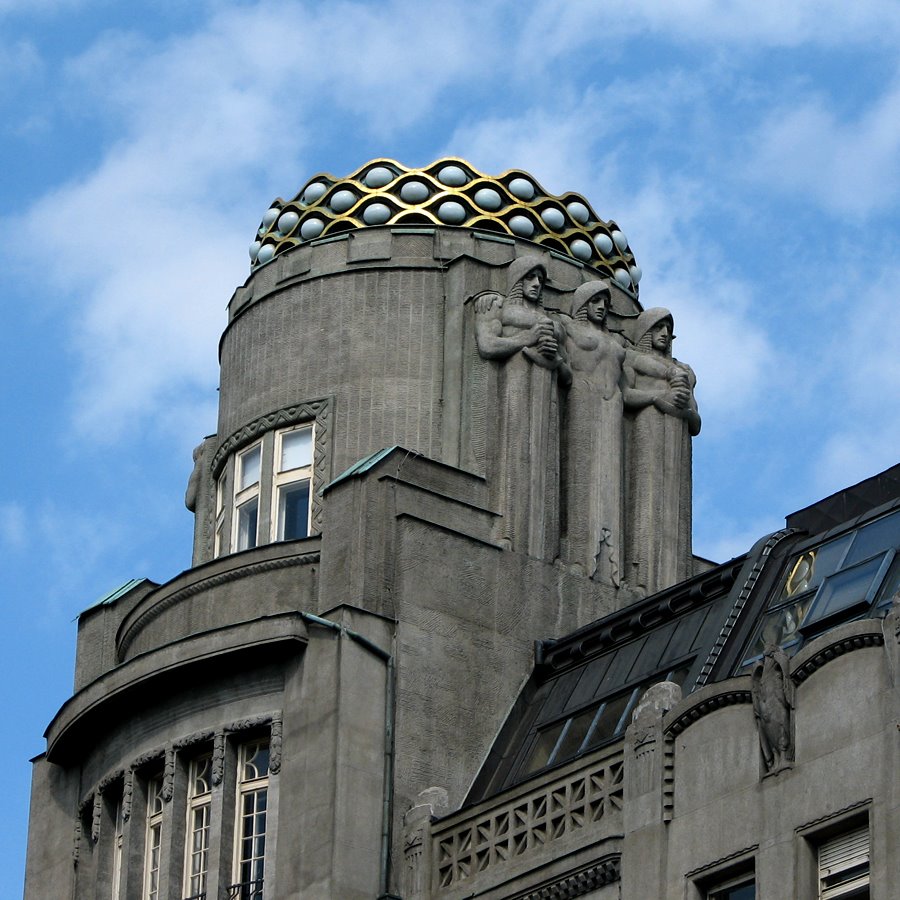
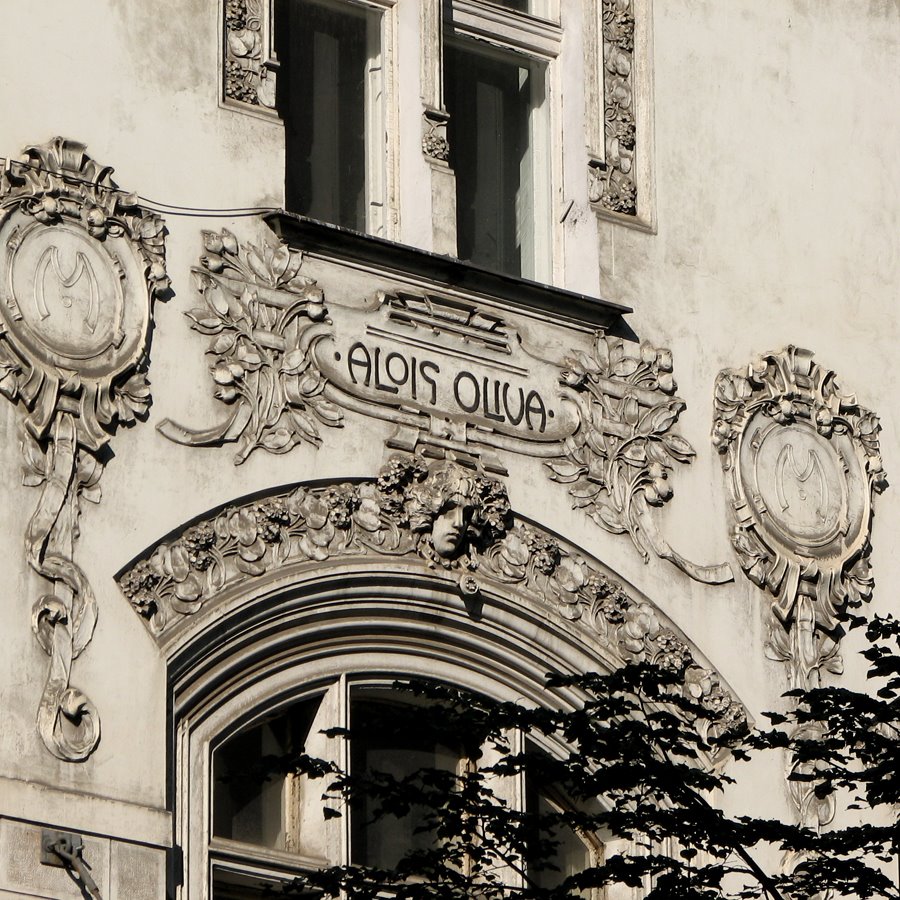
Many of the buildings are Art Nouveau with the details and artistry that in the US is seen mostly on greeting cards and college dorm posters. And to be truthful the most interesting parts of the city are seen by looking up. The cornices and windows, signs and statues are all found far above street level. Prague is also known for its beer, but I would recommend finishing your "looking up" tour before embarking on your "beers of Prague" tour. Vice versa might make for some navigational and gravitational issues.


As Milan drinks wine, Prague drinks beer. It's easy to understand and easy to participate. The glasses are large, the beer is fresh and crisp, and there is none of that lingering murkiness of lesser beers. When you drink beer in its hometown, you're drinking something altogether different. I'm regularly not a beer drinker but in Prague I happily complied. That's how good the beer is.

And it's strange to say it but there is also good Thai food. Why eat Thai food in the Czech Republic? Isn't that a wasted chance to eat Czech food? What you don't know, my friend, is that Milan is sorely lacking in Thai food. Either that, or it's hidden far far away where we can't find it. So please refrain from judging us; just know that a spring roll and Lad Nar can be had in the Czech Republic should it be desired. And it was desired.


There are a lot of sights to see: an astrologically themed clock that people gather to see ring on the hour, towers to climb, the Jewish quarter with its synagogues and cemetery, museums and monuments, statues and bridges, shockingly large spiders that come out after dark ... Prague is rife with things to see and do. This time around we were with a large group of what we now call "old" friends and so reveled in the chance to hang out & catch up and so didn't see as many of the highlights as we might have liked. But what we did manage to see has convinced us to return.

06 September 2006

long swiss weekend


There isn't enough time to properly describe our weekend jaunt. We were in the Ticino region of Switzerland and visited castles in Bellinzona, hiked in Valle Verzasca and rode a very warm rail car through the Centovalli. The best way to describe our long weekend may be Roger Ebert/Gene Siskel style with two giant thumbs up.

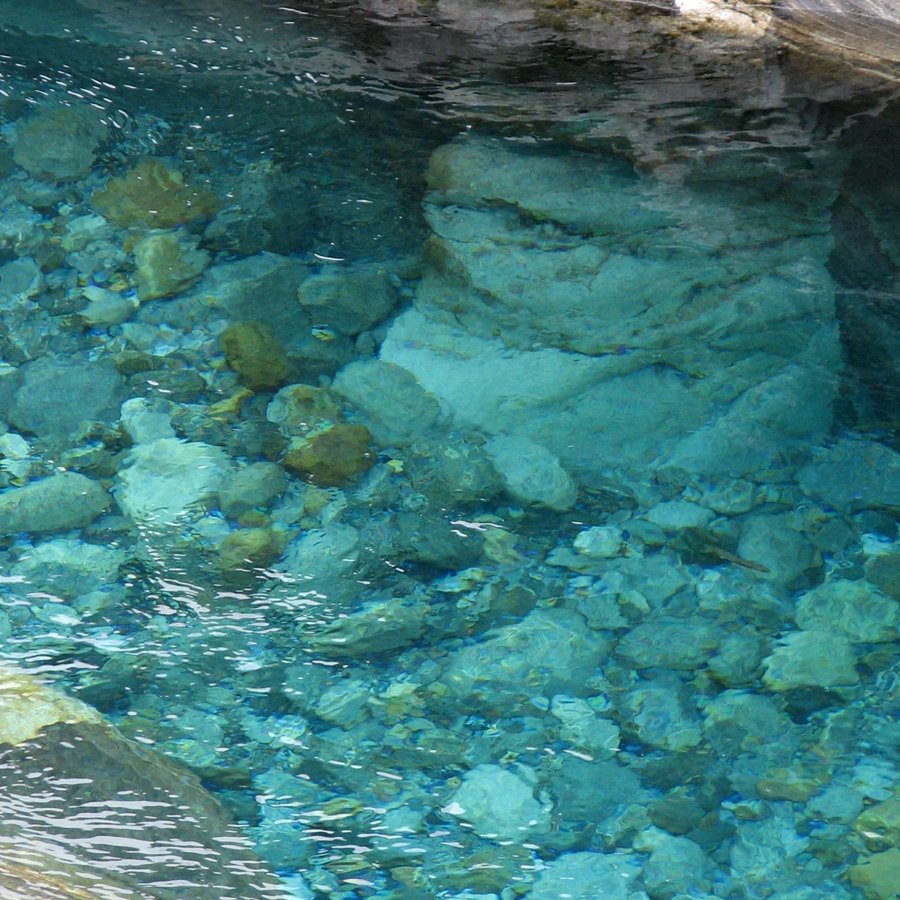
Really, the whole time we were amazed by what we had found and where we were. In fact, when we got off the bus, Stefano says that I whacked him and squealed in sheer joy. I believe him. Because when you step off a bus and are surrounded by mountains, a clear turquoise river lined with white stones, blue sky above, and trees scaling the mountain sides it's hard to know how to react. Sensory overload is a luxury.


We had spent the day before cavorting along castle walls and crashing weddings. Actually, we were just trying to eat our (Swiss!) cheese picnic at one of the castles when it so happened that someone was having their wedding reception there. We stayed cool and hid in the corner - the castle is a public treasure after all - until the bride and groom came swinging by for photos. We tried to flee up the castle ramparts but no sooner had we taken shelter on a tower top when the two lovebirds came our way for a romantic photo shoot. We scurried past them with a "complimenti!" (congratulations) and went to the opposite side of the castle to finish our market day picnic. It takes more than a bride and groom to ruin the joy of a wedge of cheese you can't find in the United States and a hunk of homemade bread.

Switzerland, by the way, makes Milan look cheap. No, really. We were in a constant state of sticker shock. Just when you think that Milan restaurants have the monopoly on over-priced pasta, you venture into Italian-speaking Switzerland and realize oh-no-no! there's always room for improvement in that area. And coffee... double the price for half the taste and charm. Switzerland is lucky that it's gorgeous enough to get away with such egregious behavior. The problem seems to be that the country, and its merchants, know that.


But back to the beauty. Unstoppable and unbelievable natural beauty. We took a ten mile hike and almost every foot of it was gorgeous. Really. Sure, at some parts we were hungry and couldn't believe that we still had 3 hours to go, but then we stopped for some over-priced pasta in a village along the way, and we were fine. Actually, giddy. So giddy that we climbed up and over rocks and found secret waterfalls and got in them. It was like Hawaii had come to Europe. Water was misting down from one waterfall three or four stories up, that fell to the next waterfall, that then tumbled its way to us. And then down past us and further below. And it was clear and crisp and cool - because it was coming from somewhere up high where nature makes crystal clear water and sends it down to us like a gift.


And the water flowing through the valley is actually turquoise. Really. I haven't done anything to adjust this photo - nature in Switzerland doesn't need Photoshop. I don't understand it but I love it. And it's this way for the whole stretch. You could inventory the rocks without ever taking them out of the riverbed.

We spent all day hiking and exploring and after an ice cream sundae in a small village populated by rock cottages, we went back to our Osteria -- a combination restaurant and hotel in the middle of nowhere -- where we had all the dinner our pocket change could afford. Surprise! Turns out the Osteria doesn't take credit cards. Good thing the waterfall keeps running and the sheep keep bahhing even without tips.


We ended our night in the valley by finding the big dipper right in front of us framed by the looming mountains, and ducking because we happened to be standing too near where the bats come to roost at night.

I can't say enough about where we were and but I have to stop now. We have to pack. We leave for Prague tomorrow.

30 August 2006

A is for amica


This is the first in a continuing series of entries inspired by the Italian alphabet.

Today I went to get a haircut at a small pink boutique. Saying boutique makes it sound chic, luxe, extraordinaire. But it's not. It is fairly indie, fairly hip, and molto cool. For example, the girl next to me was getting a very Art-School-meets-Cleopatra hair cut and the girl she'd brought along to keep her company had a buzz cut and an armful of tattoos. Molto cool indeed.

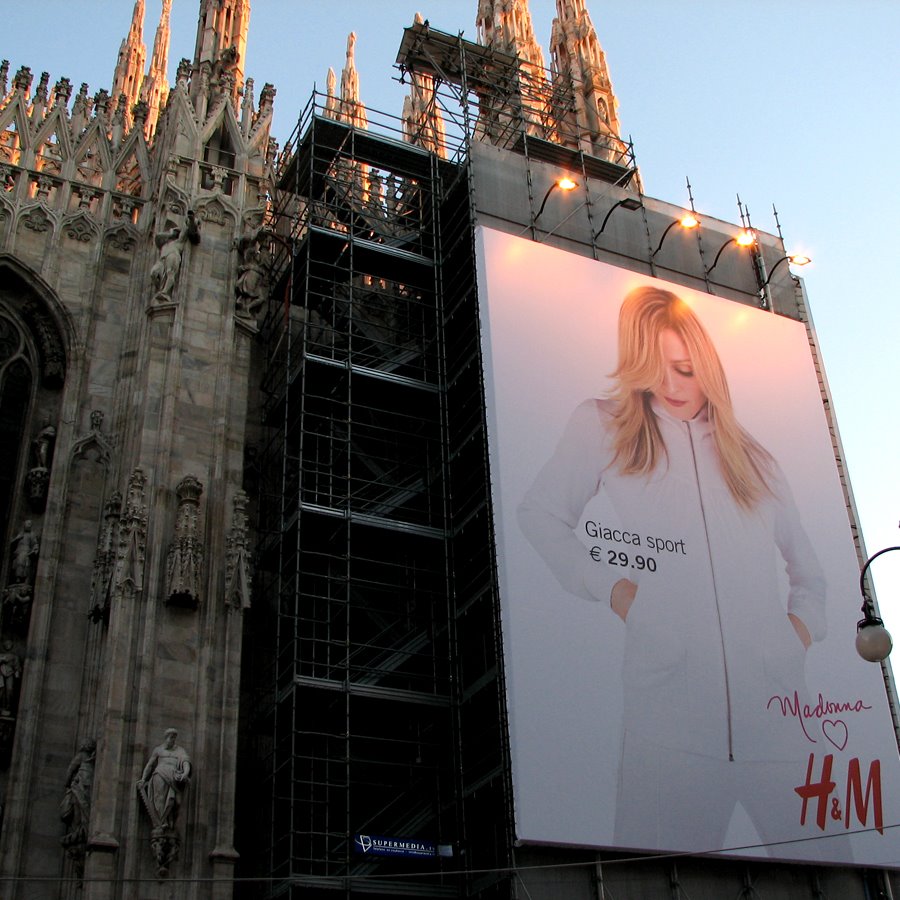
The music was non-stop Madonna through the ages so I had to ask... What did the young man with the scissors think of Madonna's giant H&M advertisement hanging on the scaffolding around Milan's Duomo? It's only the third largest cathedral in all of Europe and here's Madonna, 3+ stories tall, living large for all to see. On the side of a church, people. A giant Italian church!

He was smiling when he answered. "I love to see her there. It makes me so happy! Every time I walk past, I look up and say ciao!" (And then he waved a jaunty, perfect little wave.)

Sounds kind of like seeing a friend... Kind of like seeing an amica.

A é per l'amica